

On 18 January 1956, the first meeting of the Action Committee for the United States of Europe is held in Paris. The Committee was founded by Jean Monnet on 13 October 1955 after he had announced his decision to resign as President of the High Authority of the European Coal and Steel Community (ECSC) in November 1954.
Yestarday, 18 January 2024, the Union of European Federalists and the Young of European Federalists together the Association Jean Monnet commemorate the anniversary of the first meeting of the Action Commettee for the United States of Europe and remember the challenges that europeans have to face.
Speakers:
- Domenec Ruiz Devesa, President of the Union of European Federalists (UEF) and Member of the European Parliament
- Miguel Ángel Martín Ramos, Vice-president of the ASSOCIATION JEAN MONNET
- Christelle Savall, President of the JEF Europe
Moderator:
- Luisa Trumellini, UEF Secretary-General

Deadline: 21st January 2024
The Union of European Federalists (UEF) is recruiting a Finance and Administration Officer to work in the Secretariat based in Brussels.
Main Tasks:
- Close cooperation with the Treasurer, Office Coordinator and Grant management Officer;
- Daily follow-up of invoices, expenses, income of the organisation;
- Support during audits;
- Support general budgeting and budget proposals (with Treasurer, Office Coordinator and Grant Management Officer);
- Management purchases goods, services for running the office and events;
- Management Membership;
- Liaising with Belgian administrations and agencies (Partena Professional, insurances, Banks, Banque Carrefour des Entreprises etc), updating UEF information in case of changes (e.g. payroll, addresses, new employees…), and drafting documents to communicate them when needed;
- Supporting in HR related activities (updating internal work regulations, helping with keeping track of staff holidays and time off requests, etc.);
- Contribution to UEF activities, supporting projects and events.
Essential qualifications and qualities:
- Master’s degree is an asset but can be compensated with relevant working experience adequate for the position;
- Excellent command of English (C1);
- Relevant experience in financial management;
- Command of French at native or near native level , to liaise with various administrations and service providers in Belgium;
- Knowledge about Belgian administrations applicable to Brussels-based NGO,or fast-learner with administrative ease;
- An activist mindset and strong commitment to social change and the values and vision of UEF;
- Being passionate about membership-based political organisations and volunteering;
- Proactive and problem-solving mindset, with strong organisational and time management skills;
- Flexibility and willingness to learn into new things quickly on the job;
- Team player and comfortable in an international environment;
- Organised and precise approach to work;
- Good knowledge of Microsoft Office , collaborative tools and videoconferencing tools.
Desiderable:
- Knowledge of UEF, its network, values, structure, mission, activities;
- Previous experience in civil society organisations, especially in back office positions;
- Previous experience in membership-based and/or political organisations (volunteer experience included).
Contract conditions and remuneration:
- 12-month fixed-term contract under Belgian law, with the possibility of extension;
- Full-time, 38 hours/week;
- Monthly gross salary €1,995 plus additional benefits (€50 for public transportation, food vouchers, holiday pay) – equaling approx. to 2,000 EUR net remuneration per month;
- Work during weekends and/or evenings several times a year, with time off in lieu as compensation. The position requires some travels in Europe several times during the year, and all travel-related expenses will be covered or reimbursed by UEF.
Application procedure and agenda:
- Send a CV and a motivational letter by January 21st 2024, 23:59 CET at secretariat@federalists.eu;
- All applicants should have the right to live and work in Belgium;
- Successful candidates will be invited for a face-to-face or online interview in the last weeks of January (from the 22nd to the 31st );
- The selected candidate would ideally start working on the 1st February 2024;
- For all questions, please contact us at secretariat@federalists.eu.
A new way to elect the EU president? No more VETO voting? The European Parliament has set the stage for a potential seismic shift towards a more federalized European Union with a new proposal that seeks to alter the bloc's fabric in three substantial ways. This initiative calls for a comprehensive reshaping of EU institutions, exemplified by changes to the presidential election process and the veto vote mechanism. It also advocates for expanding EU competencies, granting the Union greater exclusive powers that may redefine the balance between EU governance and national sovereignty. Finally, it proposes a robust enforcement of EU authority by amending the consensus requirement of Article 7, thus streamlining the Union's ability to act decisively. This compact yet potent set of reforms could mark a pivotal point in the evolution of the EU's political dynamics.
This video is co-produced by the Union of the European Federalists, co-funded by CERV grant 2023 of the European Union, and YouTube Channel "EU made SIMPLE".
All other videos here: LINK
The European Union has a mix of 30 kinds of tanks, 20 types of planes, and 27 different military offices. The U.S., on the other hand, has just one military headquarters and fewer kinds of tanks and planes. If European countries shared their military resources and worked together more, they might be stronger within NATO and less reliant on the U.S. So, the big question is: Should the EU team up for its own defense and foreign policies, maybe even start a European army? Or should it just stick to working within NATO?
With the contribution and intervention of the former General Vincenzo Camporini
This video is part of the series "Treaty Reform Now Made Simple" co-produced by the Union of the European Federalists, co-funded by CERV grant 2023 of the European Union, and YouTube Channel "EU made SIMPLE".
We are pleased to present before the end of 2023, the new podcast "Repensando Europe: ideas para una Europa Federal" produced by the collaboration between UEF and UEF Spain, produced and moderated by Kevin Febres of the UEF Madrid section, whom we thank for his commitment.
This podcast aims to help disseminate the contents of the European federalists in Spanish, in this historical moment of change for Europe and in view of the European elections of 2024.
The pilot episode is moderated by Kevin Fabres, who interviews Alejandro Peinado Garcia, Secretary of UEF Spain and member of the Executive Bureau of the UEF, on the importance of the reform of the EU Treaties at this historical moment, the role of the European federalists in this context and a brief analysis of the role of the Spanish rotating presidency of the EU Council.
Today Luisa Trumellini, the Secretary General of the UEF was interviewed by the Twitter influncer, Quentin Deschandelliers aka @Mepassistant, the Eurobubble's inner voice.
The interview is dedicated about who we are, what we do, what is european federalism, our objectives, our goals, our partners, actual political campaign.
Watch the full interview here in Twitch: LINK
UEF and MFE return to participate in Focus Europa, a series of interviews on tomorrow's Europe organised by UEF and MFE with the Italian Twitch channel, Ivan Grieco's La Miniera.
In the final episode for the year 2023 will be interviewed:
1) Giulia Rossolillo, UEF Vice President, Professor of EU Law at the University of Pavia
2) Luisa Trumellini, Secretary General of the UEF
3) Luca Lionello, UEF Federal Committee Member and researcher at the Catholic University of Milan
4) Carlo Maria Palermo, UEF Federal Committee Member, CESPI Scientific Committee Member
The interview is conducted in Italian.
You can watch the episode on Twitch by subscription, or here in YouTube.
The full series can be reviewed here: LINK
Or by going to Media Library
Brussels, 18 December 2023
As the Conference on the Future of Europe concluded in May 2022, all the European institutions agreed to give the citizens recommendations for proper implementation. The European Parliament was the first to take action with its June 2022 and November 2023 resolutions calling for a Convention to reform the Treaties and activate Article 48 of the Treaty on European Union (TEU).
Today, the Council of the EU played its part, thanks to Spain’s leadership, and transmitted the European Parliament’s request for activation of Article 48 TEU to the European Council. Europe now turns to Charles Michel and EU national leaders to immediately include the EP‘s request on the agenda of the next EUCO meeting.
The request for Treaty change has to be considered by the European Council first of all because it is urgent and necessary. The European Union lacks the indispensable tools to act in the face of the challenges of security and economic competition that we are undergoing. The Russian war against Ukraine and interference, migration flows, ecological and digital transition, and enlargement force us to take action. More than ever, we need to reform our institutional framework, and the report offers several solutions.
Earlier this month, the Union of European Federalists sent a letter to Charles Michel, President of the European Council, requesting to put a decision point on the call for a Convention at the agenda of the next European leaders’ summit in Brussels. Today, the UEF reiterates this call.
Domènec Ruiz Devesa, President of the UEF said: "Of course, there is still a long way to go. First of all, the President of the European Council, Charles Michel, must put the issue on the agenda of the next European Council meeting in January or March 2024 at the latest. Secondly, a majority [...] will have to be sought. All this before the European elections in June. What is certain is that the Spanish government, during its rotating presidency of the Council, has done its job in this area, and with distinction.”
The UEF also urges Charles Michel to start working towards a majority to agree to the establishment of a Convention, with the help of the Belgian rotating presidency of the EU, to start in January 2024.
The UEF, through its sections, will be pressing national governments to support the call for a Convention; and in parallel will closely follow the developments at the European Council, and will continuously advocate for this crucial reform in the interest of European citizens. Should you wish to participate in this activity, you can join the UEF or one of its sections in Europe.
Deadline: 15th January 2024
The Union of European Federalists (UEF) is recruiting a Policy Officer to work in the Secretariat based in Brussels.
Main Tasks:
- Support the Secretariat and the Executive Board in drafting policies (e.g. policy papers, press releases, statements, contribution to surveys and research);
- Support the development and implementation of the advocacy strategy of UEF;
- Support the representation and promotion of UEF towards external partners (European institutions, pro-European NGOs etc.);
- Support the federalist advocacy actions of UEF and its sections;
- Support UEF sections in developing their capacities regarding policy and advocacy;
- Support in policy monitoring on themes linked to the strategic priorities of UEF;
- Conceptualization and planning of projects (grant writing, content, budget, logistics);
- Responsibility over events implementation: organization of international meetings and political events where needed;
- On demand, there might be support requested on occasion for different tasks to help colleagues, distribute workload and meet the targets of the organisation together as a team.
Essential qualifications and qualities:
- Master’s degree is an asset but can be compensated with relevant working experience adequate for the position;
- Excellent command of English (C1);
- Extensive knowledge of EU institutions and processes;
- Interest in European topics relevant to UEF;
- An activist mindset and strong commitment to social change and the values and vision of UEF ;
- Being passionate about membership-based political organisations and volunteering;
- Proactive and problem-solving mindset, with strong organisational and time management skills;
- Flexibility and willingness to learn into new things quickly on the job;
- Team player and comfortable in an international environment;
- Organised and precise approach to work;
- Good knowledge of Microsoft Office , collaborative tools and videoconferencing tools.
Desiderable:
- Excellent command of French (C1) and working knowledge of other EU languages.
- Experience in European project management is an asset;
- Knowledge of UEF organization, its network, values, structure, mission, activities;
- Previous experience in membership-based and/or political organisations (volunteer experience included).
Contract conditions and remuneration:
- 12-month fixed-term contract under Belgian law, with the possibility of extension;
- Full-time, 38 hours/week;
- Monthly gross salary €1,995 plus additional benefits (€50 for public transportation, food vouchers, holiday pay) – equaling approx. to 2,000 EUR net remuneration per month;
- Work during weekends and/or evenings several times a year, with time off in lieu as compensation. The position requires some travels in Europe several times during the year, and all travel-related expenses will be covered or reimbursed by UEF.
Application procedure and agenda:
- Send a CV and a motivational letter by January 15th 2024, 23:59 CET at secretariat@federalists.eu;
- All applicants should have the right to live and work in Belgium;
- Successful candidates will be invited for a face-to-face or online interview in the last weeks of January (from the 15th to the 31st );
- The selected candidate would ideally start working on the 1st February 2024;
- For all questions, please contact us at secretariat@federalists.eu.
Brussels, 13 December 2023
The Plenary of the European Parliament has adopted the report Ruiz Devesa - Simon on the European Elections 2024, which includes the proposals of the European Parliament on how to organize the European elections of June next year. The text provides for recommendations to be submitted to European and national political parties to strengthen the European dimension of the electoral process and increase the participation and electoral rights of the EU citizens.
"We call to the European political parties, and especially national parties, to commit to a series of recommendations, such as including the logos of European political forces on their ballot papers," says Ruiz Devesa. It also urges European political parties to ensure that the content of their campaigns is conducted in line with the values of Article 2 of the EU Treaty and that the process for nominating their candidates for election is carried out democratically.
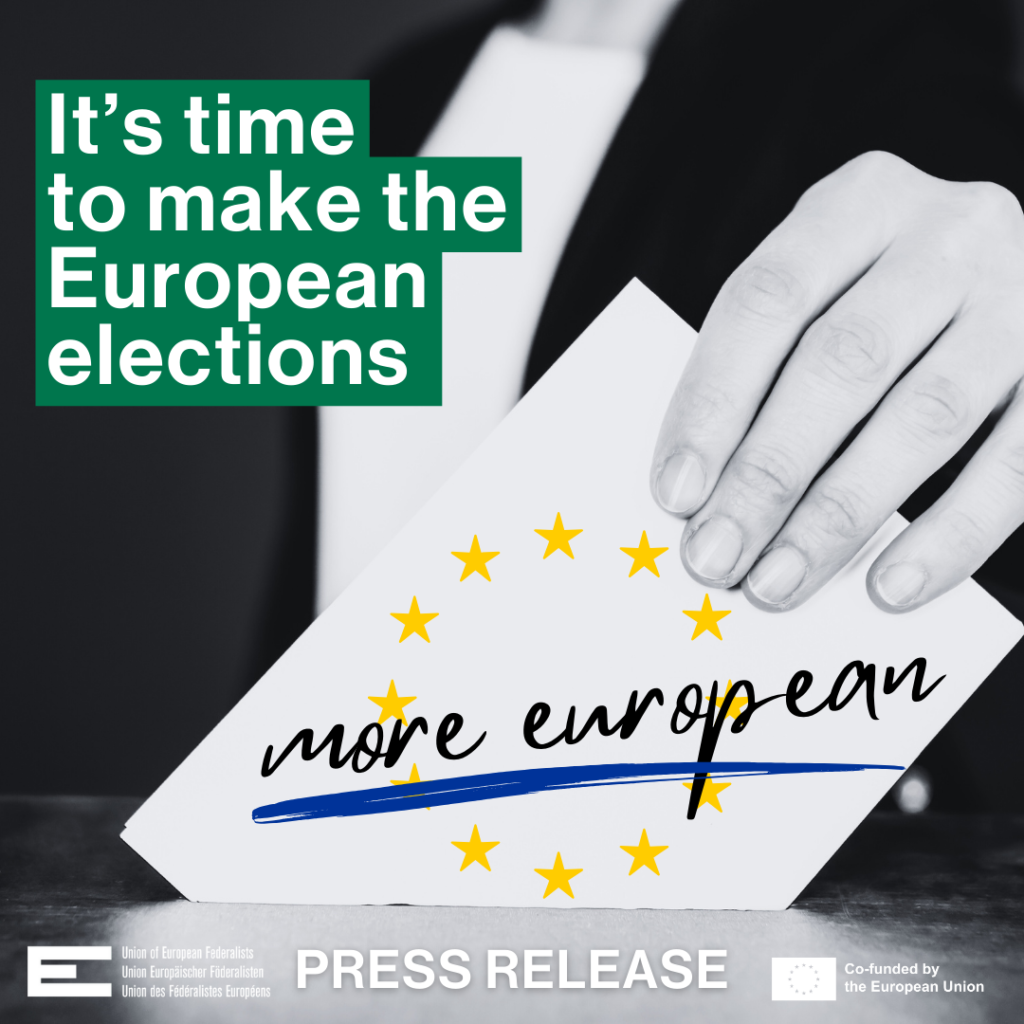
The report calls for a binding agreement between the European Parliament and the European Council on the "lead candidate" process for the election of the president of the European Commission. "It is important that, contrary to what happened in 2019, this time we can indeed ensure that the head of the list principle is complied with," defends Ruiz Devesa. "We propose that the candidate of the political group that obtains the most seats in the elections has the opportunity to start negotiations with the rest of the groups to try to form a sufficient majority and, if not, that the turn passes to the second most voted and so on until the Parliament can have a common candidate."
The Union of European Federalists (UEF) welcomes this important decision and calls on the European political parties to quickly adopt this set of recommendations, and—in addition—to provide voters with clear indications of their position on the crucial issue of treaty change.
Domènec Ruiz Devesa, President of the UEF said: "The next elections to the European Parliament must aim to evaluate the last five years of activity of the EU institutions, in a real exercise of democracy and European politics,". We cannot have "a collection of 27 parallel national elections that depend on domestic issues, but we must Europeanise this discussion and thus stimulate participation in the European elections, putting European issues on the agenda of the media".
It is possible to rewatch the Press Conference after the vote here.
In the coming months, the UEF will roll out its campaigning activities, encouraging citizens to vote from 6 to 9 June 2024, reminding candidates of the importance of a federal Europe, and debating the future of our Continent.