

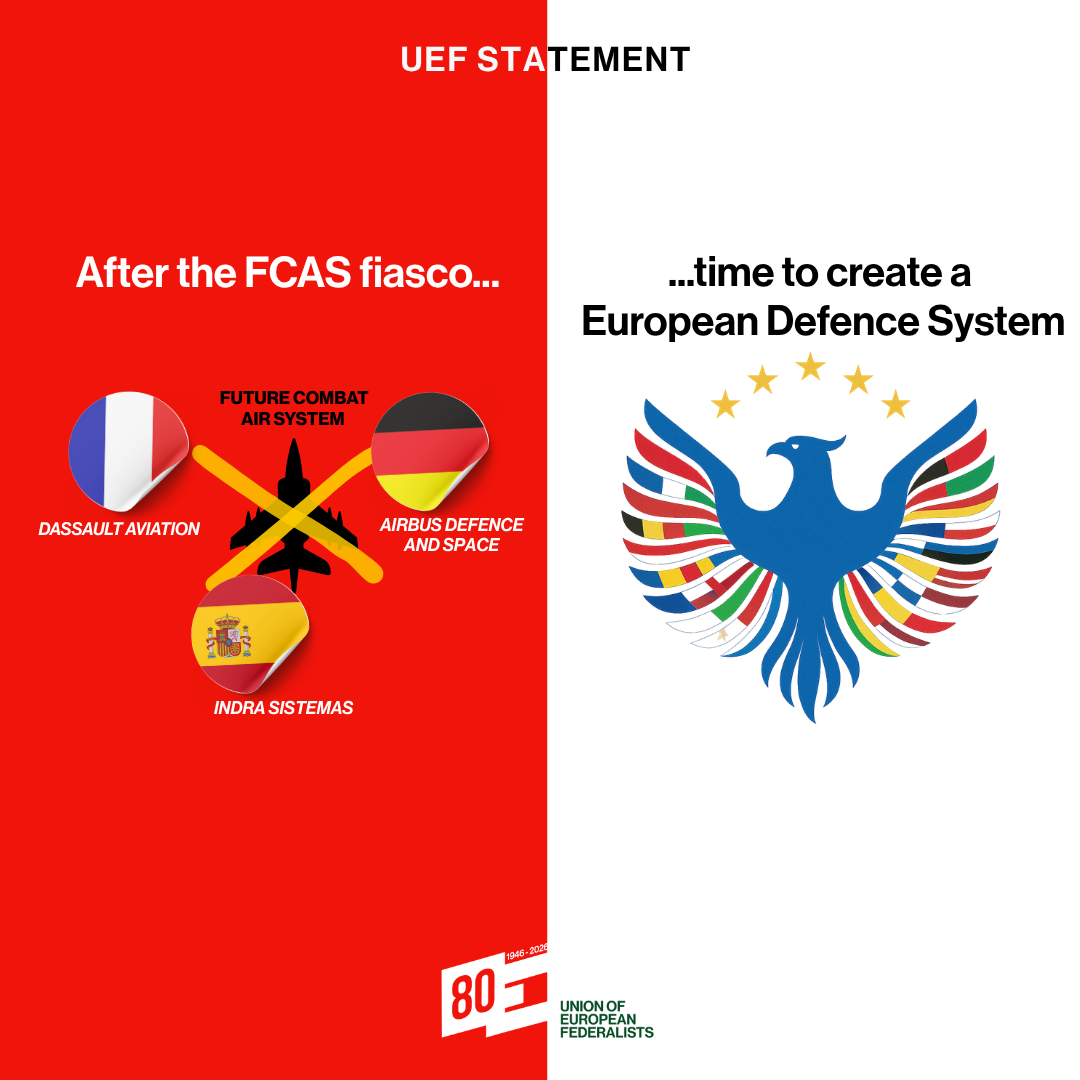
STATEMENT | After the FCAS fiasco, time to create a European Defence System
Brussels, 23 June 2026
European security is under threat, together with the world order, as shown by four years of Russian aggression on Ukraine. However, progress on European defence is very insufficient, both at the industrial and political dimensions, which in fact are closely connected. The collapse of the Franco-German-Spanish Future Combat Air System (FCAS) is a very illustrative case in point of a political gap masked by industrial failure, due to the disagreements between privately owned Dassault and the semi-state-owned Airbus, over control of the programme and workshare, access to sensitive technology, and ownership of the intellectual property developed during the project.
The collapse of FCAS pushed German and Spanish companies to propose a new “Team Gen 6”, outlining plans to pursue a next-generation fighter architecture outside the original SCAF framework. All of this, while the alternative Global Combat Air Program (GCAP) by Italy, UK and Japan is going ahead. We risk having three competing projects, where we need just one.
However, the industrial deadlock between Dassault and Airbus was not merely a commercial dispute over workshare and intellectual property, but the expression of different national political preferences and defence postures: France's doctrine of full military self-sufficiency - encompassing not only independent nuclear deterrence, but also carrier aviation, and sovereign control over its entire defence industrial base - clashed with Germany's different operational requirements and its preference to operate with allied systems. Ultimately, the governments proved either unwilling or unable to impose a compromise on the companies - unwilling, because the positions each company defended largely reflected what their respective governments considered non-negotiable national interests, and unable, because forcing a concession would have meant overriding those very interests.
In other words, this case shows once again, very clearly, that neither industrial companies nor national governments to which they are linked, can lead on military integration. A greater role for the European Commission and the European Defence Agency operating within the framework of a Common European Defence System, and stricter requirements to access EU funding is needed to go towards joint procurement and the reduction of the European weapons system. The fact that the 27 Member states have around 130 types of major land, air and naval weapon systems and the US around 30, is a key reason why we spend 30% of the US with a 10% capacity, thus wasting most of our expenditures ineffectively. The EU should incentivise the merging of these projects to create one European sixth generation fighter jet.
To reach strategic autonomy Member states must accept to go beyond voluntary industrial cooperation toward limited but real centralised procurement authority for major defence systems, alongside clearer allocation of industrial leadership based on capability rather than political return. Successful EU defence procurement is in the end dependent on setting up a European Common Defence. A European multinational force, starting with the Rapid Deployment Capacity, to whom to allocate EU-funded defence equipment is thus a crucial step.
Such an EU supranational authority must define what we need, and thus the technical specificities of the future weapon system, and the open procurement to procedures, instead of national enterprises that reflect private interests or narrow national interests.
While national defence expenditures are increasing, joint procurement is stuck at 20 per cent. However, the new Security Action for Europe (SAFE) threshold for joint procurement is even lower than the European Defence Industry Reinforcement through Common Procurement Act (EDIRPA) ones. If SAFE 150 billion € were used to strengthen EDIRPA, the European Defence Fund and the European Defence Agency to finance joint programs (for example to merge the Anglo-Japanese Global Combat Air Programme and the FCAS), this would allow significant progress. But SAFE only finances national military expenditures, which continue to benefit mainly US enterprises, with US weapons exports to Europe doubling between 2021 and 2024.
An EU defence is essential to gain deterrence capacity and ensure the EU security, spending more efficiently and reducing US dependencies. This requires identifying our capability gaps – an exercise regularly done both within NATO and the EU – developing tools to fill them, starting with the strategic enablers, for which we depend massively on the US. The Joint Undertakings could be a tool for the Commission, Members states and private actors to cooperate in developing European satellite monitoring and communication systems, air defence, troop transport, and cyber-defence capacities.
The EU must rise to the challenge of the reduced US commitment to European security, amplified and accelerated by the current administration, but started much earlier. The NATO New Force Model, approved under Biden Presidency, foresees that in the case of an attack against a European NATO member, NATO should mobilise 300.000 troops in a month, all of them Europeans. Only at later stages US troops could eventually be mobilised. With a possible significant reduction of the US troops in Europe, the need to strengthen EU capacity for territorial defence is evident. Permanent Structured Cooperation on Defence (PESCO) could be used by willing Member states to upgrade the Rapid Deployment Capacity into an EU permanent multinational force – already agreed by the European Council in Helsinki in 1999 but never made fully operational – to communitarise existing bi-lateral and multinational military cooperation among Member states, like the Baltic Naval Squadron, the Franco-German Brigade, the Eurocorps, etc, and to develop a true EU command-and-control system, possibly linked to NATO.
As Mario Draghi said in Aachen “external hardness requires internal depth”. Progress in common defence, a common industrial policy, and investments (which require resources), and federal political union, are closely interlinked. Achieving them requires the political will of at least some Member States to proceed in a unified manner across all these sectors. If steps are not taken along this path soon, citizens’ confidence in Europe’s ability to protect them will further erode, and nationalist forces will gain ground.
Domènec Ruiz Devesa, President of the UEF
Mathilde Baudouin, Secretary General of the UEF