

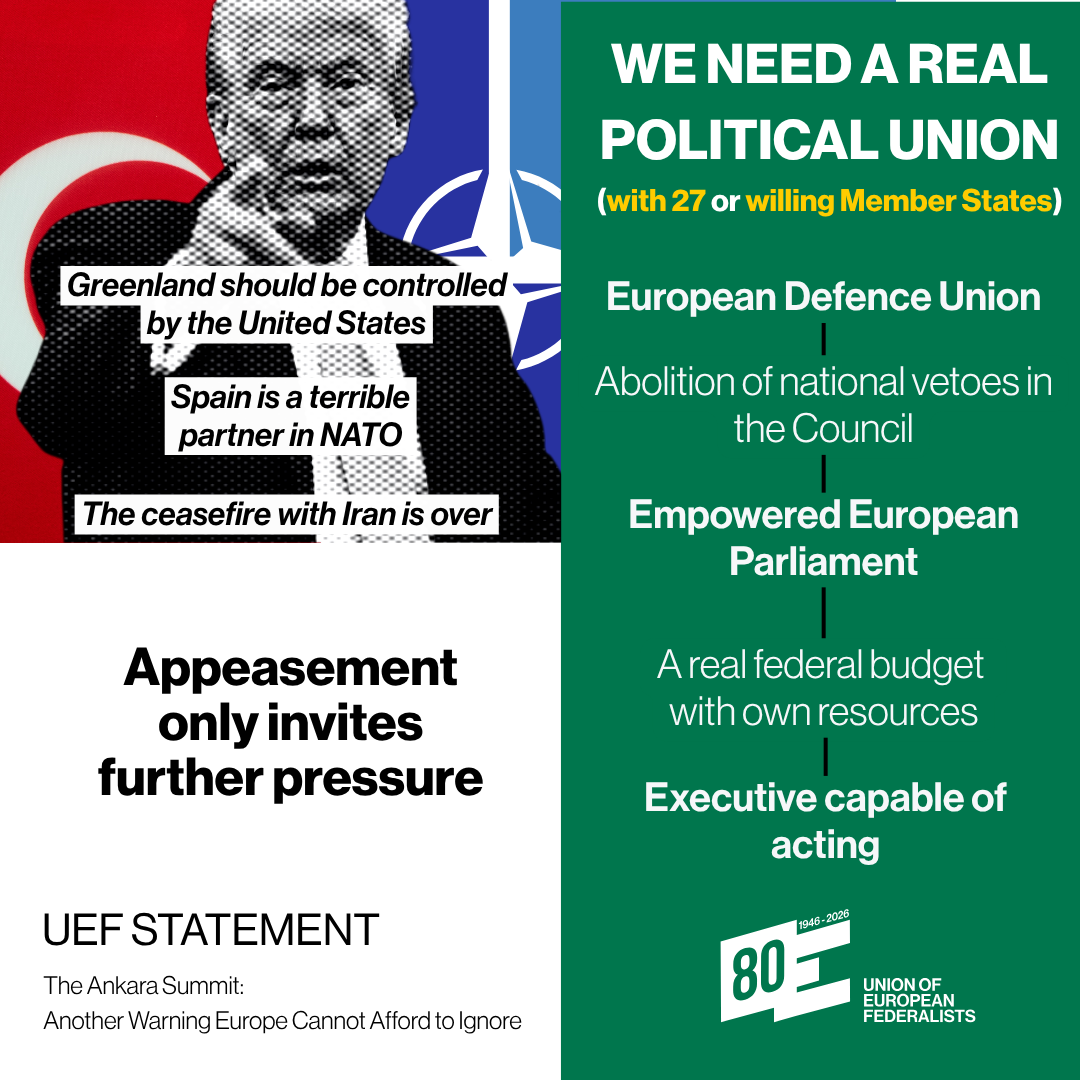
STATEMENT | The Ankara Summit: Another Warning Europe Cannot Afford to Ignore
Brussels, 13 July 2026
The 2026 NATO Summit in Ankara has once again exposed the fragility of the transatlantic security guarantee on which Europe has relied for seventy-five years. The Union of European Federalists (UEF) notes with grave concern that, even as Allies gathered to reaffirm collective defence, President Trump used most of his public appearances to attack fellow allies rather than to reaffirm solidarity.
The NATO Summit took place in Turkiye, a candidate country for accession to the Union in a moment where Erdogan’s government intensifies violations of basic human rights, including far-reaching restrictions on the main political opposition party, the media and freedom of peaceful assembly and expression in general.
Once again during the Summit Trump revived his claim on Greenland, insisting the territory is essential for the United States "but it's not important for Denmark," and invoking a distorted account of its wartime history to justify American designs on the territory of an EU and NATO member state. Danish Prime Minister Mette Frederiksen was forced, once more, to state publicly that Greenland is not for sale and that Denmark is ready to defend every inch of its territory. Simultaneously, Trump singled out Spain, calling it a "terrible partner in NATO” and threatening once again commercial retaliations.
These are not isolated remarks. They are the only the latest in a pattern of intimidation directed at sovereign EU Member States by the leader of the power on which Europe's security has depended. An ally that threatens the territorial integrity of a member of the Union — and openly disparages another for its political choices — cannot be considered a reliable guarantor of Europe's collective security.
The same summit laid bare a further dimension of this unpredictability. In the middle of the Ankara meetings, Trump declared that the ceasefire his own administration had brokered with Iran only weeks earlier was "over," branding Iranian leaders "scum" and launching renewed strikes, even as US and Iranian forces exchanged fresh attacks on the Strait of Hormuz, with further damage to the European and global economy. A summit convened to project transatlantic unity was instead overshadowed by a unilateral escalation decided without consultation, disrupting global energy markets and dragging Europe's security agenda into a conflict it had no part in starting. That the fate of a fragile Middle East truce can be upended overnight, from the sidelines of a NATO summit, on the personal judgement of a single leader, only underscores why Europe cannot continue to make its own security contingent on the impulses of a partner it can neither predict nor control.
The UEF, together with JEF Europe and the Spinelli Group, has already petitioned the European Council to simultaneously activate Article 42 TEU, establishing a European Common Defence with shared capabilities and a common strategic command, and Article 48 TEU, opening the path to Treaty reform for a federal political union. A joint European defence could generate more deterrence at lower costs than national spending in this area – but it requires a new governance in Europe on defence topics and the willingness to give national powers in this areas to the European level to gain sovereignty and independence to defend ourselves.
A Union cannot militarily without the democratic institutions to decide, finance and control. That is why the UEF insists that a genuine European Defence Union must be built hand in hand with political union: an empowered European Parliament, an Executive capable of acting, the abolition of national vetoes in the Council, and a real federal budget with own resources. If unanimity is out of reach at 27, willing Member States must set up of a federal vanguard, a Union within the Union, encompassing foreign policy, defence, and tax and financial matters.
Ankara is one more proof, added to Greenland and to so many episodes before it, that appeasement only invites further pressure. The European Council can no longer postpone what its own citizens, its own Parliament, and its own Treaties already point towards. The time to build a sovereign, federal Europe is now.