

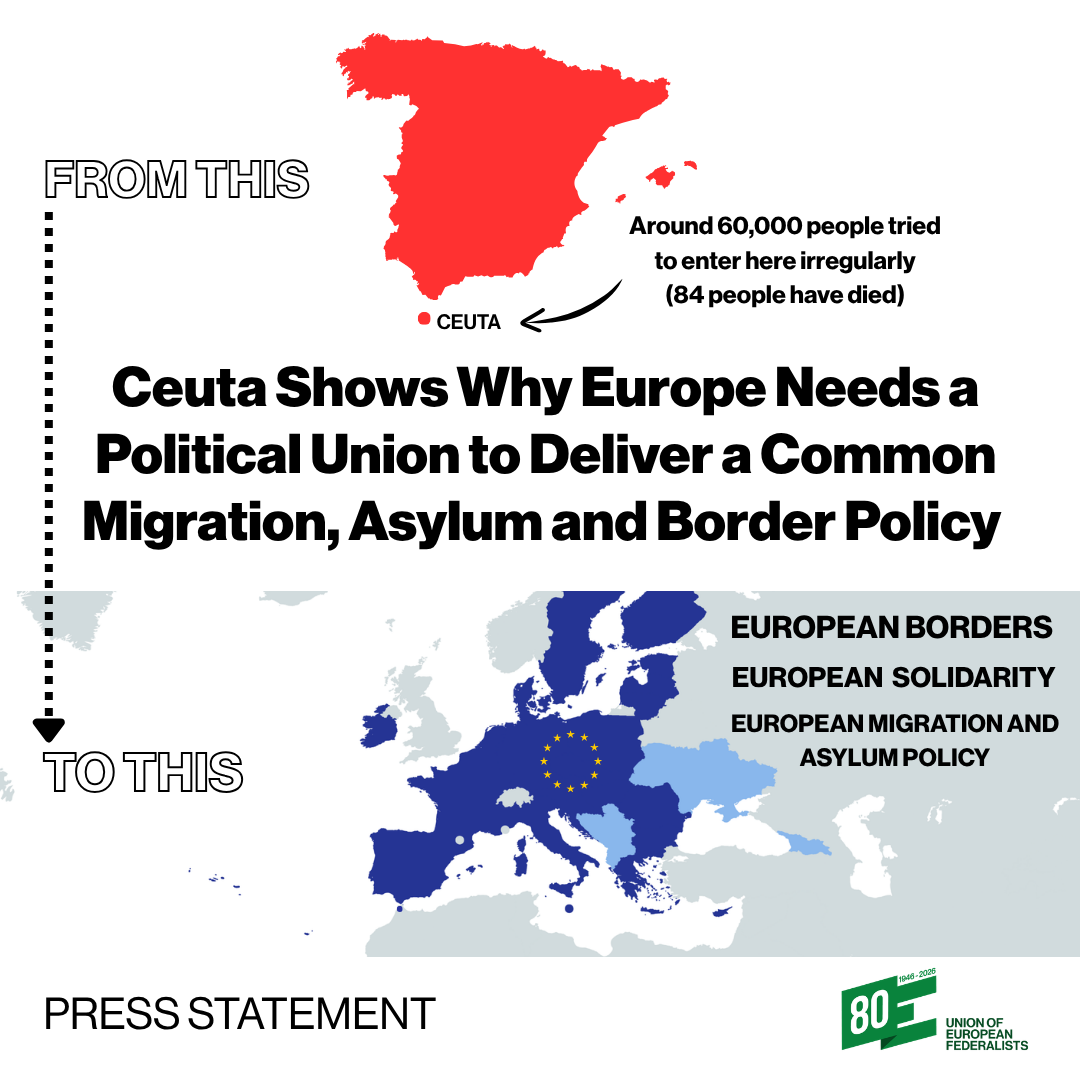
Ceuta Shows Why Europe Needs a Political Union to Deliver a Common Migration, Asylum and Border Policy
UEF calls for a European response based on solidarity with Spain following the deadly humanitarian crisis in Ceuta, warns against the instrumentalisation of migration by third countries, and underlines the importance of effectively implementing the EU Pact on Migration and Asylum
The Union of European Federalists (UEF) expresses its profound sorrow over the loss of life in the waters off Ceuta in recent days. According to the latest joint count by the Spanish Guardia Civil and the Moroccan police, at least 84 people have died while attempting to reach European shores, making this already the deadliest episode recorded at this border in more than a decade. Our first thoughts go to the victims, most of them young people carrying little more than the hope of a better life, and to their families.
Between 30 and 31 July, an estimated 50,000 to 60,000 people crossed into the Spanish autonomous city of Ceuta within the space of two days, overwhelming its reception, healthcare and security services far beyond any reasonable capacity for a city of just over 80,000 inhabitants. Most of them have already returned to Morocco.
This is the first major humanitarian emergency at the EU’s external borders since the entry into force of the EU Pact on Migration and Asylum. The EU must therefore respond in a coordinated and effective manner, reaffirming its solidarity with Spain and recalling that EU rules now exist to address orchestrated movements of people by third countries that generate or facilitate irregular migration flows towards EU territory.
Solidarity, not opportunism
UEF regrets statements by some European leaders, including Prime Minister Giorgia Meloni, suggesting the possible suspension of the free movement of persons with Spain in response to this episode.
Such statements misrepresent the legal reality. Ceuta and Melilla have never been part of the Schengen area. Spain secured this specific exception when it acceded to the Schengen Convention in 1991, precisely in order to manage the particular nature of its land border with Morocco.
What happened in Ceuta did not involve the crossing of a Schengen border. Using this episode as a pretext to threaten freedom of movement within Europe undermines European cooperation at the very moment when it is most needed.
As in previous similar crises involving Greece, Poland, Latvia and Lithuania, the EU cannot leave Spain alone to manage the current emergency.
A possible case of instrumentalisation
UEF notes with concern the reported passivity of Moroccan security forces during the initial hours of the crisis, followed by the rapid and effective deployment of riot-control units once Rabat chose to act.
This contrast raises legitimate questions as to whether the episode may constitute an instrumentalisation of migratory flows for the purpose of geopolitical pressure. Such a pattern was already observed in 2021 and is consistent with the framework developed by the European Commission following precedents involving Belarus and Turkey.
We note that there is currently no publicly available evidence linking organised trafficking networks, as alleged by the Spanish government, to the viral spread of the rumour that triggered the crossings, which appears to have spread organically through social media.
This episode could therefore constitute a hybrid threat requiring a coordinated European response — diplomatic, judicial and operational — under the Union’s existing framework on the instrumentalisation of migration.
No pushbacks, under any circumstances
UEF reiterates unequivocally that summary returns — so-called “hot returns” or pushbacks, whether at land borders or at sea — are incompatible with the Charter of Fundamental Rights of the European Union, in particular with the prohibition of collective expulsions and the right to asylum under Article 19.
Every person who reaches European territory or falls under European jurisdiction, regardless of the means by which they arrive, is entitled to an individual assessment and access to the safeguards associated with international protection.
This obligation does not cease to apply because of the method of crossing, the scale of an emergency or the physical infrastructure — including any future maritime barriers — used to control a border.
We call on the Spanish government to ensure that these standards are fully upheld as it manages return procedures in the coming weeks. We also call on the European Commission to closely monitor compliance with the obligations arising from the EU Charter at every stage of those procedures.
Our call to action
The answer cannot be the renationalisation of migration policy or the re-establishment of internal borders. On the contrary, what is needed is a more integrated European Union, beginning with the correct and effective implementation of the EU Pact on Migration and Asylum.
The effective management of migration also requires a genuine European foreign policy and the means necessary for the EU to enforce it. Until we achieve political union, it will remain impossible for a truly common European interest to emerge, and each Member State will continue to pursue its own short-term interests, influenced in part by its domestic electoral cycles.
UEF urges the European Union to:
- Firmly reiterate its policy against any instrumentalisation of migration and hybrid tactic that uses human mobility as a form of leverage, while underlining the legal obligation to save lives and protect victims;
- Activate concrete solidarity mechanisms for Spain, and for Ceuta in particular, including reception support, relocation where appropriate, and financial and operational assistance;
- Open a serious, evidence-based inquiry, in coordination with the Spanish authorities and other international bodies, into the role played by the Moroccan authorities during the initial hours of the crisis;
- Guarantee, without exception, that all return procedures comply with the Charter of Fundamental Rights of the European Union and with EU asylum law.
This tragedy is a European tragedy. It demands a European response grounded in solidarity, the rule of law and the humanity we owe to those who risk everything to reach our shores.