

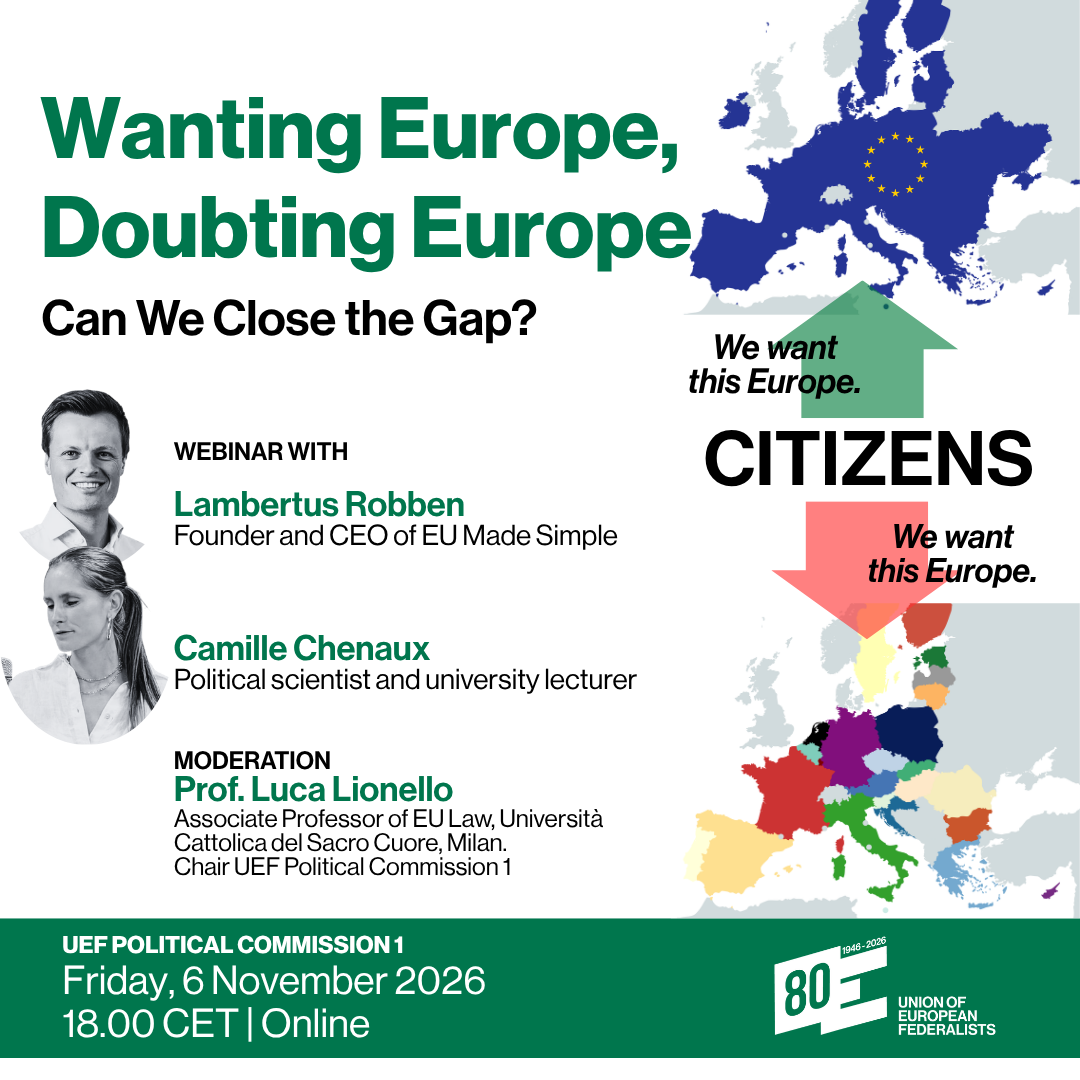
Wanting Europe, Doubting Europe: Can We Close the Gap?
Most Europeans want a stronger, more united Europe, yet few believe their leaders can deliver it. This is one of the key findings of Future Nostalgia: Europe’s Unfinished Song, a recent study by the European Council on Foreign Relations (ECFR) based on around 5,800 interviews in France, Germany, Italy, the Netherlands, Poland and the United Kingdom. Despite the rise of anti-European parties, especially in France and Germany, nearly three quarters of respondents call for a strong European vision, while a majority see Europe in decline and doubt that it is responding effectively to today’s challenges.
Taking this report as a starting point, the discussion will explore the gap between what citizens expect from Europe and what they believe it can achieve.
- Why does support for European integration coexist with such deep pessimism?
- How can the EU be explained better to those who feel disconnected from it?
- And what does this mean for those who argue for a more federal Europe?
Speakers
- Lambertus Robben, Founder and CEO of EU Made Simple
- Camille Chenaux, Political scientist and university lecturer, Author of the book "The Crisis of the Nation-State and European Populisms" (in italian)
Moderator
- Luca Lionello, Professor of EU Law, Chair of UEF Policy Commission 1
REPORT
The debate explored a contradiction at the centre of European politics. An ECFR study presented by moderator Luca Lionello found that Europeans want the EU to protect them and address challenges including defense, security, climate change and fiscal justice, while doubting its capacity to do so. Lionello asked whether this reflects poor communication, institutional limits, disappointing results—or a combination of all three. Political scientist Camille Chenaux and EU Made Simple founder Lambertus Robben approached the question from different directions.
Citizens’ search for protection
For Chenaux, the paradox begins with the crisis of the nation state. She argued that, after the Cold War, confidence in liberal democracy obscured the political consequences of two simultaneous changes: globalization and faster European integration. Power became more dispersed across levels of government, but citizens were not given a sufficiently clear account of the new system or of who would protect them within it. In her analysis, that uncertainty created an opening for populist parties to present the nation state as a familiar source of security.
Chenaux connected this longer-term change to successive crises: the financial crisis, migration, Brexit, the pandemic and Russia’s war against Ukraine. Each added pressure to institutions and to citizens’ sense of security. She argued that populist parties recognized the underlying question—who protects people in an unstable world?—but offered an inadequate answer by promising a return to national control over problems that often extend beyond national borders. Mainstream parties, in her view, have struggled even to articulate the question convincingly.
Robben offered a more immediate explanation: people expect European-scale action because they can see that the problems are European-scale, but the results repeatedly fall short. He pointed to national responses during the migration crisis, the absence of a single European voice in potential Ukraine peace negotiations, and what he regarded as a failure to use the EU’s leverage in trade with the United States. For him, doubt about the EU is not simply a misunderstanding. It also reflects disappointment with what governments and institutions have delivered together.
Communication and delivery cannot be separated
Lionello asked whether the principal problem was how the EU explains itself or whether its present structure prevents it from meeting citizens’ expectations. Robben resisted treating these as alternatives. He said that explaining the EU matters: Brexit had shown him how little some of his UK friends knew about it and helped prompt him to start EU Made Simple. His aim was to make European politics understandable through videos that could reach beyond conversations among people already interested in the subject.
Robben described discussion as part of that educational work. He said the channel commonly receives more than a thousand comments per video, including long exchanges between viewers with different political positions. Some viewers tell him the explanations have helped them decide how to vote, although he said he does not tell them which party to support. He also argued that national politicians share responsibility for the EU’s communication problem: they have an incentive to claim credit for successes at home while blaming the EU for unpopular outcomes.
Yet better communication, on its own, would not answer Robben’s criticism about delivery. The debate returned repeatedly to the same tension: citizens need to understand what the EU does, but they also need to see it acting effectively on the issues for which they expect protection. Neither guest suggested that a stronger narrative could make institutional or policy failures irrelevant.
What should Europe ask people to identify with?
Chenaux proposed that the familiar right–left divide is insufficient to describe the present political conflict. She sees a divide between “system” and “anti-system” parties. In her account, anti-system parties construct a political identity against something—immigrants, elites or other perceived adversaries—while mainstream parties have failed to offer an equally compelling positive answer to what Europeans want to become together.
A shared answer is difficult because member states do not experience every threat in the same way. Chenaux contrasted the urgency of defense for Baltic countries with the prominence of migration concerns in parts of southern Europe. She recounted a Lithuanian ambassador’s view that common defense must come first because, without it, other priorities could become meaningless. These differences, she argued, complicate any attempt to agree on a single European agenda or identity.
Robben argued for a more future-oriented story. He said audiences respond strongly to videos that imagine what the EU might become. By contrast, established achievements such as Schengen may be valued without generating enthusiasm among people who have known them all their lives. He suggested that the Federalists’ vision of a more integrated Europe gives people something concrete to imagine, rather than asking them only to appreciate what already exists.
Both guests connected identity to everyday participation. Chenaux said many young people lack basic information about European Parliament elections and political groups, making civic explanation a priority. Robben proposed making Europe Day a public holiday across member states as a visible, recurring occasion for people and national media to discuss the EU. He acknowledged that the proposal would be difficult to realize, but offered it as an example of the symbolic steps he believes could strengthen a sense of belonging.
National elections, European consequences
Lionello described national elections as consequential for the whole EU because each change of government alters the group of leaders who must agree in the European Council. A government elected on domestic priorities may therefore affect decisions far beyond its own country. The debate considered Spain, France and Germany through that lens. The guests’ comments on election outcomes were expectations and concerns, not settled results.
Robben expected Spain’s Partido Popular to win and potentially govern with Vox. He anticipated a less ambitious pro-European position than that of Pedro Sánchez, but did not expect a PP-led government to represent the same level of EU risk that concerned him elsewhere. In France, both guests considered a victory by Le Pen or the National Rally plausible, while differing over what it would mean in government.
Chenaux thought the demands of governing would constrain and potentially moderate Le Pen or Bardella. She drew a distinction between promises made in opposition and choices available to a government, and stressed France’s historical role within Europe. Robben was less confident. His chief concern was Ukraine: he said a French government could reduce bilateral support and, more consequentially, use unanimity requirements to obstruct EU-level measures. He did not claim to know that this would happen, but identified it as his most serious worry about a Le Pen victory.
Germany prompted a different discussion. Chenaux expressed particular concern about the AFD’s rise, while Robben described its evolution from an anti-euro party to one focused heavily on migration and opposition to support for Ukraine. He argued that messages linking aid for Ukraine to losses for German pensioners had become politically effective. Chenaux returned to her system-versus-anti-system framework, noting that parties from different positions on the conventional right–left spectrum can converge in their opposition to existing policy.
The speakers disagreed about the political “firewall” around the AFD. Robben argued that exclusion had not stopped its growth and suggested there might be forms of engagement short of a governing coalition, such as accepting its votes on particular measures. Lionello challenged that reasoning with the Italian experience, warning that bringing far-right parties into mainstream alliances had not necessarily moderated them. Chenaux did not offer a definitive answer: inclusion can legitimize an extremist party, she said, but exclusion can appear undemocratic to its voters. The debate left this question open.
The United States and Europe’s independence
The discussion of US politics focused less on one election than on the future of the transatlantic relationship. Chenaux welcomed the US midterm outcome discussed during the webinar but doubted that it would substantially change American priorities toward Europe. In her view, an “America First” tendency extends beyond Trump’s rhetoric: politicians across the US political spectrum are likely to concentrate primarily on American interests. Robben agreed that Europe should not assume a return to its earlier relationship with Washington once Trump leaves office.
Robben’s immediate worry was that European politicians might wait for the current US presidency to end and then abandon efforts to become more capable of acting independently. He also raised the possibility that a president constrained on domestic policy could become more forceful in foreign affairs; Chenaux agreed this was a concern. Both treated greater European independence as a lasting task rather than a short-term response to one US administration.
Robben went further, arguing that Trump had helped make the case for European federalism by exposing the risks of dependence on an external partner. When an audience question asked whether an AFD-led Germany might similarly galvanize pro-European action, he rejected the parallel. Trump is outside the EU; a government undermining cooperation from within a major member state could instead make collective action harder or threaten the project itself. Chenaux added that Europe can also develop through constructive relationships with partners outside it, not only through reactions to threats.
Defense: more spending, but how much cooperation?
Defense illustrated the distinction between doing more and doing more together. Robben said he was disappointed that increased European spending remained divided among national programmes and purchases. He pointed to continued German procurement from the US and difficulties surrounding the FCAS fighter-aircraft project as examples of the limits of current cooperation. He favoured a genuine defense union and, eventually, an army of Europeans, while acknowledging that the latter remains a longer-term ambition.
Chenaux observed that defense is not necessarily an easy electoral issue, particularly when governments face competing domestic priorities. Robben argued that joint projects could be presented more persuasively to voters: countries would still spend on defense, but could explain that they were building capability together and sharing costs. Their exchange showed that the debate was not only about the scale of spending. It was also about whether cooperation could make the spending more effective and more publicly intelligible.
Enlargement and reform: which comes first?
The guests agreed that enlargement raises difficult questions about the EU’s ability to decide and act. Robben strongly supported enlargement, including for its symbolic value: admitting a new member would show that countries still want to join and that existing members can agree to welcome them. He said he had previously believed treaty reform must come first, but now thought reform and enlargement might proceed together. He suggested that accession terms could include safeguards against a new member using veto rights to block collective action. These were proposals for consideration, not agreed plans.
Chenaux stressed the tension between widening and deepening the Union. If reaching agreement among 27 members is already hard, she asked, what would it mean to do so among 30 or more? She argued that Europe must decide what it wants to become rather than assume enlargement and closer integration will automatically reinforce one another.
An audience question raised another possibility: a smaller group of willing states acting more closely together, including in defense. Robben supported a multi-tier vision in which some countries could integrate further while others maintained a different relationship with the EU. He referred to treaty mechanisms that might permit forms of differentiated cooperation, while noting he was not offering a lawyer’s assessment of their limits. Chenaux saw smaller-group action as a pragmatic option, but cautioned that it would not, by itself, create a common narrative for all Europeans.
Lionello brought the debate back to unanimity. He argued that a leader’s apparent moderation on some European issues does not resolve the institutional problem if that leader remains committed to veto powers. He singled out Giorgia Meloni’s defense of unanimity as an obstacle to the reforms he considers necessary. Chenaux and Robben distinguished Meloni from more extreme anti-EU figures, but Lionello maintained that the key test for institutional change is whether governments will give up their ability to block decisions.
What pro-European organizations should do
Asked about priorities for pro-European forces, Chenaux returned to citizens. She called for clearer information about European politics and for a narrative in which people see themselves as participants in Europe, rather than treating the EU as a distant institution. Robben likewise emphasized accessible explanation, open discussion and an appealing account of what could come next. He said his channel planned further coverage of national European elections, EU Inc. and enlargement, reflecting his view that audiences are interested in what happens across member states, not only in their own country.
The closing outlook was cautiously optimistic rather than complacent. Chenaux suggested that crises can create pressure for Europe to change. Robben argued that periods with relatively pro-European leaders should be used to demonstrate what cooperation can accomplish, rather than treated as a reason to wait. Across their differences, the guests returned to the debate’s starting point: people’s desire for a more protective EU will not close the credibility gap unless Europe can both explain its purpose and show that it can act.