

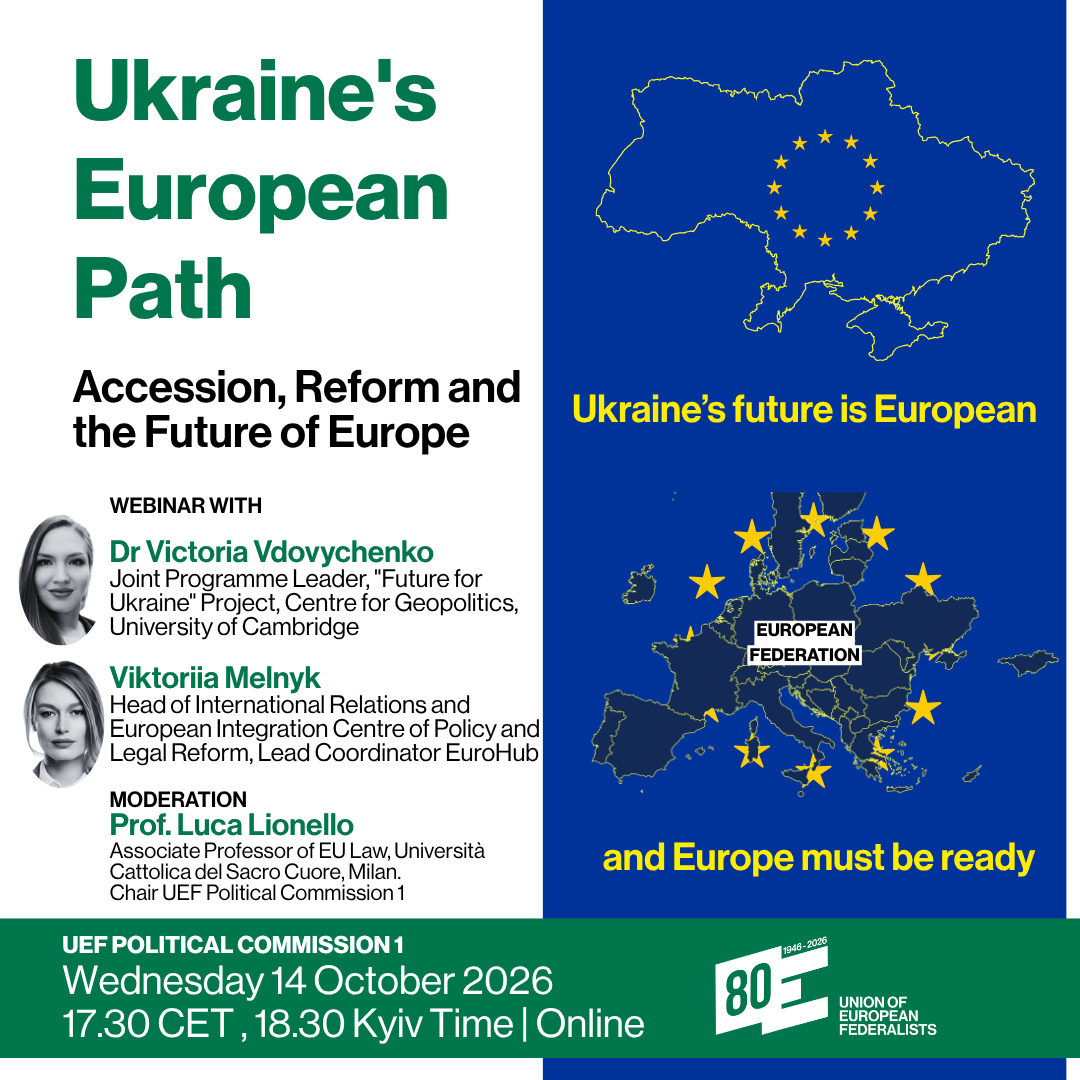
Ukraine's European Path. Accession, Reform and the Future of Europe
Accession, Reform and the Future of a Europe
On 6 October, the European Commission is set to present its long-awaited Communication on the EU's preparedness for enlargement. The key takeaway is that accession will no longer be a single moment. Instead, it will be reached through a cascade of gradual integration decisions guided by roadmaps, and safeguards will continue to apply for ten years or more after accession. This phasing aims to make enlargement politically feasible, chiefly because member states fear reform backsliding in new members, and this arrangement gives them at least some safeguards.
In addition, to ease economic concerns, the draft proposes phased access to the Common Agricultural Policy, which makes this a particularly significant part of the document for us.
Ukraine is pursuing EU membership while resisting a full-scale war, a defining test of European integration. UEF holds, per its resolution "On a Victorious Ukraine in a Federal Europe", that enlargement and federal deepening must advance together. This webinar pairs EU-law expertise with first-hand Ukrainian institutional voices, so enlargement is debated with Ukraine, not just about it.
WEBINAR WITH
- Dr Victoria Vdovychenko, Joint Programme Leader, "Future for Ukraine" Project, Centre for Geopolitics, University of Cambridge
- Viktoriia Melnyk, Head of International Relations and European Integration Centre of Policy and Legal Reform, Lead Coordinator EuroHub
MODERATION
- Prof. Luca Lionello, Associate Professor of EU Law, Università Cattolica del Sacro Cuore, Milan, Chair UEF Political Commission 1
REPORT
The seminar considered Ukraine’s accession to the EU as a political transformation affecting both Ukraine and the European Union. Ukrainian reforms, the removal of national vetoes, continental security and the ability to counter disinformation were discussed as closely connected issues.
This report reconstructs the speakers’ contributions and participants’ observations while distinguishing their respective perspectives. Timestamps refer to the recording.
1. The meeting and its approach
The online event, entitled Ukraine’s European Path. Accession, Reform and the Future of Europe, was held on 14 October 2026 and organised by the Union of European Federalists (UEF).
The speakers were Victoria Vdovychenko, Joint Programme Leader of the Future for Ukraine programme at the University of Cambridge’s Centre for Geopolitics, and Viktoriia Melnyk, Head of International Relations and European Integration at the Centre of Policy and Legal Reform and Lead Coordinator of EuroHub.
Luca Lionello, a professor of EU law at the Università Cattolica del Sacro Cuore in Milan and Chair of UEF Political Commission 1, moderated the discussion.
In his introduction, Lionello set out the federalist perspective: enlargement and deeper integration must advance together. Ukraine’s entry requires reforms in the candidate country, alongside an EU capable of welcoming it and functioning with more members.
The Commission’s recent communication on EU preparedness for enlargement provided the starting point. Lionello invited participants to examine the process through Ukrainian voices, bringing analysis of the European institutions into dialogue with the experience of those working on reforms in Ukraine.
Timestamp 00:00–05:10
2 Victoria Vdovychenko on European openings
The first presentation focused mainly on the European side of accession. Vdovychenko described the decisions that, in her account, had been taken in Luxembourg the previous day as a turning point.
She reported the opening of two further groups of negotiating chapters, known as clusters, for Ukraine: the internal market, and competitiveness and inclusive growth. She stated that this would bring the number of main negotiating chapters opened to 24 out of 33.
She also referred to Ukraine’s aim of opening the remaining two clusters by the end of the year, covering the green agenda and sustainable connectivity, and resources, agriculture and cohesion. These figures and developments are reported as part of her presentation.
Four elements of the European proposals
Gradual integration. Candidate countries could gain progressive access to individual European policies, markets and programmes once they met the relevant criteria, before formal accession. Vdovychenko interpreted this approach as a way of delivering tangible benefits and progress during negotiations.
Reform of EU decision making. She presented qualified majority voting as a response to blockages caused by unanimity. In her account, the Commission was seeking legally workable solutions that would not necessarily require treaty changes. North Macedonia illustrated the costs of an accession process extending over many years.
Enlargement as a two way process. The Union must adapt to welcome new members. Vdovychenko argued that these changes should also be discussed with candidates and ideally agreed with them. Negotiations should become more of a dialogue, although the EU would retain a decisive role in setting conditions.
Stronger safeguard clauses. She explained these guarantees as an attempt to reassure member states about possible democratic backsliding or rule of law violations after accession. The logic she described was to make reduced reliance on national vetoes politically acceptable by strengthening monitoring and intervention mechanisms.
Political conditions and implementation of reforms
Vdovychenko acknowledged the sensitivity of bilateral issues. She referred to relations with Hungary, disputes over education legislation and concerns in other states, including Poland and Romania.
On the Ukrainian side, she stressed that transposing directives into national law was insufficient: their practical implementation had to be demonstrated. Clear objectives for each chapter and cooperation between parliament, government and civil society were therefore important.
She raised the possibility that Ukraine and Moldova might progress at different speeds, depending on assessments of their respective achievements. In this connection, she referred to Interim Benchmark Assessment Reports, known as IBARs.
Her overall tone was hopeful. She saw a possible renewal of momentum after years of slow progress, driven both by Russian aggression and by accumulated frustration in candidate countries.
Timestamp 05:10–17:24
3 Viktoriia Melnyk on the need for concrete results
Melnyk offered a more cautious assessment. She welcomed the start of discussions about EU reform, but observed that Commission proposals still needed to translate into a shared commitment among member states.
She recalled that, since 2022, Ukrainian experts had repeatedly raised the Union’s preparedness for enlargement with European counterparts. In her experience, discussions had often stalled over treaty change and the move beyond unanimity. Other proposed forms of special integration, which she referred to as “light membership”, had also failed to produce visible results.
The underlying political question was whether member states and candidate countries truly intended to complete enlargement and accept its consequences.
Opening negotiations and applying the merit principle
Melnyk supported the rapid opening of the remaining clusters. Opening a cluster does not certify that all reforms have been completed: it allows the benchmarks required to finish the work to be established.
She also explained the political value of negotiations that move forward. A credible European prospect encourages Ukrainian institutions to prepare and adopt reforms; blockages on the European side can weaken this dynamic.
One of her strongest observations concerned bilateral disputes. If accession is to depend on a candidate’s achievements, member states should avoid introducing further national conditions at every stage. The merit principle should therefore guide their conduct too.
Melnyk cited North Macedonia, which had even changed its name without removing all obstacles to its European path. In her view, continually adding conditions risks undermining the credibility and transformative power of the enlargement process as a whole.
Domestic reforms and administrative capacity
Melnyk described the development of Ukraine’s negotiating infrastructure and the preparation of roadmaps on the rule of law, public administration reform and the functioning of democratic institutions.
She mentioned interim benchmarks for Chapters 23 and 24 and closing benchmarks for other chapters, noting the substantial work remaining. She acknowledged that the pace of reform had not always met expectations, while emphasising the daily preparatory work undertaken by public institutions.
War makes the task harder: security constraints, limited resources and institutions operating under extended mandates complicate transformation. Connection problems also interrupted her presentation; Melnyk switched off her camera, linking the difficulties to the effects of attacks.
She emphasised public administration reform, which she considered less prominent among international partners than it deserved. Ukraine needs an administration able both to negotiate accession and to function as the administration of a future member state. Parliament’s capacity to examine and adopt the required legislation must also be strengthened.
Melnyk identified a participant, Polina, as someone involved in coordinating the rule of law roadmap. Lionello invited her to speak, but the transcript records no subsequent substantive contribution from her.
Timestamp 18:57–29:55
4 Lionello’s questions on disinformation and integration
Opening the discussion, Lionello reiterated that Ukrainian accession was a political choice of decisive importance for Europe’s future. He feared that the greatest obstacles might lie on the EU side, partly because of political forces opposing Ukraine’s membership.
He asked two questions: how could Russian narratives and disinformation weakening support for accession be countered? Would Ukraine be ready to enter a more integrated Union, accepting a greater transfer of sovereignty?
Vdovychenko on information warfare
Vdovychenko described the European path as a nonlinear process, using the image of a tango: two steps forward and one back. She then focused on the ability of narratives to create doubt within European societies.
In her view, Russia’s objective was to erode support for financial, military, humanitarian and energy assistance to Ukraine, as well as for its European integration. She identified vulnerabilities in election campaigns, decisions on national budgets and the EU’s multiannual budget, differing threat perceptions and misunderstandings within local communities.
She observed that perceptions of danger in Finland and the Baltic states differed from those in countries further from Russia. She also mentioned research conducted with a partner organisation on narratives in the responses of several generative artificial intelligence systems.
She reported a prevalence of pro Russian or pro Chinese narratives in the material examined, without providing enough detail during the meeting about the sample or methodology to assess the finding. Her general recommendation was to strengthen European cohesion and treat the information dimension as part of collective security. She did not set out a detailed programme of alternative communication.
Melnyk on enlargement as a security instrument
Melnyk broadened the argument: the war concerned the security of the entire continent, and difficulties in relations with the United States made it necessary to strengthen alliances within Europe.
She referred to Russian influence in the Western Balkans and Moldova, describing political and information attacks as instruments that could precede military aggression. From this perspective, enlargement would help consolidate Europe’s security space.
The question about transferring sovereignty resurfaced later through discussion of vetoes and political unity, without a systematic answer on a particular federal model.
Timestamp 29:57–44:38
5 Beatrice Vincenzi and Luisa Trumellini on elections and reform
Lionello read a question from Beatrice Vincenzi: could the Trump administration’s choices ahead of the US midterm elections influence the EU, particularly those member states most sceptical about enlargement?
Luisa Trumellini then offered a broader political reflection. She argued that Europe could not afford the lengthy timelines of earlier enlargements. Ukrainians and other Europeans faced a common challenge: defending freedom and an open society against external pressure and forces capable of weakening the EU from within.
She linked this urgency to overcoming national vetoes, strengthening political unity and the outcome of forthcoming elections in European countries. She strongly criticised the direction of the US administration, referring also to access to intelligence information.
In Trumellini’s view, European institutions might recognise the urgency of action while remaining constrained by the weaknesses and priorities of individual states. She asked whether a more political and united Union would also serve Ukraine’s interests, with Ukraine contributing its own experience.
The speakers’ responses
Vdovychenko described Trump’s policy as marked by oscillation and anticipated further instability. She stressed the need for coordination among European leaders.
In responding to Trumellini, she placed time at the centre of the issue: delays have immediate consequences for Ukraine. She wished the decisions under discussion had been taken years earlier. She recognised the importance of reform and political will, without endorsing every possible institutional solution unconditionally.
Melnyk offered personal testimony, noting that she lived in Ukraine with her family. She described recent missile attacks on Kyiv and its surrounding region, civilian casualties and damage to energy infrastructure, linking these to concerns about the winter.
She criticised an approach that, in her reading, pressured the victim to become more accommodating towards the aggressor. She also referred to vulnerabilities arising from dependence on external services, citing Starlink.
As a practical avenue, she pointed to European defence cooperation: joint companies, drones and missile protection projects. Europe should develop the capacity to influence the geopolitical environment.
She was explicit about vetoes: blockages affecting enlargement and sanctions revealed a problem that could worsen if the number of governments hostile to the Union’s values increased. Reforming decision making would therefore also protect the EU itself.
Timestamp 44:42–01:01:13
6 Pierangelo Cangialosi on pro Russian attitudes
Pierangelo Cangialosi asked how to explain persistent pro Russian sympathies and Soviet nostalgia in some European countries and in Italy. He cited Roberto Vannacci and suggested several possible explanations: economic interests, oil and fear of nuclear weapons.
Vdovychenko replied that there was no single cause. Political sympathies intertwined with historical memory, identity, material interests and established narratives.
She stressed that simply debunking false information often came after its influence had already taken hold; that a leader’s positions did not automatically represent an entire population; and that educational and cultural work with younger generations offered important opportunities.
She proposed critically examining nostalgic narratives and also telling the story of historical links between Ukraine and other European countries, referring to her own work on relations with Italy.
Melnyk added a sharper interpretation: money and energy were instruments of influence, but culture and sport also helped construct a positive image of Russia. She cited the prestige of ballet and opera as factors that could sustain this image. In her interpretation, that representation tended to obscure the violence of Russian policy, directly experienced by Ukrainians.
During the same segment, a second question from Beatrice Vincenzi was read aloud. It concerned Zelensky’s room for manoeuvre in expressing disagreement with the instability of US policy without creating further tensions with European leaders. Vdovychenko acknowledged its difficulty, but the transcript contains no separate, developed answer.
Timestamp 01:01:16–01:12:14
7 Paolo and Ákos on European belonging and national concerns
Towards the end, Lionello read a question from Paolo, whose surname was not given: how could a shared sense of European citizenship be built, and how widespread was a feeling of belonging to Europe in Ukraine?
He also referred to a comment from Ákos, who introduced himself as half German and half Hungarian. The comment was not reproduced in full. The subsequent discussion indicates that it concerned national fears and perceptions, but its exact content cannot be reconstructed.
Vdovychenko on Ukrainians’ European identity
Vdovychenko linked Ukraine’s European choice to the mobilisation of November 2013. She rejected the habit of speaking of “Europeans and Ukrainians” as separate groups: from her perspective, Ukrainians already belonged to Europe.
She pointed to civil society’s demands for reform and protests, even during wartime, as concrete expressions of this belonging.
She acknowledged that Ukrainian membership raised economic concerns, particularly regarding agriculture and competition. Ukraine had to work on several fronts: military, informational and the building of support in European societies. She proposed distinguishing economic competition from cooperation based on shared values.
Melnyk on institutional recognition of belonging
Melnyk referred to Ukrainian history and democratic traditions as foundations of the country’s European identity. She described accession as the legal recognition of a belonging already felt.
She cited European flags at demonstrations defending the anticorruption bodies NABU and SAPO and emphasised young people’s involvement.
She acknowledged remaining problems in the reform process, while reiterating that citizens, experts and military personnel were contributing in different ways to making that European future possible.
Timestamp 01:12:19–01:19:37
8 Areas of agreement and unresolved questions
The discussion revealed strong agreement on three ideas: Ukrainian accession has strategic value for Europe as a whole; the Union must reform to make it possible; and the credibility of the European path supports Ukraine’s domestic reforms.
The difference in emphasis between the speakers remained significant. Vdovychenko highlighted the political opening represented by European proposals; Melnyk stressed their implementation, administrative capacity and the need to avoid continually adding bilateral conditions.
Several questions received less development: the precise model of political union envisaged, the extent of acceptable sovereignty transfers, the practical operation of safeguards and the management of enlargement’s economic costs.
In closing, Lionello reiterated the connection between Ukraine’s future and Europe’s, expressed hope for further cooperation and announced a subsequent webinar on EU reform and building public support.
Timestamp 01:19:40–01:21:52