

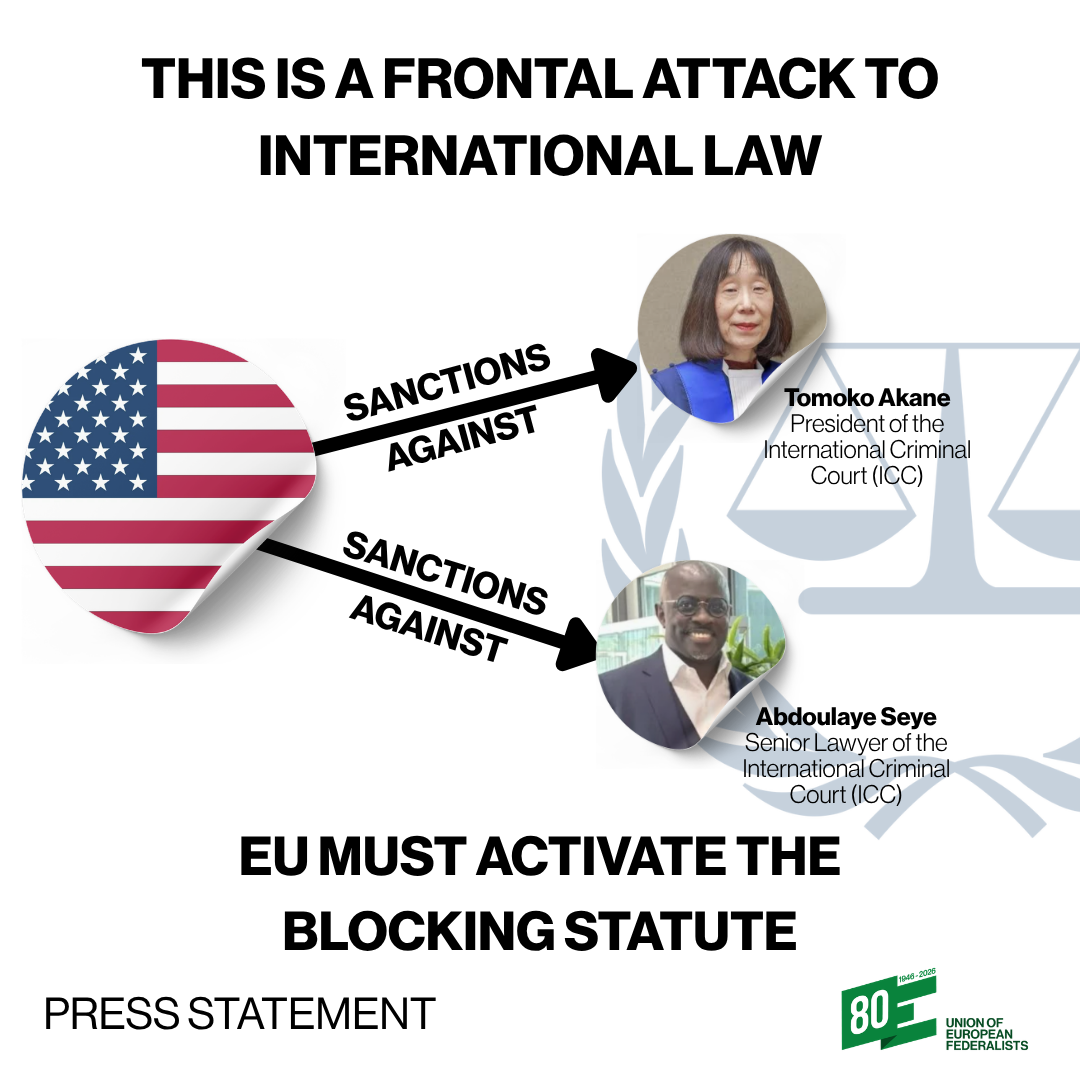
PR | The US sanctions against ICC President and Senior Lawyer are a frontal attack to international law
The US sanctions against ICC President and Senior Lawyer are a frontal attack to international law and must be met resolutely by the international community
EU must activate the blocking statute to prevent any sanctions against ICC.
On August 19, US Secretary of State Marco Rubio announced sanctions against the President of the International Criminal Court (ICC), Tomoko Akane, and the ICC’s senior lawyer, Abdoulaye Seye. The sanctions were imposed on the grounds that they had participated in the ICC’s efforts to prosecute officials whose governments had not consented to the Court’s jurisdiction.
These sanctions are part of a US foreign policy aimed at weakening the multilateral institutions established after World War II. Under US pressure, Chad became the fifth country in recent months to begin a formal withdrawal process from the International Criminal Court, following Venezuela, Burkina Faso, Mali and Niger. These developments are the consequences of a broad campaign against the ICC launched on July 13.
The International Criminal Court was established by the Rome Statute, which has been ratified or acceded to by 125 states worldwide, including all EU Member States, to prosecute the gravest crimes of concern to the international community: genocide, war crimes, crimes against humanity and the crime of aggression.
Significantly, China, Russia, North Korea, Iran, Israel and the US have not ratified the Rome Statute. Their refusal reflects a broader rejection of the principle that they should be subject to the same rules as other states and that their officials and military personnel should be held accountable for any crimes against humanity they may commit.
The Court is currently under attack by the Trump Administration. First, Microsoft was reportedly instructed to withdraw its services, effectively disrupting the Court’s IT infrastructure. Subsequently, judges and prosecutors were cut off from the US financial system, on which banks and financial institutions around the world rely, thus making it impossible for them to use credit cards or access other financial services. Now, the US is imposing sanctions on the Court’s President and senior prosecutor.
Sanctions are typically imposed on individuals accused of committing serious offences. The US is instead using them against those seeking to investigate and prosecute such crimes. The Court has issued arrest warrants for Putin in connection with Russia’s aggression against Ukraine and alleged crimes committed during the war, as well as for Netanyahu in connection with alleged crimes against humanity committed in Gaza, far beyond any proportionate exercise of the right to self-defence. These actions have triggered the United States’ campaign against the ICC, placing Washington, in this respect, alongside states that reject the principle of international accountability.
The Union of European Federalists (UEF) calls on the 125 governments that are parties to the Rome Statute to defend the International Criminal Court against US sanctions.
The UEF welcomes the statement issued by the European External Action Service and the declaration by Kaja Kallas, the EU’s High Representative, in support of the Court.
Furthermore, the UEF calls on the European institutions to activate the EU’s Blocking Statute (Council Regulation (EC) No 2271/96), which prevents European operators from complying with US sanctions that have extraterritorial effects. This statute provides the EU with a legal mechanism to resist the application of foreign laws that conflict with European legal protections. The Blocking Statute was notably used in 2018, when the EU sought to mitigate the effects of US sanctions on Iran following the US withdrawal from the Iran nuclear deal. The ICC President, Judge Tomoko Akane, who is now subject to US sanctions, has stressed that the EU Blocking Statute is one of the Court’s most essential tools for withstanding sanctions and ensuring its continued functioning.
Finally, the UEF calls on the European Parliament to adopt a resolution in support of the ICC and to reaffirm the Court’s essential role in protecting human rights and upholding international justice.
PRESS CONTACT
Davide Negri,Political Communication and Campaign Strategist of the UEF