

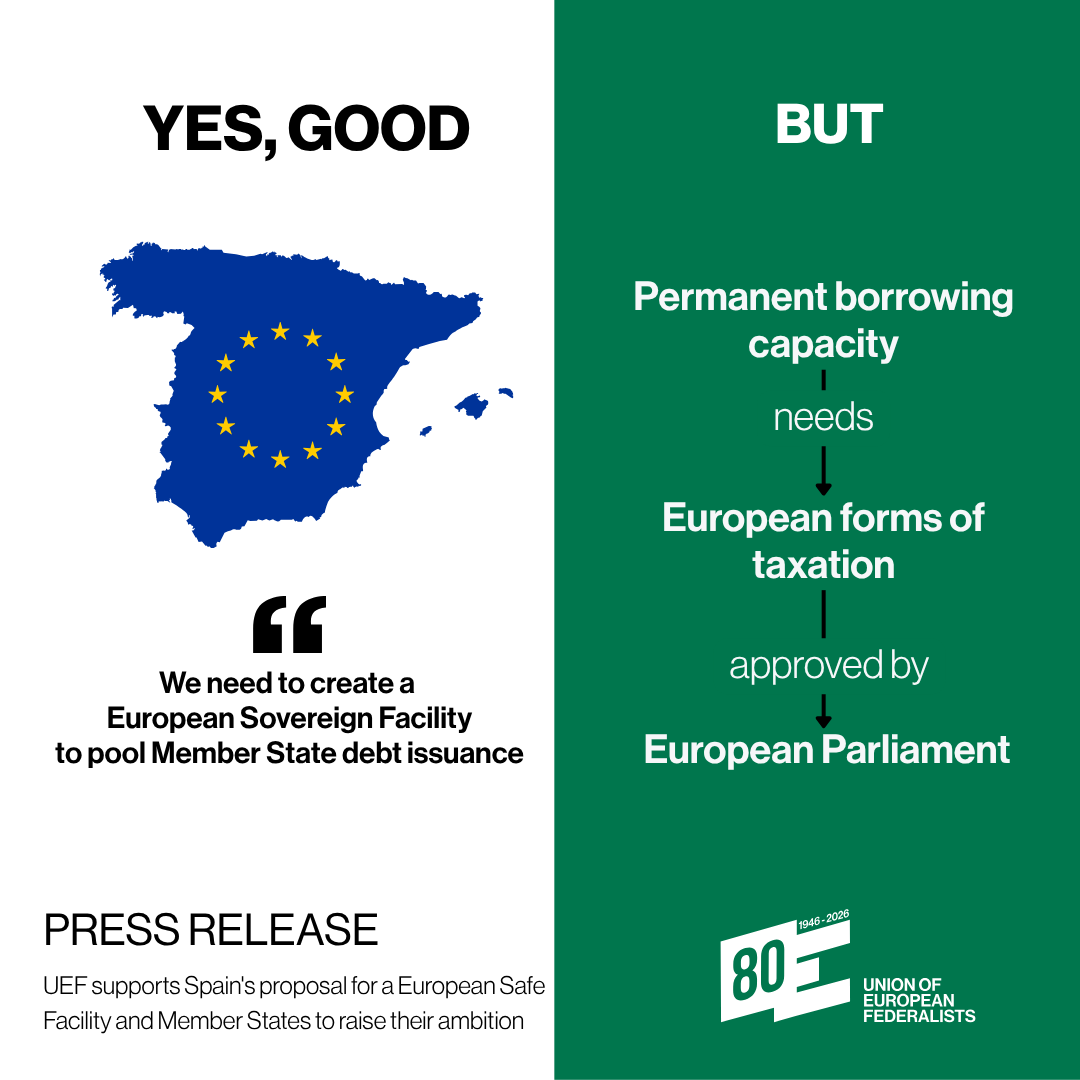
PR | UEF supports Spain's proposal for a European Safe Facility and Member States to raise their ambition
Brussels, 13 July 2026
The Union of European Federalists (UEF) welcomes the non-paper presented by the Government of Spain on the creation of a European Sovereign Facility (ESF). This is a bold and pragmatic proposal that can contribute to developing a European safe asset through common debt issuance, while preserving fiscal obligations and avoiding any increase in overall public debt.
The Spanish non-paper proposes a "European Sovereign Facility" through which the European Commission would centralize part of participating countries' annual borrowing—covering around a third of their debt redemptions plus deficit needs—by issuing common EU bonds and passing the money back as loans, all without creating any new debt, since it just reorganizes financing that would exist anyway. Participation would be voluntary and conditional on following EU fiscal rules, and the goal is to build a much bigger, more liquid pool of EU debt (up to roughly €850 billion a year) so it becomes attractive enough to global investors to lower borrowing costs for everyone involved, backed by a double guarantee (the loan itself plus the EU budget) that shields non-participating countries if someone defaults. In the event of a default by a participating country, losses borne by the EU budget will be recovered from EU payments to that member state. Only if these were insufficient would other participating states cover losses, while non-participants would be shielded and would hold a claim on the defaulting member state.
Such an initiative would complement the EU bonds issued by the Commission to finance SURE, Next Generation EU, and the loan to Ukraine.
The proposal is consistent with the resolution adopted by the UEF European Congress in Barcelona in March 2026, which called for a new generation of European joint borrowing, a gradual transition towards a European safe asset, and the possibility for a coalition of willing Member States to move forward when unanimity proves impossible to do it at 27. At a moment when global investors are increasingly seeking alternatives to traditional reserve assets, in particular the US dollar, Europe has a historic opportunity to lower borrowing costs for several Member States, strengthen the international role of the euro by providing a sizable quantity of a Euro-denominated asset, and enhance its economic and geopolitical influence.
Domènec Ruiz Devesa, president of UEF and MEP 2019-2024 stated that: “A genuine window of opportunity exists today for the euro to strengthen its global role. The international monetary system is evolving, but Europe is failing to seize this moment because too many governments remain trapped in short-sighted national calculations. A European safe asset is not merely a financial instrument. It is a strategic tool to strengthen Europe's sovereignty, reinforce the international role of the euro, reduce financial fragmentation and increase the European Union’s capacity to project power and defend its interests globally. In a world of continental powers, monetary sovereignty and geopolitical influence go hand in hand.”
Spain has put forward a serious and innovative proposal that should ideally develop within the EU framework. Other Member States, starting with France and Italy, two of the largest economies of the euro area and among the main beneficiaries of a deeper and more liquid European sovereign debt market, should now join in transforming this initiative into a concrete political project, beyond the financial benefits for individual Member States, that could catalyze in the medium term the creation of an EU permanent borrowing capacity focused on financing clearly defined European public goods (like defense, energy, measures agains climate change) and strategic investments where Europe can deliver more effectively and efficiently than European member states.
Such a permanent borrowing capacity must be necessarily accompanied by European forms of taxation approved by the European Parliament. This could also foster deeper political integration while maintaining fiscal obligations ensuring financial stability in Europe, triggering the necessary steps to further reform the governance and institutions in Europe to make them fit-for-purpose and ensure that funds are spent efficiently/effectively and in total more fiscal space won, in the spirit of the reports of Mario Draghi and Enrico Letta. Such steps would represent a decisive advance towards a stronger Economic, Monetary, and fiscal Union and, ultimately, towards a more sovereign and federal Europe.
For media enquiries, please contact:
- UEF Secretariat, secretariat@federalists.eu