

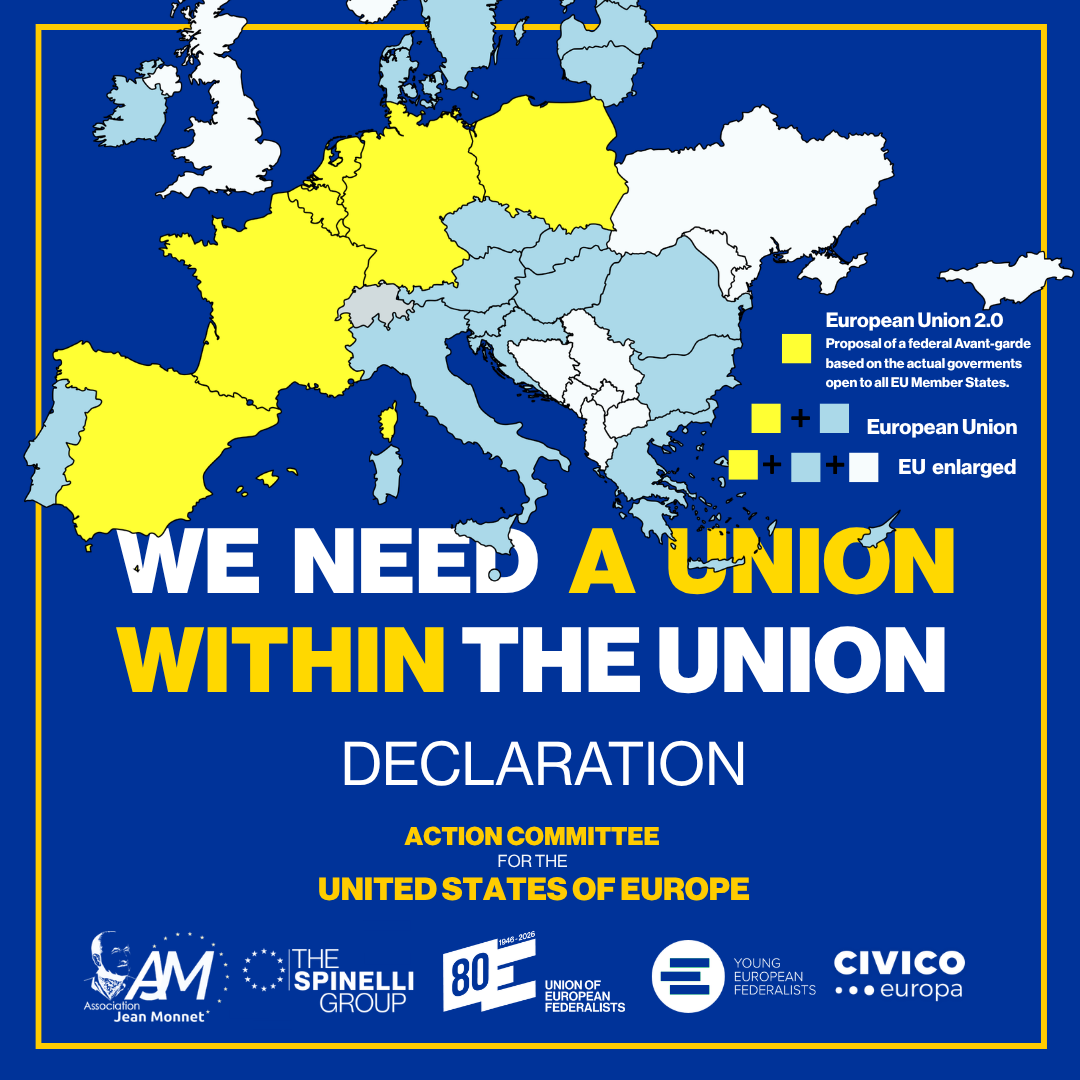
We need a Union within the Union
The following opinion editorial is published in the spanish newspaper El Pais, the french Les Nouvel Obs and the italian Focus Europe.
“We are in difficulties. That is a good sign. If we were not, we would never change anything.
And making Europe means changing things.”
— Jean Monnet
The European Union has delivered more than seventy years of peace and prosperity. However, it was not designed to operate in a world dominated by continental empires. A stronger core Union must now emerge. Europe is an ageing continent, lagging the United States and China in growth and productivity, suffering from low investment, and struggling to sustain its social model. At the same time, it faces a profound geopolitical shift: Russia threatens its security from the East, while its traditional ally, the United States, is becoming at best an unreliable partner and at worst a hostile power.
With just 5 per cent of the world’s population and a (so far) declining share of the global economy, only a more united Europe—economically and politically, capable of ensuring its own security and defence—can effectively confront the three continental powers seeking to divide the world into spheres of influence amid the collapse of the multilateral order. Yet, even after the aggression against Ukraine and Trump’s threats over Greenland, European leaders have not launched any bold initiative to scale up the Union.
The problem is not a lack of plans, but a lack of consensus among the twenty-seven. Letta and Draghi have proposed an important policy package to relaunch growth and competitiveness: completing the single market and mobilising public and private investment in key sectors. This should be a no-brainer. Removing national barriers in financial services, telecommunications, digital markets, and energy would deliver a major boost to the EU economy. The same applies to the harmonisation of bankruptcy and corporate law.
We must also complete the Capital Markets Union and the Banking Union to retain European savings for investment within Europe. Such an economic programme would not only relaunch prosperity and improve living standards but also provide the technological and financial base needed to project power globally in defence of our values and interests.
However, this is not enough. Europe must build its own defence system, given the unreliability of the United States—and therefore of NATO—and must be able to take decisions by majority in foreign policy. The Treaty of Lisbon already provides avenues for both objectives, including the possibility of reform. Yet there is no progress.
Recent events illustrate the urgency. The war in Iran, the blockade of the Strait of Hormuz, and the bombing in Lebanon showed how even issuing a joint statement can be paralysed by the veto of a single Member State. Earlier, Orbán’s latest veto—blocking a €90 billion Eurobond-financed loan to Ukraine and the 20th sanctions package against Russia—put the entire continent’s security at risk, despite Hungary representing just 1 per cent of EU GDP and 2 per cent of its population.
Furthermore, the Council has so far failed to agree on a single regulator for digital, telecommunications, and financial services—essential for a true internal market—or on a European Deposit Insurance Scheme, let alone tax harmonisation. Powerful national interests continue to defend cross-border barriers and have effectively captured their governments, forming blocking minorities. Meanwhile, the Council often applies unanimity even where it is not legally required.
Is there a way forward? For some single market reforms, the Council can act by qualified majority voting. However, major initiatives in taxation, debt, foreign policy, and defence will likely remain blocked by national vetoes. Therefore, unless we are prepared to accept the status quo—and risk Europe’s future as an independent actor—the time has come to create a federal vanguard of willing Member States. This is how we created Schengen and the single currency.
This vanguard would complete the internal market; pool sovereignty over the euro, taxation, and large-scale investments in technology, climate policy, and energy independence based on renewables, and defence products. It would establish a European Security Council, and a Defence System with civilian capabilities and its own chain of command, and adopt majority-based decision-making across the board, including in foreign policy, defence, taxation and financial matters. This “Union within the Union” could be established through a combination of enhanced cooperations with a homogeneous membership, supported by an instrumental treaty to regulate decision-making rules and ensure democratic accountability.
In such a dangerous world, where our security and survival are clearly at stake, we cannot accept that a single capital can hold everyone back. We are convinced that if Germany, France, the Benelux countries, Poland, and Spain take the lead in proposing this Union 2.0—open to all—it will act as a powerful magnet for other Member States that have so far been reluctant to support necessary reforms.
We therefore call on citizens to mobilise and on European leaders to act in the innovative spirit of the 9 May 1950 Declaration.
On behalf of the Action Committee for the United States of Europe:
- Guy Verhofstadt, President of European Movement International and former Prime Minister of Belgium.
- Domènec Ruiz Devesa, President of the Union of European Federalists and former Member of the European Parliament, Spain
- Moritz Hergl, President of the Young European Federalists, Germany.
- Rosen Plevneliev, former President of Bulgaria.
- Petre Roman, former Prime Minister of Romania.
- Danuta Hübner, former Commissioner, Poland.
- Josep Borrell, President of CIDOB and former EU High Representative for Foreign and Security Policy, Spain.
- Willy Claes, former Secretary General of NATO, Belgium.
- Andrea Wechsler, Member of the European Parliament, Spinelli Group, Germany.
- Monica Frassoni, former Co-President of the European Green Party, Italy and Belgium.
- Thijs Reuten, Member of the European Parliament, Spinelli Group, Netherlands.
- Jo Leinen, former Member of the European Parliament, Germany.
- Sandro Gozi, former Secretary of State for Europe, Spinelli Group, Member of the European Parliament, Italy and France.
- Pierre Larrouturou, former Member of the European Parliament, France.
- Richard Corbett, former Member of the European Parliament, Britain.
- Christelle Savall, former President of the Young European Federalists, Luxembourg.
- Giulia Rossolillo, Professor of European Union Law, Italy.
- Francisco Aldecoa, Professor of International Relations, Spain.
- Lieven Taillie, Honorary President of the European Journalist Association in Belgium.
- Michele Fiorillo, Philosopher, Civico Europa, Italy.
- Eric Pestel, Advisor to the President, Association Jean Monnet, France.
More news about the Action Committee for the USE here: LINK