

The Executive Bureau of the Union of European Federalists (UEF) appointed on 3 August, Domènec Ruiz Devesa, Member of the European Parliament, as President ad interim, following the departure of Sandro Gozi. Prior to this nomination, Domènec Ruiz Devesa held the position of Vice-President of the UEF.
Under Sandro Gozi’s leadership, the UEF participated at the Conference on the Future of Europe, re-launched its collaboration with the Spinelli Group, the European Parliament's intergroup of federalist-minded MEPs, and put forward several political actions culminating in this year's Treaty Reform Now! campaign, collecting more than a thousand signatures from EU political leaders, elected officials, and representatives of the European Civil Society.
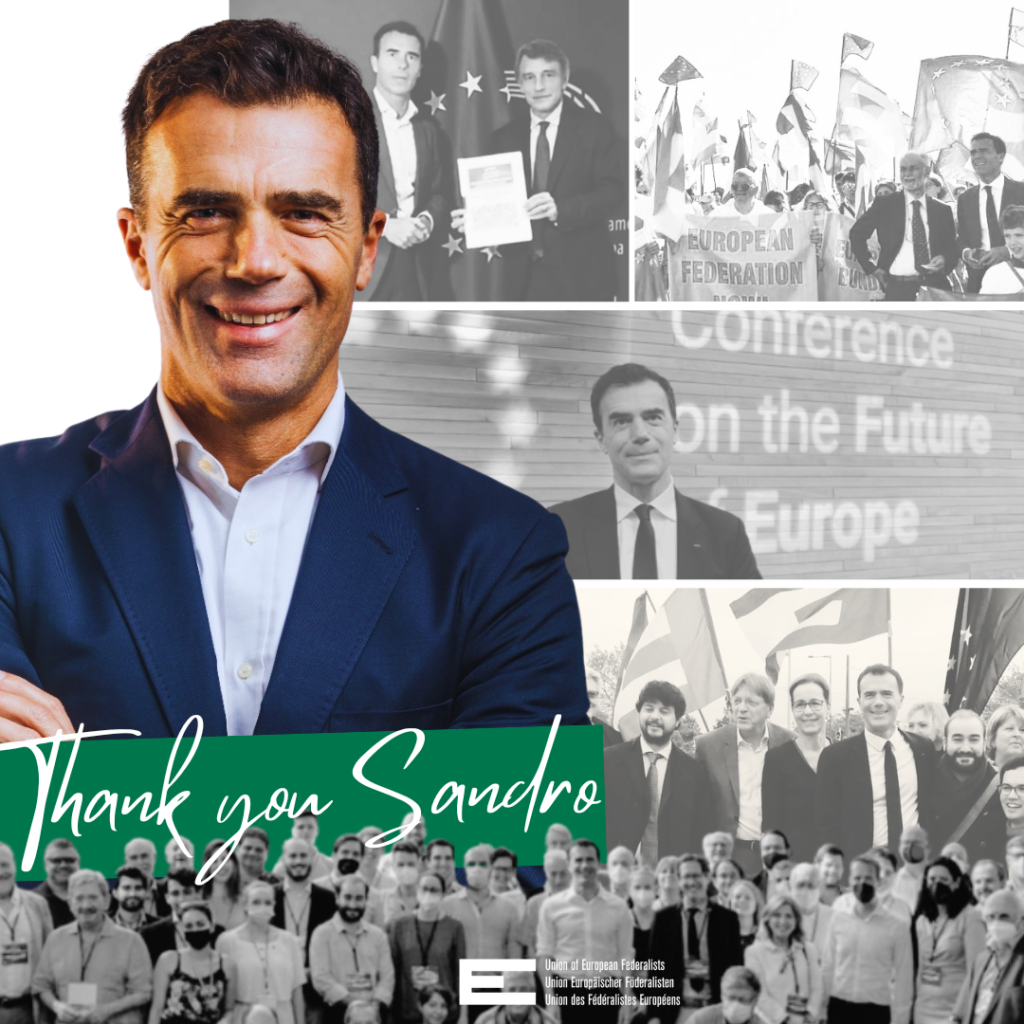
Domènec Ruiz Devesa saluted his predecessor’s achievements: “Sandro Gozi, a true Federalist, did the utmost to improve the UEF and advance its agenda. I know our personal friendship will endure and it is my commitment to continue to cooperate with the European Parliament and the Spinelli Group.”
The UEF remains committed to the advancement of a federal, sovereign and democratic Europe, notably through:
- The negotiations on the reform of the EU electoral law and the composition of the European Parliament after 2024, for which Domènec Ruiz Devesa and Sandro Gozi are reporting on the European Parliament’s behalf,
- The upcoming AFCO report calling for a Convention for the reform of the treaties,
- The preparation for the upcoming European elections.
Background
The Union of European Federalists (UEF) is a pan-European, non-governmental political organisation dedicated to the promotion of European political unity since 1946. We believe that completing European political unity is required to ensure Europe’s economic prosperity and strength. The UEF calls for a European democracy where all citizens can determine the policies of a European government. The UEF promotes a federal, sovereign and democratic Europe.
The European Union (EU) has been a driving force for economic integration and stability among its member states. However, the current EU budget system faces significant challenges, including uneven contributions and structural inefficiencies. To address these issues and strengthen the EU, this video delves into the history of EU financing, examines the problems with the EU budget today, and explores the potential benefits of a fiscal union. By analyzing these aspects, we can work towards a more cohesive and sustainable future for the European Union and its member states.
This video is realized with the contribution of Giulia Rossollillo, Member of the Executive Bureau of the UEF and professor of the European Union Law at the University of Pavia.
This video is co-produced by the Union of the European Federalists, co-funded by CERV grant 2023 of the European Union, and YouTube Channel "EU made SIMPLE".
9.15 | WELCOME MESSAGE
- Sandro Gozi, MEP (Renew, France), President of the Union of European Federalists and Chair of the Spinelli Group
Video message from 00:00:00 to 00:04:00
THE NATO SUMMIT IN VILNIUS: EXPECTATIONS AND PERSPECTIVES FOR THE EUROPEAN SECURITY ARCHITECTURE AND FOR THE ROLE OF THE EU IN THE INTERNATIONAL SECURITY POLICY
- 9.30 | Petras Auštrevičius, MEP (Renew Europe, Lithuania), Member of the Subcommittee on Security and Defence
interviewed by Dr. Nana Walzer, Journalist, University Lecturer, Chairwoman of europe:united
- 10.15 | Lukas Mandl, MEP (EPP, Austria), Deputy Chair of the Subcommittee on Security and Defence, President of UEF Austria
interviewed by Dr. Nana Walzer, Journalist, University Lecturer, Chairwoman of europe:united
Video message from 00:04:00 to end
11.00 | ON THE EVE OF THE VILNIUS NATO SUMMIT: GEOSTRATEGIC DECISIONS TO SECURE UKRAINE’S FUTURE
In the light of ongoing brutal Russian war of aggression against Ukraine, NATO member states are more united than ever and persistent in their support to Ukraine, as well as strengthening NATO defence capacities and readiness. Last year NATO adopted its new Strategic Concept, in which all Members stated that ,,the Russian Federation is the most significant and direct threat to Allies security and to peace and stability in the Euro–Atlantic area”. Now, on the eve of Summit in Vilnius, it is crucial to ensure that the Alliance is fully prepared to address this threat and to send a clear signal that Ukraine’s future in NATO is inevitable.
Therefore, the Union of European Federalists, together with European Movement Lithuania, kindly invite participants to discuss objectives of the NATO Summit in Vilnius, methods of strengthening European security architecture and the Ukraine’s Euro-Atlantic aspirations.
- Yehor Cherniev, Head of the Ukraine Delegation to the NATO Parliamentary Assembly, (tbc)
- Markus Ferber, MEP (EPP, Germany), President of the Hanns Seidel Foundation & Vice-President of the Union of European Federalists
- Sandro Gozi, MEP (Renew Europe, France), President of the Union of European Federalists
- Žygimantas Pavilionis, MP (Homeland Union – Lithuanian Christian Democrats, Lithuania), Chair of the Parliamentary Committee on Foreign Affairs of the Republic of Lithuania
- Dr. Hanna Shelest, Head of Security Programmes at the Foreign Policy Council “Ukrainian Prism”, Editor-in-chief at UA: Ukraine Analytica
- Dr. Marie-Agnes Strack-Zimmermann, MP (FDP, Germany), Chair of the Defense Committee in the Bundestag, Germany (tbc)
- Moderator:
- Prof. Dr. Margarita Šešelgytė, Director at Institute of International Relations and Political Science, Vilnius University
12.30 | Lunch Break
- THE NATO SUMMIT IN VILNIUS: EXPECTATIONS AND PERSPECTIVES FOR THE EUROPEAN SECURITY ARCHITECTURE AND FOR THE ROLE OF THE EU IN THE INTERNATIONAL SECURITY POLICY
- 13.30 | Professor Dalia Bankauskaite, Associate Professor at the Vilnius University, Lithuania, and Senior Fellow at the Center For European Policy Analysis CEPA, Board member of European Movement Lithuania
- 14.15 | Christian Moos, Member of the European Economic and Social Committee, Group III (S&D), Secretary General of Europa Union Deutschland & Board Member of European Movement Germanyinterviewed by Dr. Nana Walzer, Journalist, University Lecturer, Chairwoman of europe:united
Video message from 00:31:28 to 01:05:04
15.00 | THE NATO SUMMIT IN VILNIUS: WHAT IS THE ROLE OF EUROPEAN CIVIL SOCIETY IN THIS CONTEXT AND WHAT CAN IT DO TO SUPPORT CIVIL SOCIETY IN UKRAINE?
Debate with
- Kati Schneeberger, District Councillor (The Greens) City of Vienna, designated Federal Director BEJ Austria, President of VIENNA goes EUROPE
- Klaus Klipp, President of Europa Union FrankfurtModerator:
- Dr. Nana Walzer, Journalist, University Lecturer, Chairwoman of europe:united
Video message from 01:05:05 to end
15:45 | End of the Theme Day
Why a Communications Handbook?
In the ongoing effort of the UEF to improve the way our organisation communicates on federalist values, ideas, and actions, the European Secretariat of the UEF is publishing a series of training on communications.
This handbook is the "physical" aspect of this project. It covers the basics to communicate effectively and in a concerted manner. More than ever, the Federalist movement must show unity and deliver concrete results. Our activists, European citizens, and political representatives are counting on us to promote and advance the idea of a federal Europe, sovereign and democratic. One way of achieving this objective is through thoughtful communication.
While this guide is open to all, it is mostly targeted at the people responsible for the communications activities of the UEF's national and local sections. Feel free to share it within your sections, with your members and the people who have a stake in how the UEF or your section communicates.
I hope that this guide will be of use to you. In any case, feel free to contact the Secretariat of the UEF: we are at your service. I wish you a pleasant and informative reading.
Federalist regards,
Anna Echterhoff, Secretary-General of the UEF
How to use this handbook
This guide is written for the novice and the experts alike, as both will find advice adapted to their skills, as well as important information that all Federalist activists should know. This document will give you the most important information and tips for starting and improving your communications activities.
The best way to use the handbook is to apply as much as possible the advice, information, and lessons it contains. After each page, consider how you can enrich your work with what you just read. Proceed to advanced methods only when you are confident in your mastery of the basic elements.
Do not worry: this time will come sooner than you think.
We wish you the best in your communications activities.
Alexandre Météreau, UEF Policy and Communications Officer
Davide Negri, Communication Consultant
The Union of European Federalists (UEF) recalls that saving lives must be the absolute priority of the European Union. “Our thoughts are to those who lost their lives and to their families. We call for coordinated support and full assistance to the survivors. In line with the EU Charter of Fundamental Rights, the Union must guarantee the respect of Human Rights and international law including the non-refoulement principle. We need now full clarity and transparency in the ongoing investigation by the Greek Authorities,” said Sandro Gozi MEP, President of the UEF.
The UEF calls for three concrete actions, ahead of the next European Summit meeting under the Swedish Presidency:
- Firstly, a thorough, independent, and impartial investigation into the cause of this catastrophe to bring concrete answers to the pressing questions around the shipwreck: Why was a search and rescue operation not launched sooner? What are the causes of the ship capsizing?
Those who lost their lives, survivors and their families deserve transparency, truth and justice. - Secondly, similarly to actions taken after the Lampedusa shipwreck 10 years ago, the establishment of a “Task Force Pylos”. The Task Force will be in charge of identifying the current gaps and listing concrete measures needed for effective rights-based management of the EU's external borders and a sustainable EU asylum and migration policy. A stated objective of this Task Force should be the development and implementation of multipurpose maritime operations based on continuous cooperation of all relevant Agencies (FRONTEX, EFCA and EMSA) and national competent bodies.
- Thirdly, a real policy change to develop a truly common EU Labour Migration policy, including through bold and courageous Treaty changes. The changes should respond to the needs and economic interests of the Union. To fight effectively against the network of smugglers, it is urgent to reinforce and extend the EU’s cooperation with third countries including cooperation in the area of justice and judicial investigation.
Ten years after the Lampedusa shipwreck, this new tragedy resurfaces the pending question concerning the European Union’s capacity to tackle migration and asylum challenges efficiently and humanely. Pylos demonstrates the extent of the challenge: preventing loss of lives by establishing safe and legal routes to Europe for people looking for protection. Despite the continuous efforts of the past ten years and the vast amount of money spent, basic elements of the EU asylum framework (such as humanitarian visas or a system of mutual recognition of asylum decisions) are still missing.
Since 2019, the UEF has called for safe and legal ways to entry in Europe as the only way to avoid such frequently occurring tragedies in the Mediterranean. In the same spirit, the European Parliament has invited on several occasions the European Commission to table concrete legislative proposals on these issues. Yet, once again, we come to the brutal realisation that these goals have not been attained.
The protection and saving of lives at the external borders should be the key priority in European integrated border management. The capacity and operational readiness to conduct effective search and rescue operations should be an important and integral part of the sea border surveillance operations at the external sea borders.
As the number of people drowning in the Mediterranean trying to reach safety in Europe rises, we cannot let Pylos be just another tragedy in a Union unconcerned with human suffering. Instead, let’s work to build a safer and humane migration and asylum system. Only then will we be able to truly live up to the values our Union is founded upon.
Background
14 June 2023 saw one of the deadliest shipwrecks reported in the Mediterranean, as a ship carrying around 750 migrants and asylum seekers trying to reach Europe capsized off the coast of Greece. More than 80 people died and 600 more are still missing at sea.
Watch the video recording here below
On the morning of Europe Day 9 May 2023, activists of the Federalist network offer coffee and croissants to passersby and Members of the European Parliament, reminding them of the urgency to reform the European treaties and ensure a proper follow-up of the CoFoE.
During the action we were joined by MEPs Sandro Gozi, Guy Verhofstadt, Brando Benifei and Mercedes Bresso.

On Monday 8 and Tuesday 9 May, the Union of European Federalists (UEF) and its partners in France and Alsace (Mouvement Européen and Les Jeunes Européen) organised two important events for the democratic future of Europe.
On the evening of the 8th, more than one hundred federalists gathered for a public debate on the Future of Europe at the Museum of Modern and Contemporary Art with the participation of Sandro Gozi, President of the UEF and Member of the European Parliament. Guy Verhofstadt presented the European Parliament’s Institutional Affairs Committee report on Treaty change and what European representatives have in mind for the future of Europe. All other panellists from the European and Strasbourg’s civil society, Citizen Ambassadors of the Conference on the Future of Europe (CoFoE), touched on the reform of European Treaties and the positive changes it will bring to European citizens.
Among them were UEF Vice-Presidents and MEPs Markus Ferber and Domènec Ruiz Devesa, Prof. Frédérique Berrod, a member of the UEF France Scientific Committee, and Véronique Bertholle, deputy-major for the city of Strasbourg.
On the morning of Europe Day, activists of the Federalist network offered coffee and croissants to passersby and Members of the European Parliament, reminding them of the urgency to reform the European treaties and ensure a proper follow-up of the CoFoE.
Both these events are linked to the UEF’s petition Respect the Will of the Citizens and the Conference on the Future of Europe calling the Council of the EU to answer to the European Parliament’s resolution of June 2022 asking for treaty reform. The petition now gathers more than 1300 signatures from elected officials, civil servants, academics, and citizens.
“It is time for a strong political message. We must mobilise for treaty reform” said Sandro Gozi, President of the UEF. “The debate organised by the UEF in Strasbourg on 8 and 9 May is this occasion.”
Background
The Conference on the Future of Europe, which ended in May 2022, highlighted the necessity, shared by its Citizen Ambassadors, for the reform of the European treaties. The European Parliament endorsed this call as soon as June 2022, by voting on a resolution calling for a Convention to draft new treaties.
The Council of the European Union, in clear breach of its legal obligations and its engagements during the CoFoE, refused to answer to the European Parliament’s resolution and to give the Conference a proper follow-up.
The UEF campaigns for the recognition of the recommendations of the CoFoE Citizens and the necessity for Treaty change for a federal, democratic and sovereign Europe.


