

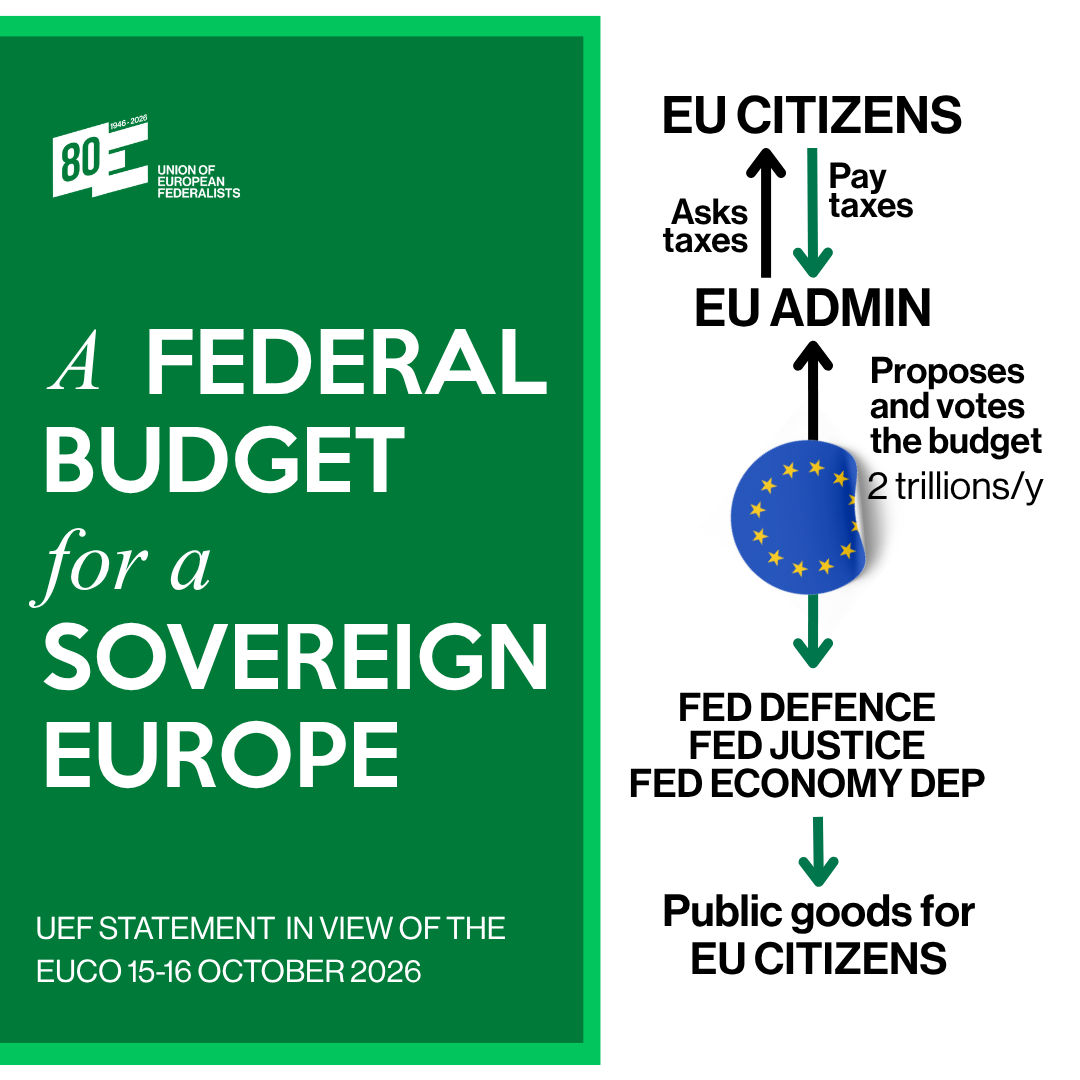
STATEMENT | A Federal Budget for a Sovereign Europe
The Union of European Federalists (UEF) sets out its position on the 2028–2034 Multiannual Financial Framework, own resources and a European fiscal capacity in view of the EUCO of 15-16 October 2026.
Europe is facing simultaneous geopolitical, economic, social, technological and climate challenges, while the Union is expected to provide security and defence, competitiveness, decarbonisation, social and territorial cohesion, support for Ukraine, resilient infrastructure and preparedness for future crises.
The budgetary starting point is the European Commission proposal of 16 July 2025 for a 2028–2034 Multiannual Financial Framework (MFF) of almost EUR 2 trillion in current prices, corresponding on average to 1.26% of EU gross national income (GNI), as well as the proposal for a new basket of own resources.
The European Parliament, in its interim position adopted in April 2026, called for 1.27% of EU GNI for Union programmes and for the costs of servicing NextGenerationEU (NGEU) debt, estimated at around 0.11% of GNI, to be financed over and above the MFF ceilings.
Once NGEU debt service is considered, the Commission proposal leaves substantially less fiscal space for Union policies than the headline figure suggests, at a time when new common responsibilities are becoming structural rather than temporary.
The UEF advocates an MFF that is at least 1.27% of EU GNI for Union policies, with NGEU debt service financed above the expenditure ceilings; in any event, the resources available for Union policies must not be lower in real terms than under the 2021–2027 MFF once NGEU is excluded, and the budget must evolve in line with new common responsibilities.
A flexible budget with a strong European character
The next MFF must combine adequate scale with greater flexibility and simplicity. A budget designed around too many rigid compartments is ill-equipped to react to shocks, technological change and shifting geopolitical priorities. Simplification should reduce administrative burdens and fragmentation while preserving democratic accountability, common European objectives and transparent control of results.
The budget architecture must be simpler and more flexible, with fewer unnecessary silos, adequate unallocated margins and crisis-response capacity, and the possibility to reallocate resources when circumstances change, subject to transparent criteria, parliamentary scrutiny and protection of the Union’s long-term objectives. Simplification must mean better European delivery, not weaker common policies or less democratic control.
National and Regional Partnership Plans (NRPPs) are not inherently a step towards renationalisation. If embedded in a strong common European framework, they can simplify delivery, improve flexibility and better connect reforms and investment. Their design must nevertheless safeguard the Union character of spending, the partnership principle, transparent milestones and targets, and a direct and meaningful role for regions and local authorities in programming, implementation and monitoring.
The UEF supports the use of NRPPs where they reduce fragmentation, administrative burden and overlapping instruments and where they strengthen the link between reforms, investment and measurable European objectives. However, they must not become predominantly national envelopes or bilateral arrangements between the Commission and central governments. They must preserve strong EU-level programmes and cross-border projects and guarantee an effective role for regions and local authorities, consistent with economic, social and territorial cohesion.
The next MFF cannot be designed as a zero-sum exercise in which defence and security are financed through disproportionate cuts to cohesion, the Common Agricultural Policy, research and innovation, the green and digital transitions, social investment or external action. Priorities must be reviewed and spending must be able to adapt, but genuinely new common responsibilities require additional common resources.
The UEF rejects a false arbitrage between established and new European priorities. Cohesion and the Common Agricultural Policy, defence and security, research and innovation, competitiveness, climate and energy investment, social policy and external action all contribute to European resilience. New priorities should be financed through additional common resources and stronger European added value rather than through systematic cannibalisation of existing policies.
Genuine own resources and democratic fiscal sovereignty
Article 311 TFEU provides that the Union shall provide itself with the means necessary to attain its objectives, while the present own-resources system remains dominated by national contributions and subject to unanimity and national approval, reinforcing net-balance calculations rather than a genuinely European budgetary debate.
A Union expected to provide European public goods must progressively acquire a genuine fiscal capacity: sufficient, stable and predictable own revenues; democratic control over both revenue and expenditure; and a permanent capacity to finance common investments and respond to major common shocks.
The MFF and the own-resources system are constitutional questions as much as budgetary ones: a Union that cannot decide democratically on the resources needed to carry out its common decisions cannot exercise full political sovereignty.
The UEF advocates a strong rebalancing of Union revenue away from GNI-based national contributions towards genuine own resources. The GNI-based resource should progressively return to being a residual balancing instrument rather than the dominant source of EU revenue.
The Council and the Member States should adopt the Commission's 2025 own-resources package as a minimum first step, while ending all rebates, lump-sum corrections and equivalent correction mechanisms, reducing retained collection costs for traditional own resources, and ensuring that new revenues are additional to - and do not substitute for - an adequately sized MFF.
The UEF advocates further genuine European own resources, assessed as a coherent basket according to sufficiency, stability, fairness, simplicity, progressivity where appropriate and a clear link to European policies or cross-border externalities. This roadmap should include policy-based options such as a European digital levy and a broad financial transaction tax, alongside revenues linked to the ETS, CBAM and other Single Market-based sources, while protecting households and SMEs from disproportionate burdens.
The European Parliament must have co-decision over the revenue side of the Union budget. New own resources should increasingly derive from European political decisions and flow to the Union budget because of genuine European added value, rather than merely relabelling national contributions.
Common investment and sustainable debt management
NGEU demonstrated the added value of common European borrowing in an exceptional crisis and that its debt service must not crowd out future Union programmes or be used as an argument for renewed austerity at European level.
The European Commission should develop, under full parliamentary control and sound debt-management rules, a permanent common borrowing capacity for clearly defined European public goods, strategic cross-border investment and responses to major common shocks.
The UEF advocates a sustainable and growth-friendly repayment strategy for NGEU debt. Debt service should remain outside the MFF programme ceilings and should be financed primarily through new own resources. The repayment profile should be smoothed over an appropriate long-term horizon, making full use of refinancing and active debt management so as to avoid excessive annual repayment peaks and the crowding-out of cohesion, competitiveness, defence, innovation and investment. As part of the development of a permanent European fiscal capacity, the Union should assess whether the current repayment horizon remains economically appropriate and adapt the relevant legal framework where justified.
One political package for a sovereign Europe
Expenditure, own resources and institutional reform must be negotiated as one political package. The European Union should not take on permanent new responsibilities while leaving their financing dependent on ad hoc national transfers and unanimous vetoes.
The European Council should activate the passerelle in Article 312(2) TFEU, allowing the Council to adopt the MFF regulation by qualified majority while preserving the European Parliament's consent under the current Treaties.
The Council should act on the European Parliament's request for Treaty change and to submit to the European Council the proposal to convene a Convention under Article 48 TEU. Treaty reform should replace unanimity in Article 311 TFEU with qualified majority voting, make the European Parliament an equal co-legislator on own resources and the MFF, and remove the requirement for unanimous national approval of the Own Resources Decision.
The European Parliament should use its consent power strategically and to make approval of the next MFF dependent on a balanced settlement comprising: an adequate real level of expenditure; NGEU debt service above the ceilings and a sustainable repayment profile; a credible package of new own resources; the abolition of rebates; a simpler and more flexible budget architecture that preserves cohesion and the role of regions; and a concrete institutional pathway towards majority decision-making and Treaty reform.
If unanimity continues to block necessary progress, the European Commission, the European Parliament and willing Member States should use all available Treaty mechanisms to advance fiscal integration among those ready to move forward, while keeping such initiatives open to all Member States and directed towards a stronger Union framework.
The institutions must not sacrifice the quality, democratic legitimacy or European character of the settlement for the sake of an artificial deadline. A timely agreement is desirable, but the objective must be a budget capable of financing the Union’s priorities from 2028 and of supporting an enlarged, more sovereign and more democratic Europe.
Europe must become the master of its own budget. A genuine European fiscal capacity, backed by democratic own resources, flexible common expenditure and common investment instruments, is indispensable if the Union is to provide the public goods, solidarity and strategic capacity that its citizens and its place in the world require.
Brussels, 13 October 2026