

EL 92 | The Europe That Does Not Decide
ITALIAN | FRENCH | GERMAN | GREEK | SPANISH | ROMANIAN
France and Germany are pushing to bring European diplomacy under the direct control of the Commission, while eleven countries are calling for an end to the national veto in foreign policy. Yet in her State of the Union address, von der Leyen chose to stay silent on the institutional reforms that could finally unlock the Union.
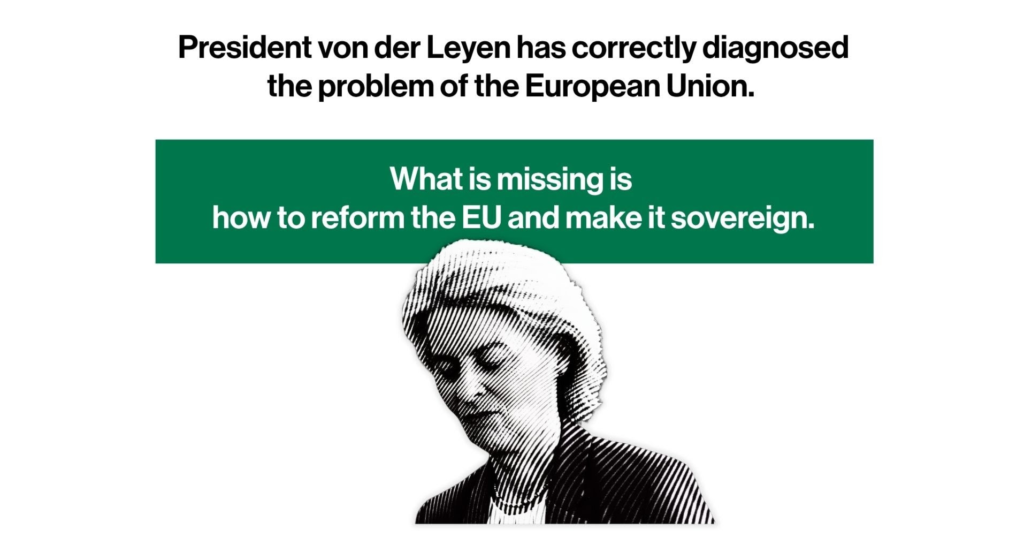
As Russia intensifies its vile attacks on Ukrainian cities, frustrated by its dismal results on the front, and Washington continues to turn its back on Europeans — amid the gradual withdrawal of US troops from the old continent and the arrival in Moscow and Kyiv of amateur envoys vainly trying to push for an appeasement with Putin — the European Union remains paralysed by its own hesitations, unable to rise to its responsibilities. As von der Leyen herself recalled in her latest State of the Union address, Europe is surrounded by internal and external enemies, driven by the goal of destroying the achievements of 80 years of integration and intent on reducing it to little more than a fractious, divided assembly of nations, led by leaderships ready to bow in vassalage to the great non-European empires.
In an increasingly dangerous world governed by predatory powers, in which citizens have lost faith in politics and perhaps in democracy itself, the solutions needed to allow the Union to hold firm are well known: extending social protections for the weakest, increasing investment for sustainable growth, placing limits on the overwhelming power of digital giants, addressing the unfolding environmental catastrophe, and securing its own defence through a unified system of deterrence. These are precisely the points von der Leyen touched on in her speech. And yet the President herself failed to mention the underlying issue that is the necessary precondition for effectively pursuing all these goals: overcoming the unanimity rule — that formidable dictatorship of the minority which subordinates the general interest of European citizens to the selfish needs of whichever national government happens to hold a veto.
Culpably, the President of the European Commission chose not to engage with the debate, already well under way, on the institutional reforms that can no longer be postponed. Proof of this can be found in two closely intertwined proposals that have emerged in recent months: the reform of the European External Action Service (EEAS) and the move beyond unanimity in foreign policy.
As for the EEAS, it is a body created in 2010 that aspires to become a sort of EU foreign ministry. It is a hybrid structure, half Commission, half Member States, whose main task, however, is to coordinate — not decide — national foreign policies. The High Representative who leads it, currently Estonia's Kaja Kallas, holds a “double-hatted” mandate: she is simultaneously Vice-President of the Commission and chair of the Foreign Affairs Council, the table where the foreign ministers of the twenty-seven sit. On paper, this dual nature should ensure coherence between the Community method and the intergovernmental one.
In practice it produces the opposite effect: Kallas speaks more on behalf of the governments than on behalf of the Union, and in effect becomes hostage to the most cautious among them, since every significant initiative of hers — from sanctions on Russia to military support for Kyiv — requires the unanimous agreement of twenty-seven capitals with very different interests, historical sensitivities and electoral constraints. For months France and Germany — with Emmanuel Macron and Friedrich Merz as political sponsors — have been pushing for a reform. The idea is to bring the EEAS, or part of its responsibilities, inside the Commission, under the direct supervision of Ursula von der Leyen. The official argument is efficiency: avoiding duplication between the Commission and the EEAS on development aid, the defence industry, enlargement and the neighbourhood policy. The less openly stated effect would be to concentrate power further in the hands of the Commission President, reducing Kallas to a role comparable to that of a foreign minister answering to a prime minister — with von der Leyen holding the final word.
The second proposal is the more significant one: extending qualified majority voting to foreign policy, today an almost absolute realm of unanimity. It is precisely on this terrain that, in early September, eleven countries — Austria, Belgium, Denmark, Finland, France, Germany, Luxembourg, the Netherlands, Romania, Spain and Sweden — signed a joint letter calling for an end to “obstructive vetoes” in foreign policy, proposing five principles: strengthening loyal cooperation among states, encouraging constructive abstention in place of an outright veto, preventing foreign policy decisions from being used as bargaining chips on unrelated files, exploring use of the passerelle clause provided for under Article 31 TEU, and admitting only “proven vital reasons” as grounds for blocking the move to majority voting.
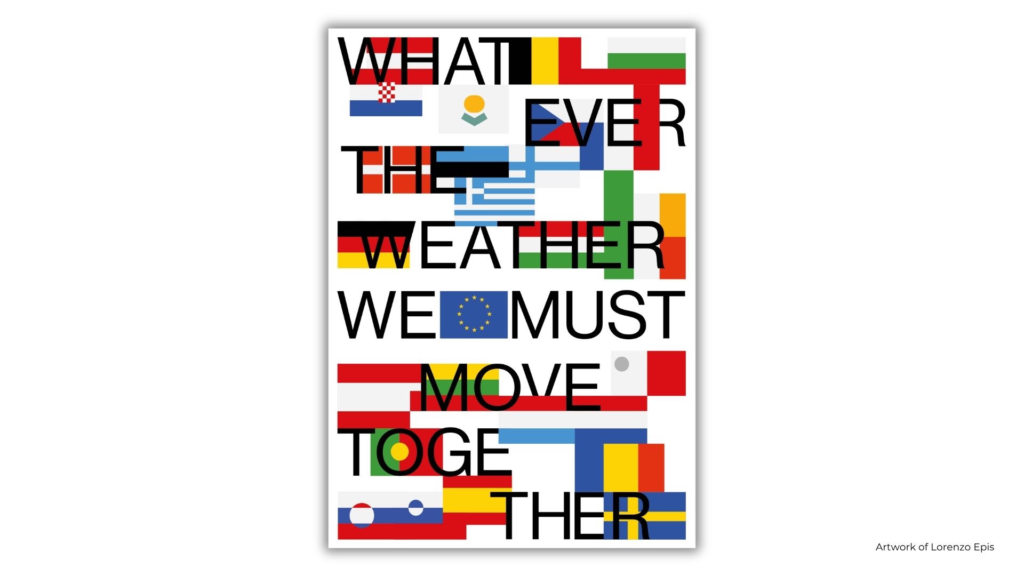
It is clear that a single voice in foreign policy is the indispensable condition for allowing Europe to build its own strategic autonomy: to respond to Donald Trump's arrogance, to act as one against Moscow, to finally hold a coherent and dignified position on the Middle East, without remaining at the mercy of others' decisions. Overcoming the veto in foreign policy would also carry a deeper meaning. It is in fact possible that, in a world increasingly dominated by power politics, foreign policy will reassert its primacy — in the sense that the urgent demands of security and survival in the face of external attacks will increasingly shape states' internal institutions, rather than the other way around. In the case of the European Union, a single foreign policy would be a springboard for further federal developments of the organisation, from building fiscal capacity, to the effective and humane management of migration policy, to industrial policy for competitiveness.
The choice is clear, and so are the consequences. On one side, Europe's enemies want to block any reform, knowing that time is on their side: the prolonging of European immobility will inevitably lead to a progressive weakening of the Union, until the victory of eurosceptic forces in key countries delivers the final blow to the integration process.
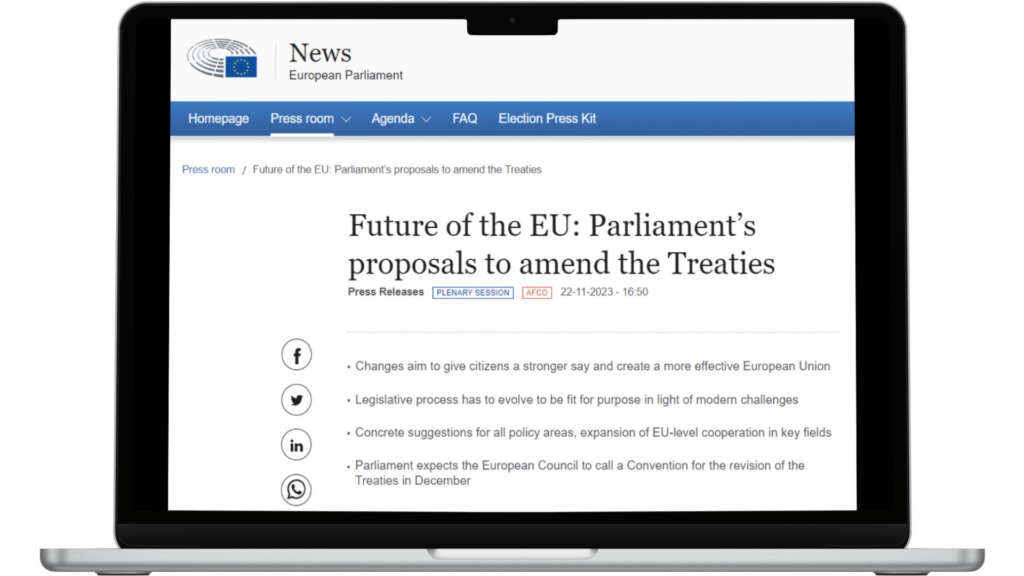
On the other side are the federalist forces, aware that a qualitative leap in the integration process is unavoidable if the Union still wants to have a future. Caught in between are many of the pro-European forces still in government in various Member States, and the European Commission itself. It was, in this respect, dispiriting that in her State of the Union address, von der Leyen, for all her ambitious tone on common defence and the need to “stand united,” glossed over the issue of institutional reforms, proposing yet another symbolic exercise — this time a “Congress of Europe” for the seventieth anniversary of the Treaty of Rome — while the conclusions of the Conference on the Future of Europe, and the subsequent calls for Treaty reform put forward on that basis by the European Parliament, remain unaddressed.
There is also a political window that makes this immobility particularly costly. The defeat of Viktor Orbán in Hungary in April 2026 removed — at least temporarily — one of the most systematic and predictable vetoes in the Council, opening up room for manoeuvre that is unlikely to stay open for long: should Marine Le Pen win the French presidential election in 2027, the entire negotiating architecture on which Paris and Berlin are building these proposals would collapse, and with it, probably, any chance of reform for years to come.
Finally, it must be stated clearly that the EEAS reform and the extension of majority voting are not isolated negotiations: they are inevitably intertwined with other files being decided in the same period. The 2028-2034 Multiannual Financial Framework, with the Commission's proposal to double the funds earmarked for Ukraine and significantly increase common defence spending, is the ground on which the real willingness of states to finance the geopolitical ambition they speak of at summits will be tested. Long-term support for Kyiv — which requires multiannual commitments difficult to reconcile with a veto renewable every six months — is another direct test of the inadequacy of unanimity. And emancipation from the United States on rearmament, with initiatives for European industrial defence capacity, can never be complete if every joint procurement, every mission, every sanction remains hostage to whichever government is most reluctant at the time.
The fundamental question, then, is not technical but political: does Europe truly want a foreign policy capable of deciding in real time, or does it prefer to go on coordinating its national policies with its usual slowness, hoping that external threats — Russian, American, or both — will be courteous enough to wait for Brussels to reach an agreement?

The European Letter is published in 7 languages under the auspices of the Luciano Bolis European Foundation in cooperation with the Union of European Federalists.