European Union: Autonomous Actor or Vassal? Debates on artificial intelligence, monetary policy, and fiscal integration
25/04/2026
News & Comment
Italy, UEF, UEF Sections
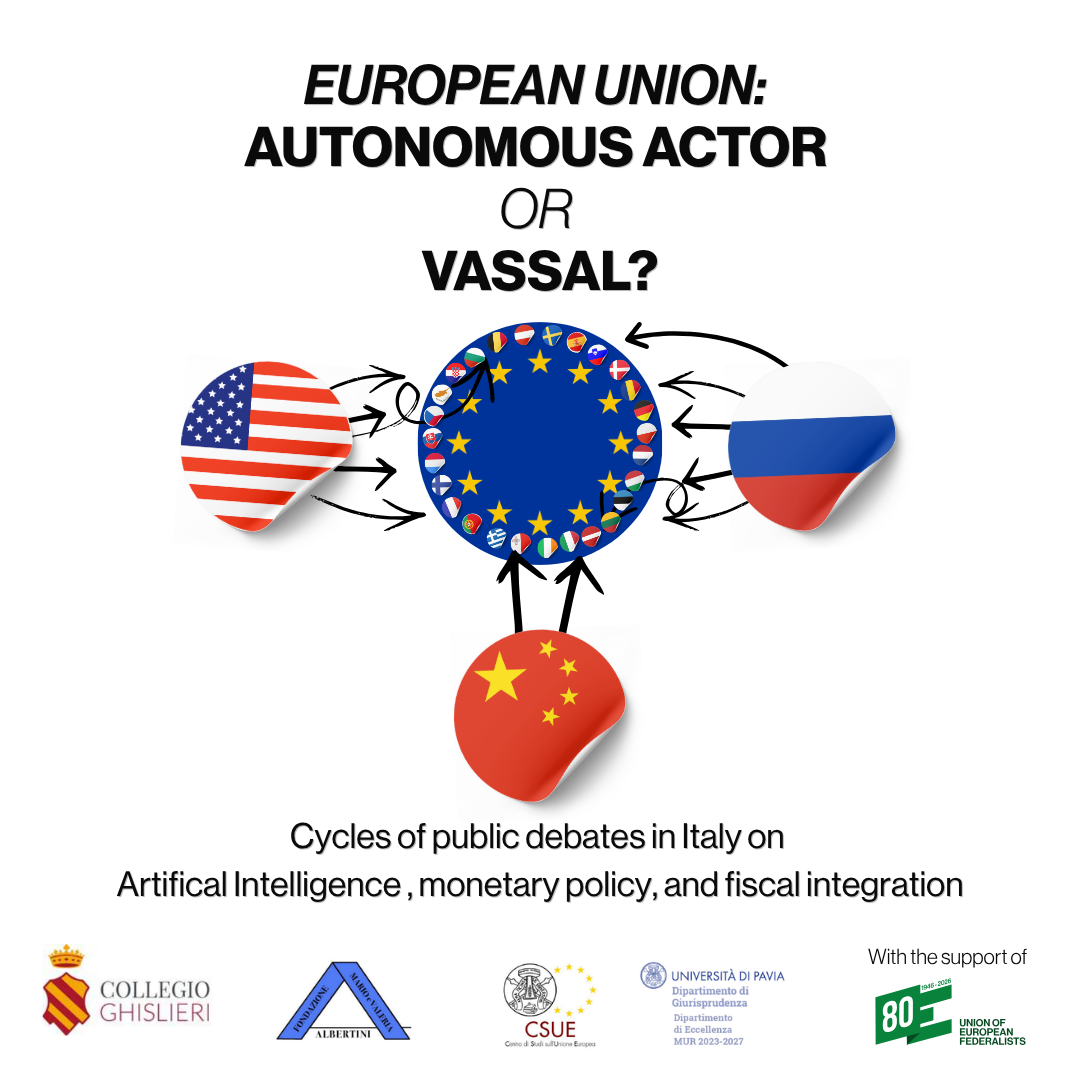
Thanks to the initiative of Giulia Rossolillo, Vice-President of the Union of European Federalists, the Fondazione Mario e Valeria Albertini, in cooperation with the Department of Law of the University of Pavia, Collegio Ghislieri, and the Centre for Studies on the European Union (CSUE), organized a cycle of three public debates entitled “European Union: Autonomous Actor or Vassal?”.
The events, hosted in the Aula Goldoniana of Collegio Ghislieri in Pavia, aimed to address a crucial question: can the European Union act as a truly autonomous global actor, or does it remain structurally dependent on external powers?
As outlined in the official programme , the cycle covered three key dimensions of European sovereignty: artificial intelligence, monetary policy, and fiscal integration.
First Debate: The Ethical Dimension of Artificial Intelligence
The first meeting, held on 31 March at Collegio Ghislieri, featured Giuliano Noci (Politecnico di Milano) and addressed “The True Ethical Dimension of Artificial Intelligence.” The debate, moderated by Giulia Rossolillo, opened a broader reflection on the systemic impact of artificial intelligence on contemporary society.
Article based on this event
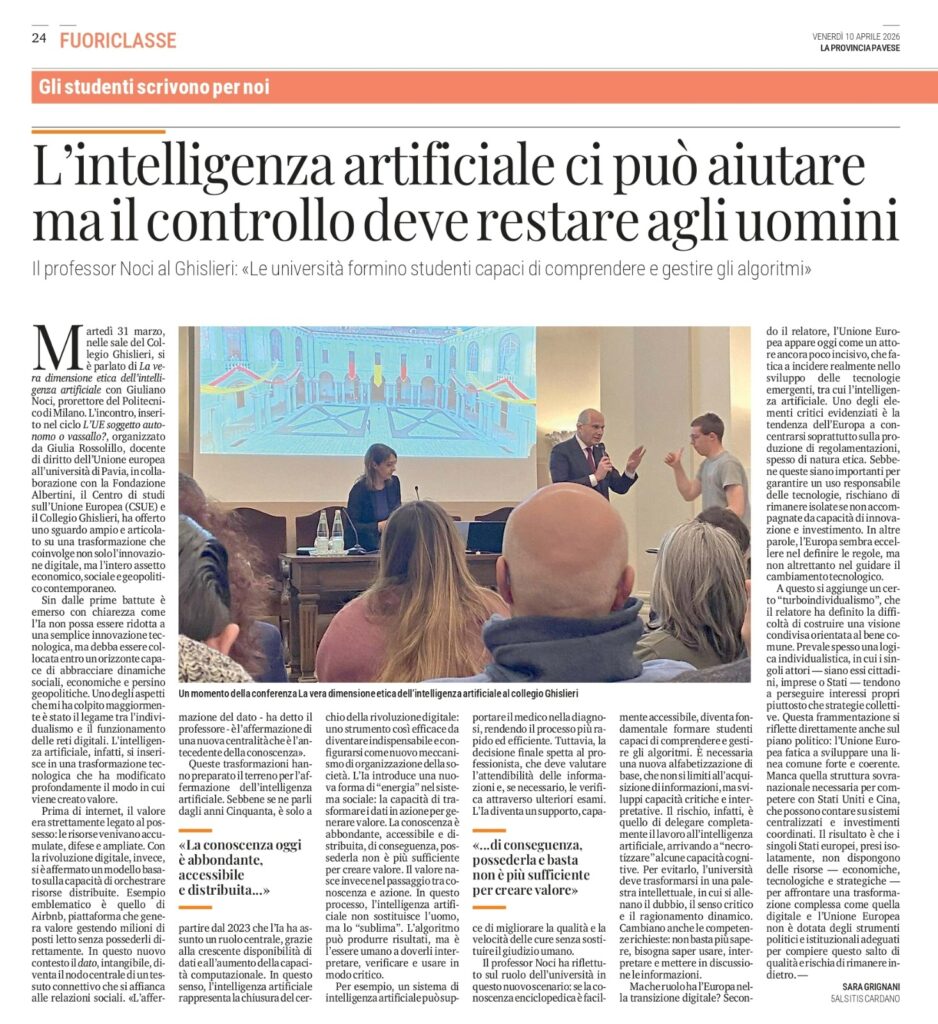
Artificial intelligence can help us, but control must remain in human hands
Professor Noci at Ghislieri: “Universities must train students capable of understanding and managing algorithms”
On Tuesday, March 31, at Ghislieri College, a discussion was held on The True Ethical Dimension of Artificial Intelligence with Giuliano Noci, vice-rector of the Polytechnic University of Milan. The meeting, part of the series The EU: autonomous actor or vassal?, organized by Giulia Rossolillo, professor of European Union law at the University of Pavia, in collaboration with the Albertoni Foundation, the Center for European Union Studies (CSUE), and Ghislieri College, offered a broad and detailed perspective on a transformation involving not only digital innovation, but the entire contemporary economic, social, and cultural framework.
From the very beginning, it became clear that AI cannot be reduced to a simple technological innovation, but must instead be understood within a broader horizon embracing social, economic, and even geopolitical dynamics. One of the aspects most emphasized by the speaker was the relationship between individualism and the functioning of digital networks. Artificial intelligence is part of a technological transformation that has profoundly changed the way value is created.
Before the internet, value was closely tied to ownership: resources were accumulated, defended, and expanded. With the digital revolution, however, a model emerged based on the ability to orchestrate distributed resources. A symbolic example is Airbnb, a platform that generates value by managing millions of beds without directly owning them. In this new context, data — intangible in nature — becomes the central node of a connective network intertwined with social relationships.
“Knowledge today is abundant, but distributed…”
The speaker’s point was clear: “Information alone is no longer sufficient.” These transformations prepared the ground for the rise of artificial intelligence. Although AI has been discussed since the 1950s, it is only from 2023 onward that it has taken on a central role, mainly thanks to data availability and increased computational capacity. In this sense, artificial intelligence represents the completion of the digital revolution: a tool so effective that it becomes indispensable and acts as a mechanism for organizing society.
AI introduces a new form of “energy” into the social system: the ability to transform data into action in order to generate value. Knowledge is abundant, accessible, and distributed; therefore, merely possessing it is no longer enough to create value. Value instead comes from recognizing the hidden and relational meaning of data, and from being able to interpret and use it.
For example, an artificial intelligence system can assist a doctor in diagnosis, making the process faster and more efficient. However, the final decision belongs to the professional, who must evaluate the reliability of the information and, if necessary, verify it through further examinations. AI thus becomes a support tool, capable of improving the quality and speed of healthcare without replacing human judgment.
Professor Noci also reflected on the role of universities in this new scenario: if encyclopedic knowledge is easily accessible, it becomes essential to train students capable of understanding and managing algorithms. A new basic form of literacy is needed — one that does not stop at acquiring information, but develops critical and interpretative skills. The risk, in fact, is that the use of new technologies may generate cultural dependence and a progressive loss of critical autonomy.
But what role does Europe play in the digital transition? According to the speaker, the European Union currently appears to be a still weak and not very influential actor, struggling to truly shape the development of emerging technologies, including artificial intelligence. One critical aspect highlighted was Europe’s tendency to focus mainly on producing regulations, often of an ethical nature. Although these are important for ensuring the responsible use of technology, they risk remaining isolated if not accompanied by innovation and investment capacity.
In other words, Europe seems to excel at defining rules, but not equally at leading technological change. Added to this is a certain “turbo-individualism,” which the speaker described as the difficulty of building a shared vision oriented toward the common good. An individualistic logic often prevails, in which actors — whether citizens, companies, or states — tend to pursue particular interests rather than collective strategies. This fragmentation is also directly reflected at the political level: the European Union struggles to develop a strong and coherent common direction.
What is lacking is the supranational structure necessary to compete with the United States and China, which can rely on centralized systems and coordinated investments. As a result, individual European states, taken separately, do not possess the economic, technological, and strategic resources needed to face a complex transformation such as the digital one. Furthermore, the European Union itself lacks the political and institutional tools required to make this leap in quality, and therefore risks falling behind.
Sara Grignani 5ALS itsi Cardano
Second Debate: European Monetary Sovereignty and the Digital Euro
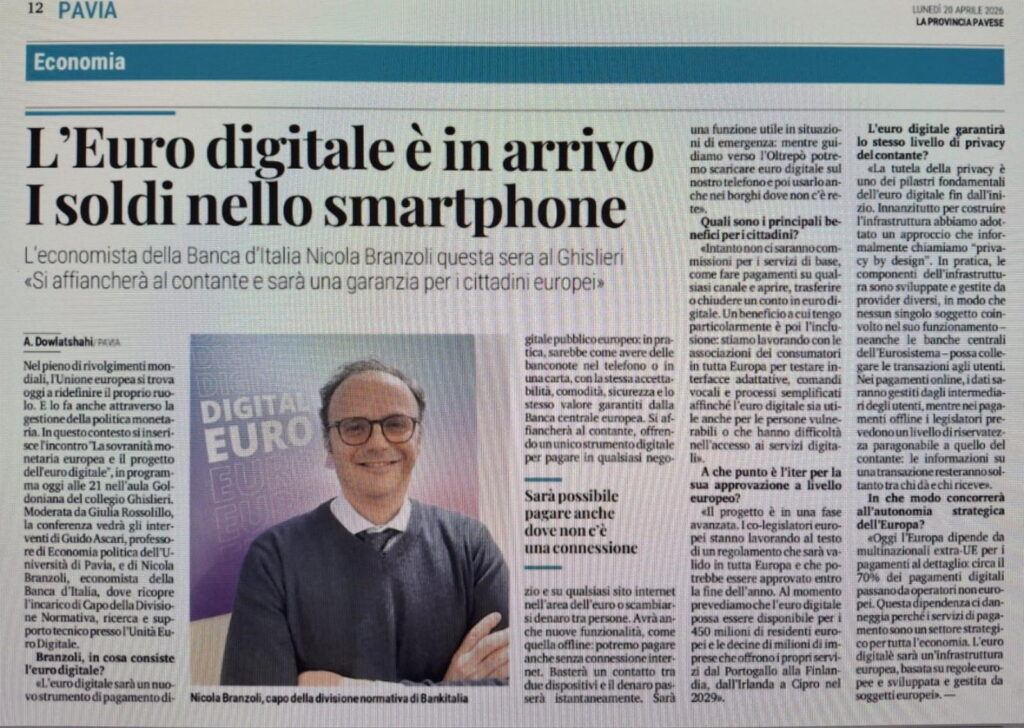
The second meeting, held on 20 April, featured Guido Ascari (University of Pavia) and Nicola Branzoli (Banca d’Italia), focusing on “European Monetary Sovereignty and the Digital Euro.”
The discussion framed the digital euro as a strategic tool for strengthening European autonomy in payments and finance.
Articles based on this event
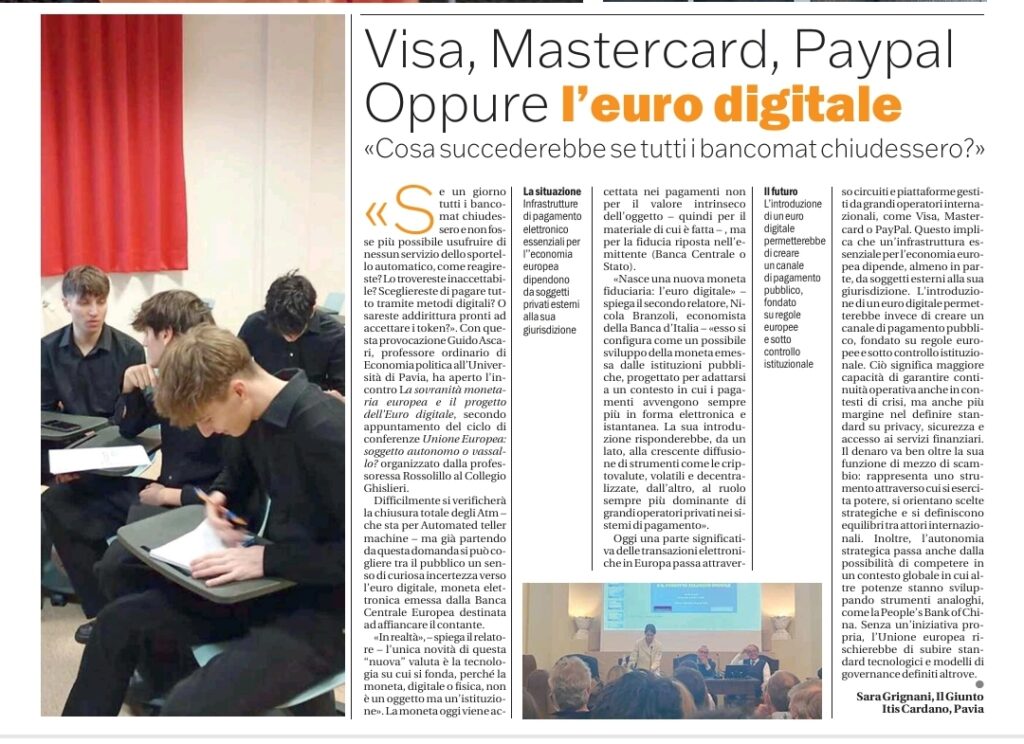
Visa, Mastercard, PayPal Or the Digital Euro “What would happen if all ATMs shut down?”
“What if one day all ATMs shut down and it was no longer possible to use any cash machine service? How would you react? Would you find it unacceptable? Would you choose to pay exclusively with digital methods? Or would you even be ready to accept tokens?” With this provocative question, Guido Asperti, professor of Political Economy at the University of Pavia, opened the meeting European Monetary Sovereignty and the Digital Euro Project, the second event in the conference series European Union: autonomous actor or vassal? organized by Professor Rossillo at Ghislieri College.
A complete shutdown of ATMs — Automated Teller Machines — is unlikely to occur, yet this question already reveals among the audience a sense of curious uncertainty toward the digital euro, an electronic currency issued by the European Central Bank intended to complement cash.
“In reality,” the speaker explained, “the only novelty of this ‘new’ currency is the technology on which it is based, because money, whether digital or physical, is not an object but an institution.” Today, money is accepted in payments not because of the intrinsic value of the object — that is, the material it is made of — but because of the trust placed in the issuer (the Central Bank or the State).
“A new fiduciary currency is emerging: the digital euro,” explained the second speaker, Nicola Branzoli, economist at the Bank of Italy. “It is taking shape as a possible evolution of money issued by public institutions, designed to adapt to a context in which payments are increasingly electronic and instantaneous. Its introduction would respond, on the one hand, to the growing spread of instruments such as cryptocurrencies, which are volatile and decentralized; and on the other hand, to the increasingly dominant role of large private operators in payment systems.”
Today, a significant share of electronic transactions in Europe passes through networks and platforms managed by major international operators such as Visa, Mastercard, or PayPal. This means that an infrastructure essential to the European economy depends, at least in part, on entities outside its jurisdiction. The introduction of a digital euro would instead make it possible to create a public payment channel, based on European rules and under institutional control. This would mean a greater ability to guarantee operational continuity even in times of crisis, as well as more room to define standards concerning privacy, security, and access to financial services.
Money goes far beyond its function as a medium of exchange: it represents a tool through which power is exercised, strategic choices are directed, and balances among international actors are defined. Moreover, strategic autonomy also depends on the ability to compete in a global context where other powers are developing similar instruments, such as the People’s Bank of China. Without its own initiative, the European Union would risk having to accept technological standards and governance models defined elsewhere.
Sara Grignani, Il Giunto ITIS Cardano, Pavia
Third Debate: European Debt and the Future of the Union
The final meeting, scheduled for 28 April, featured Massimo Bordignon (Università Cattolica del Sacro Cuore) and will address “European Debt and the Future of the Union.”
The discussion tackeld one of the most politically sensitive issues for European integration:
“Common debt is not only an economic instrument — it is a step toward political union.”
Conclusion
Across all three debates, a clear message emerged: European autonomy requires deeper integration and stronger coordination.
“The question is no longer whether Europe should act together, but whether it can afford not to.”
The cycle highlighted how technological, monetary, and fiscal sovereignty are interconnected dimensions of a broader political challenge.
Ultimately, the initiative reaffirmed a core federalist insight:
“Without unity, Europe risks remaining a global vassal rather than becoming a true autonomous actor.”