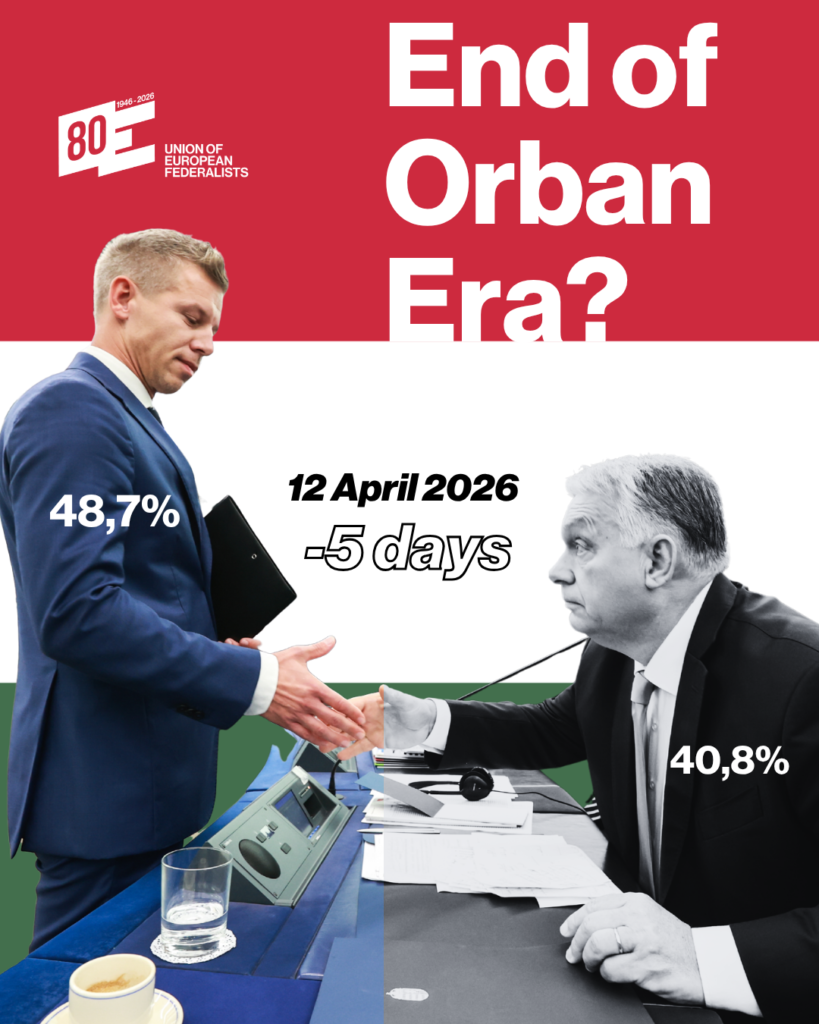
PR | UEF welcomes democratic change in Hungary and calls for rapid EU action on Ukraine and institutional reform
Brussels, 13 April 2026
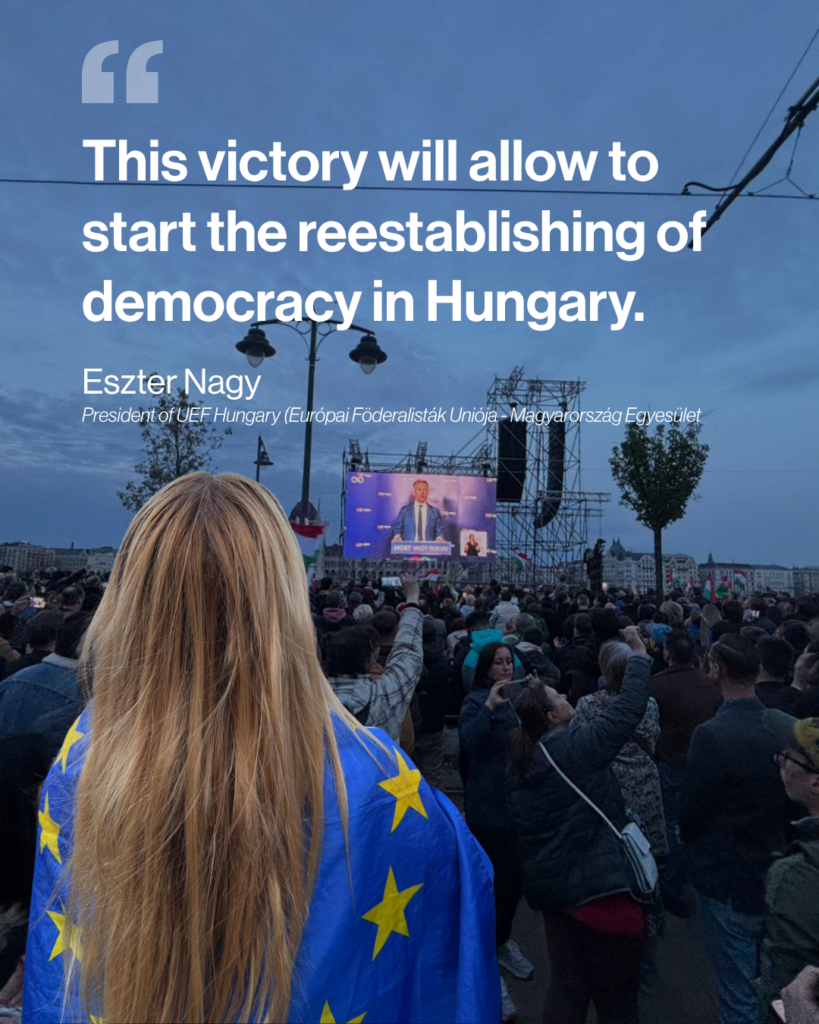
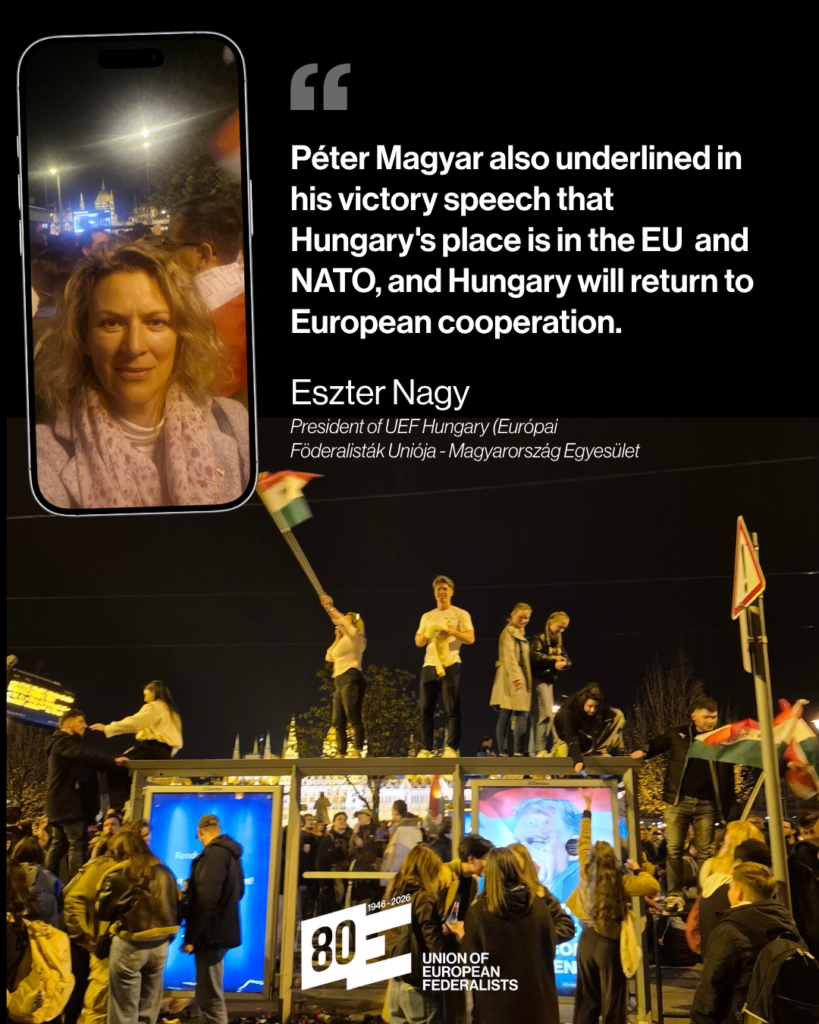
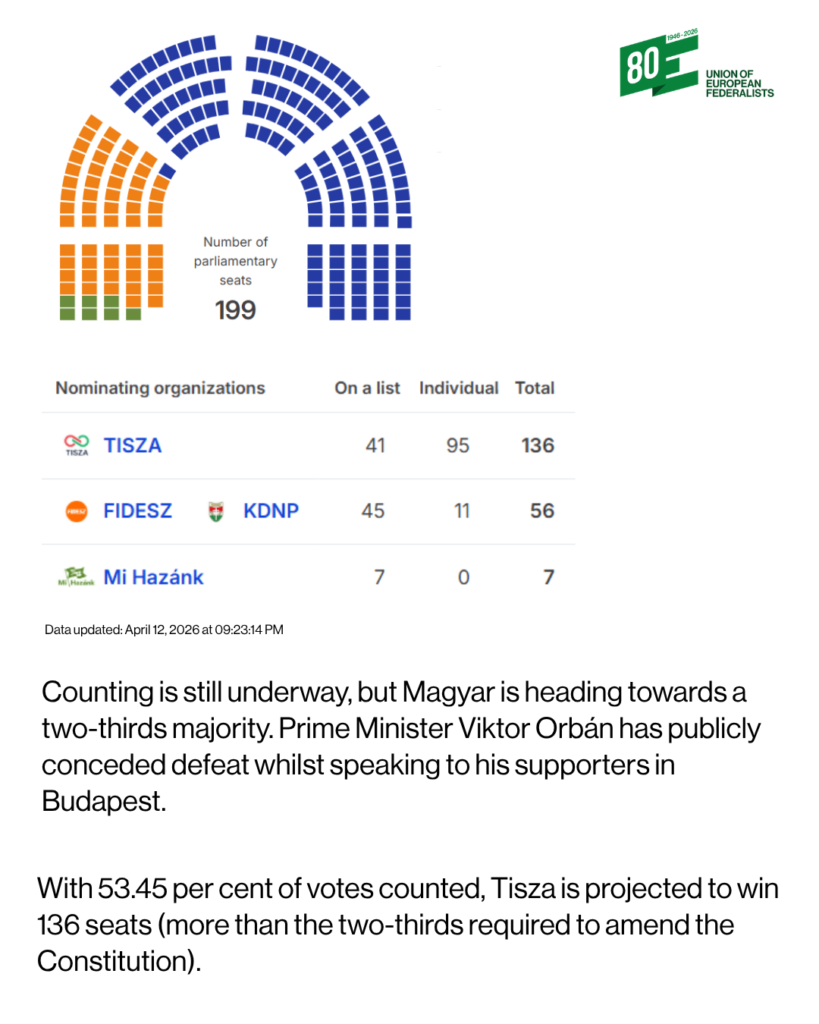
The Union of European Federalists (UEF) warmly welcomes the outcome of the Hungarian parliamentary elections of 12 April 2026. We congratulate the winner and next Prime Minister Peter Magyar and the Hungarian people for their democratic engagement, for reaffirming their commitment to European values, the rule of law, and solidarity with the rest of the Union.
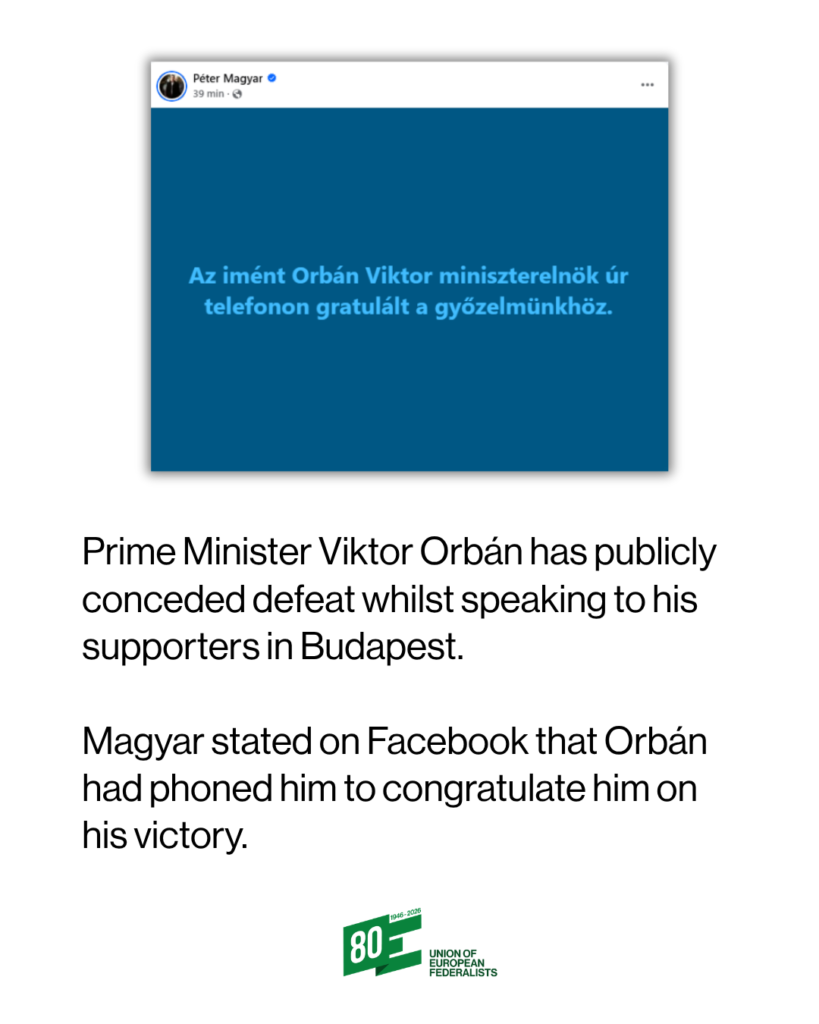
The resounding defeat of Viktor Orbán constitutes an extremely positive and timely development not only for Hungary, but for Europe as a whole, and for Ukraine. At a moment when the European Union must demonstrate unity and resolve in the face of Russia’s ongoing aggression and US threats against their commitment in the transatlantic Alliance, the prospect of constructive engagement from Budapest represents a significant step forward, after all these years of obstruction by Orbán and his violations of the principle on loyal and sincere cooperation, including sharing information and coordinating his actions with Putin.
Therefore, the UEF urges the incoming Hungarian government to lift its predecessor's vetoes, and on the European institutions—most notably the Council—to act without delay, once the new Hungarian government takes office, to:
- adopt the €90 billion financial assistance package for Ukraine, ensuring sustained macro-financial support and reconstruction capacity;
- approve the 20th package of sanctions against Russia, reinforcing the Union’s economic and political pressure on the Kremlin.
At the same time, the UEF stresses that the structural weaknesses of the Union’s decision-making system remain unchanged. The end of a single obstructionist government does not resolve the systemic risks associated with unanimity in the Common Foreign and Security Policy (CFSP) and other key areas.
Therefore, the UEF identifies a window of opportunity between now and the French presidential elections of April 2027 to advance decisive institutional reforms. In particular, the European Council should:
- agree to activate the passerelle clauses provided for in the Treaties to extend qualified majority voting in CFSP and budgetary and financial matters, among others, and if unanimity is lacking, proceed with enhanced cooperations.
- agree to activate Article 42.2 TEU on establishing European Common Defence, and if unanimity is lacking, proceed under Permanent Structured Cooperation.
- follow up on the European Parliament’s proposals for Treaty revision under Article 48 TEU.
Europe must not rely on favourable political contingencies to function effectively. It must endow itself with the institutional tools necessary to act decisively, regardless of national political cycles.
The UEF stands ready to support all efforts aimed at strengthening the Union’s unity, democratic legitimacy and capacity to act.
Domènec Ruiz Devesa , President and MEP 2019-2024
Mathilde Baudouin , Secretary General