Alexandre Météreau, Policy Officer of the UEF and EU influencer Quentin Deschandelliers, aka MEPassistant (@mepassistant) will comment on the SOTEU speech 2023 with interventions from Domenec Ruiz Devesa MEP, President of the UEF, and Sandro Gozi MEP, Chair of the Spinelli Group.
Just a few hours after the State of the European Union address by the President of the European Commission, a group of European parliamentarians led by Guy Verhofstadt, board member of the Spinelli Group, presented in a press conference a draft report calling for Treaty Change.
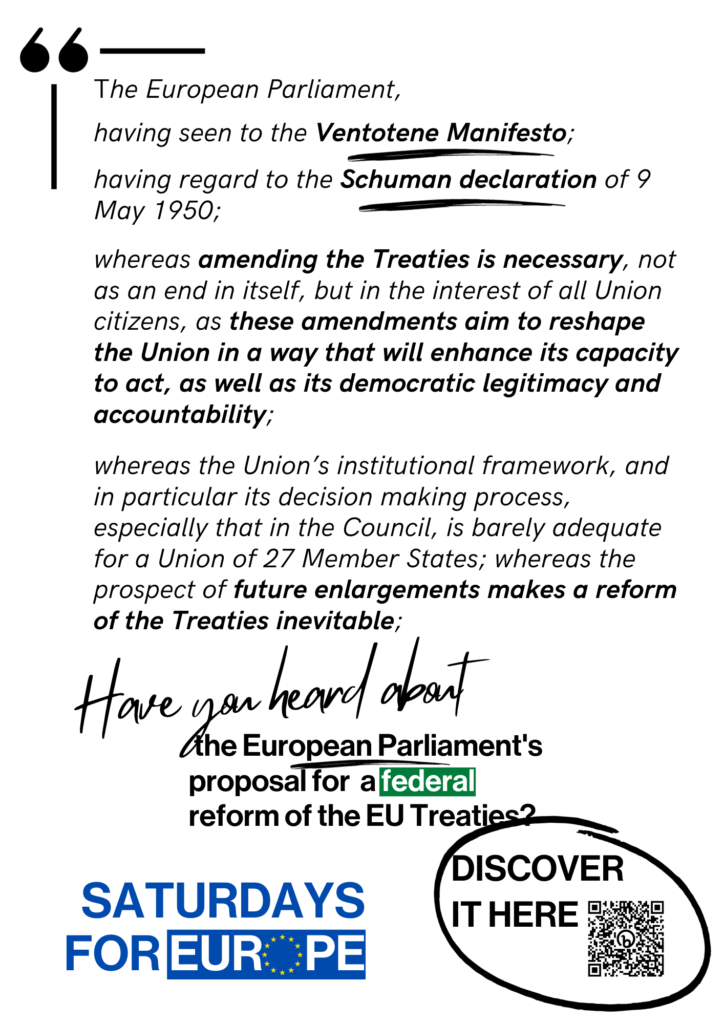
Although the text will need the approval of the European Parliament’s Institutional Affairs Committee (AFCO), the political consensus of the report makes it a great proposal to initiate a Convention that will draft the new European treaties.
During her SOTEU address, European Commission President Ursula von der Leyen endorsed the need for Treaty Change through a Convention. Yet, she failed to encourage the European Council to rise to the challenge. She also claimed that the enlargement of the Union to the Western Balkans and Ukraine should not wait for Treaty reform.
The Federalists disagree with this approach. We believe that enlargement calls for deep institutional reforms. The European Union cannot work with more than 30 members with the institutions it has today.
In a live stream organised by the UEF on Wednesday, Domènec Ruiz Devesa MEP, President of the UEF, said "There is a double message from Ursula von der Leyen. On one hand enlargement and deepening go hand in hand, and on the other she puts conditions on deepening—for us federalists, there can be no ‘if’.”
Context
Every year, the President of the European Commission gives the State of the European Union (SOTEU) address, where she underlines the upcoming priorities for the European executive. This year’s SOTEU, on Wednesday 13 September, was the last one before the European elections of 2024.
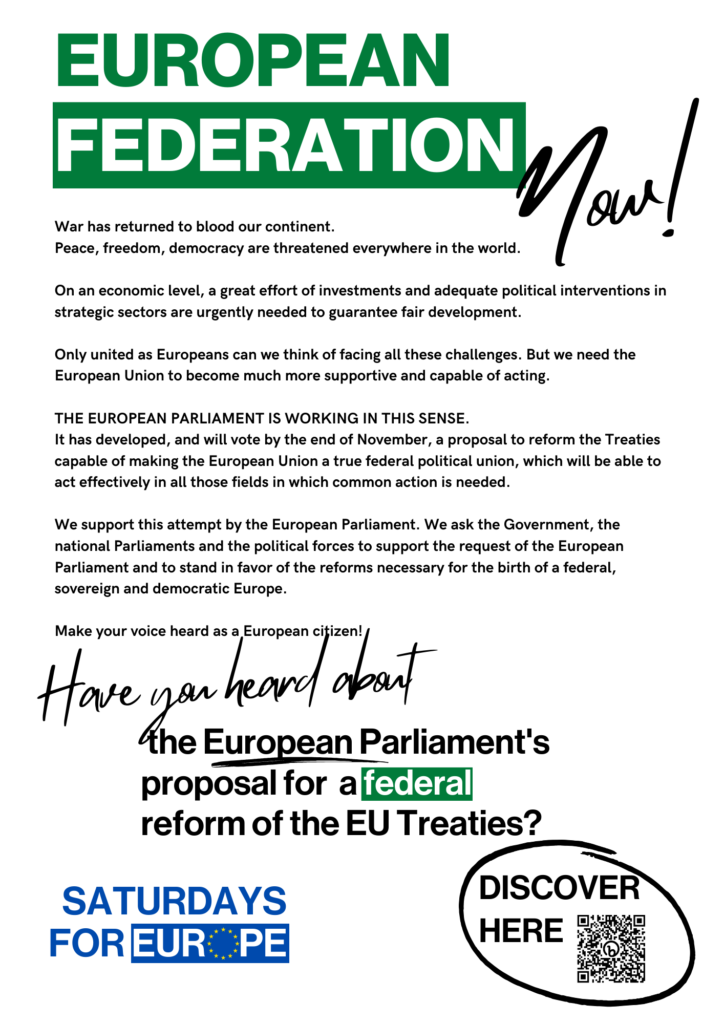
Later that day, a group of Members of the European Parliament led by Guy Verhofstadt presented a draft report calling for Treaty Change. This report will be put to a vote at the European Parliament’s Institutional Committee in September, then to the Plenary in November 2023.
Listen here the debate on video
Reaching its 42nd edition, the Training Seminar, organised by the Municipality of Ventotene in collaboration with the Spinelli Institute and under the patronage of the Province of Latina (Italy), was a new opportunity for in-depth analysis and comparison about the European themes. In recent years, the island of the Manifesto of Ventotene has seen the passage of many new ideas for improving our common path of European integration and for the federalist training of thousands of young people.
On Sunday, 3 September at 5 p.m. in the Terracini Polyvalent Hall, the seminar was opened with a double panel of guests, chaired by Stefano Castagnoli, President of the Spinelli Institute and of Movimento Federalista Europeo, dedicating the speeches to the path marked by the Conference on the Future of Europe and to the proposals that the European Parliament has supported vis-à-vis the Council for the reform of the EU treaties. Present, together with representatives of the municipality, Mayor Caputo, and of the provincial administration, Marco Tomeo, were MEPs Domenec Devesa (President of the European Union of Federalists), Brando Benifei and Fabio Massimo Castaldo, all committed to promoting the positions for a European convention that takes into account the results that the citizens' representatives in the Cofoe have elaborated. Together with the other guests Luisa Trumellini, UEF Vice-President and MFE National Secretary, Antonio Argenziano, JEF President, Matteo Gori, GFE National Secretary, Pier Virgilio Dastoli, President European Movement Italy, Federica Onori, Italian Parliamentary Delegate to the OSCE Assembly, and Gabriele Panizzi, Vice-President Spinelli Institute, a complete picture of the world of institutions and associations fighting for more democracy in a federal sense in Europe was outlined.
The large number of participants at the international seminar (the 39th edition this year) brought enthusiasm with 130 young forces ready to 'stimulate', even after the seminar was over, the construction of a healthy European civic consciousness. The international seminar itself was again enriched this year by the participation of young globalists and the contribution and cooperation of JEF Europe.
During the opening session, the Antonio Saggio Prize, now in its ninth edition, was awarded to Lorenzo Giovanni Melli Merisi by his son Fabrizio Saggio.
The training seminar this year was also complemented by important events thanks to the memory work that organisations such as the Italian Post Office undertake with their philatelic campaigns. In fact, a special cancellation and a commemorative postcard were presented by the Italian Post Office "MFE80" on the occasion of the 80th anniversary of the founding of the European Federalist Movement and the 42nd edition of the seminar, and an exhibition, "The flag of Europe", the result of a European competition on the values represented by the European flag, which saw the winner Julianne Vella awarded a scholarship for participation in the international seminar.
As every year, tribute was paid to Altiero Spinelli and Luciano Bolis at the Ventotene cemetery.
The seminar featured eight training sessions devoted to the most important themes of European history and institutions, including the great project that was, and is, the Manifesto for a Free and United Europe, the Ventotene Manifesto. The sessions were also dedicated to current issues related to international peace and defence and the necessary reforms for a strategic European autonomy; a specific session was confirmed thanks to the collaboration with the Istituto Affari Internazionali, the Centre for Studies on Federalism and the Einaudi Foundation.
The collaboration with the Trentino De Gasperi Foundation, the Jean Monnet House in Bazoches (Paris) and the Robert Schuman Foundation in Luxembourg is also an important step towards European education, with a meeting held in Ventotene itself in the Council Chamber in the presence of Deputy Mayor Pepe and representatives of the founding fathers' houses, reinforced by experiences such as that of an international seminar held on an experimental basis at the Monnet House last May with the 'Ventotene-Houjarray School' (born from the collaboration between the Spinelli Institute and the Jean Monnet House itself and Eurom). During the training days, the scholarship dedicated to Luigi Vittorio Majocchi was awarded to Francesco Maiolo and, thanks to the contribution of Arci Solidarietà, which presented the "Words of Europe" project financed by the European Union, a scholarship was awarded to Edoardo Pecene. Another scholarship, thanks to the contribution of CGIL, was awarded to Giulia Apuzzo.
In addition to the scheduled speeches on the opening day, the UEF collaborated with the Istituto Spinelli in the realisation of the International Seminar programme with several speeches:
- Luisa Trumellini and Domenec Ruiz Devesa spoke on 4 September in the session "The relevance of the Ventotene manifesto and federalism for the future of the EU".
- Carlo Maria Palermo, PC 4 chair, spoke on 5 September morning on 'Europe facing the return of the war".
- Dafne Gogue, EB member spoke on 5 September on "Federalism to govern globalisation: from international anarchy to common institutions and cooperation".
- Giulia Rossolillo, EB member, and Davide Negri, Communication advisor of UEF, spoke on 7 September in the session on "Elections and beyond: Federalist proposals and campaigns for Treaty Reform".
The seminar concluded on 8 September with a round table entitled 'The role of local and regional authorities and Italy in the process of European integration'. After the institutional speeches by Carmine Caputo, Mayor of Ventotene, and Luca Magliozzi for the Province of Latina, and the Lazio Region with a message by Emanuela Mari, President of the Commission for European Affairs of the Lazio Regional Council, the speeches by Pina Picierno, Vice-President of the European Parliament, followed, coordinated by Mario Leone, Director of the Spinelli Institute, Stefano Castagnoli, President of MFE, Gianluca Bonato, President of GFE, Manuela Bora, former delegate to the Conference on the Future of Europe, Massimiliano Smeriglio, Member of the European Parliament, Francesco Zarzana, Vice-President of ALDA European Association for Local Democracy, Chiara Alicandro, European Citizens Ambassador to COFOE, Marco Gheller, Chanoux Foundation Institute for Federalist and Regional Studies. At the end of the round table, there was a discussion forum of the seminar participants coordinated by the GFE on issues and ideas for the future of Europe. Finally, the annual 'Altiero Spinelli' Journalist Award was presented to Adriana Cerretelli, columnist for Il Sole 24 ore. Council Vice-President and Minister of Foreign Affairs Antonio Tajani sent a message recalling how 'the participation of the younger generations in initiatives such as today's is crucial, because Europe is concretely built starting from communities and citizens'.
This report is done by Mario Leone and Davide Negri
In the context of Europe Forum in Turku, the Finnish section of the Union of European Federalists has organized a Federalist gathering on Thursday 31 August from 17:00 to 19:00, at the restaurant Cindy, Itäinen Rantakatu 19.
The event is organized in cooperation with the Union of European Federalists and Finnish Energy Industries.
There have been interventions by:
- Ms Verana Kaun, president of UEF-Finland
- Mr Antti Kohopää, head of EU affairs, Finnish Energy Industries
- Ms @juttaurpilainen, Member of the European Commission
The event has been an occasion for all the Federalists to gather together, meet and discuss ways to promote deeper EU integration and a federal democratic Europe in the public debate.


The Executive Bureau of the Union of European Federalists (UEF) appointed on 3 August, Domènec Ruiz Devesa, Member of the European Parliament, as President ad interim, following the departure of Sandro Gozi. Prior to this nomination, Domènec Ruiz Devesa held the position of Vice-President of the UEF.
Under Sandro Gozi’s leadership, the UEF participated at the Conference on the Future of Europe, re-launched its collaboration with the Spinelli Group, the European Parliament's intergroup of federalist-minded MEPs, and put forward several political actions culminating in this year's Treaty Reform Now! campaign, collecting more than a thousand signatures from EU political leaders, elected officials, and representatives of the European Civil Society.

Domènec Ruiz Devesa saluted his predecessor’s achievements: “Sandro Gozi, a true Federalist, did the utmost to improve the UEF and advance its agenda. I know our personal friendship will endure and it is my commitment to continue to cooperate with the European Parliament and the Spinelli Group.”
The UEF remains committed to the advancement of a federal, sovereign and democratic Europe, notably through:
- The negotiations on the reform of the EU electoral law and the composition of the European Parliament after 2024, for which Domènec Ruiz Devesa and Sandro Gozi are reporting on the European Parliament’s behalf,
- The upcoming AFCO report calling for a Convention for the reform of the treaties,
- The preparation for the upcoming European elections.
Background
The Union of European Federalists (UEF) is a pan-European, non-governmental political organisation dedicated to the promotion of European political unity since 1946. We believe that completing European political unity is required to ensure Europe’s economic prosperity and strength. The UEF calls for a European democracy where all citizens can determine the policies of a European government. The UEF promotes a federal, sovereign and democratic Europe.
The European Union (EU) has been a driving force for economic integration and stability among its member states. However, the current EU budget system faces significant challenges, including uneven contributions and structural inefficiencies. To address these issues and strengthen the EU, this video delves into the history of EU financing, examines the problems with the EU budget today, and explores the potential benefits of a fiscal union. By analyzing these aspects, we can work towards a more cohesive and sustainable future for the European Union and its member states.
This video is realized with the contribution of Giulia Rossollillo, Member of the Executive Bureau of the UEF and professor of the European Union Law at the University of Pavia.
This video is co-produced by the Union of the European Federalists, co-funded by CERV grant 2023 of the European Union, and YouTube Channel "EU made SIMPLE".
9.15 | WELCOME MESSAGE
- Sandro Gozi, MEP (Renew, France), President of the Union of European Federalists and Chair of the Spinelli Group
Video message from 00:00:00 to 00:04:00
THE NATO SUMMIT IN VILNIUS: EXPECTATIONS AND PERSPECTIVES FOR THE EUROPEAN SECURITY ARCHITECTURE AND FOR THE ROLE OF THE EU IN THE INTERNATIONAL SECURITY POLICY
- 9.30 | Petras Auštrevičius, MEP (Renew Europe, Lithuania), Member of the Subcommittee on Security and Defence
interviewed by Dr. Nana Walzer, Journalist, University Lecturer, Chairwoman of europe:united
- 10.15 | Lukas Mandl, MEP (EPP, Austria), Deputy Chair of the Subcommittee on Security and Defence, President of UEF Austria
interviewed by Dr. Nana Walzer, Journalist, University Lecturer, Chairwoman of europe:united
Video message from 00:04:00 to end
11.00 | ON THE EVE OF THE VILNIUS NATO SUMMIT: GEOSTRATEGIC DECISIONS TO SECURE UKRAINE’S FUTURE
In the light of ongoing brutal Russian war of aggression against Ukraine, NATO member states are more united than ever and persistent in their support to Ukraine, as well as strengthening NATO defence capacities and readiness. Last year NATO adopted its new Strategic Concept, in which all Members stated that ,,the Russian Federation is the most significant and direct threat to Allies security and to peace and stability in the Euro–Atlantic area”. Now, on the eve of Summit in Vilnius, it is crucial to ensure that the Alliance is fully prepared to address this threat and to send a clear signal that Ukraine’s future in NATO is inevitable.
Therefore, the Union of European Federalists, together with European Movement Lithuania, kindly invite participants to discuss objectives of the NATO Summit in Vilnius, methods of strengthening European security architecture and the Ukraine’s Euro-Atlantic aspirations.
- Yehor Cherniev, Head of the Ukraine Delegation to the NATO Parliamentary Assembly, (tbc)
- Markus Ferber, MEP (EPP, Germany), President of the Hanns Seidel Foundation & Vice-President of the Union of European Federalists
- Sandro Gozi, MEP (Renew Europe, France), President of the Union of European Federalists
- Žygimantas Pavilionis, MP (Homeland Union – Lithuanian Christian Democrats, Lithuania), Chair of the Parliamentary Committee on Foreign Affairs of the Republic of Lithuania
- Dr. Hanna Shelest, Head of Security Programmes at the Foreign Policy Council “Ukrainian Prism”, Editor-in-chief at UA: Ukraine Analytica
- Dr. Marie-Agnes Strack-Zimmermann, MP (FDP, Germany), Chair of the Defense Committee in the Bundestag, Germany (tbc)
- Moderator:
- Prof. Dr. Margarita Šešelgytė, Director at Institute of International Relations and Political Science, Vilnius University
12.30 | Lunch Break
- THE NATO SUMMIT IN VILNIUS: EXPECTATIONS AND PERSPECTIVES FOR THE EUROPEAN SECURITY ARCHITECTURE AND FOR THE ROLE OF THE EU IN THE INTERNATIONAL SECURITY POLICY
- 13.30 | Professor Dalia Bankauskaite, Associate Professor at the Vilnius University, Lithuania, and Senior Fellow at the Center For European Policy Analysis CEPA, Board member of European Movement Lithuania
- 14.15 | Christian Moos, Member of the European Economic and Social Committee, Group III (S&D), Secretary General of Europa Union Deutschland & Board Member of European Movement Germanyinterviewed by Dr. Nana Walzer, Journalist, University Lecturer, Chairwoman of europe:united
Video message from 00:31:28 to 01:05:04
15.00 | THE NATO SUMMIT IN VILNIUS: WHAT IS THE ROLE OF EUROPEAN CIVIL SOCIETY IN THIS CONTEXT AND WHAT CAN IT DO TO SUPPORT CIVIL SOCIETY IN UKRAINE?
Debate with
- Kati Schneeberger, District Councillor (The Greens) City of Vienna, designated Federal Director BEJ Austria, President of VIENNA goes EUROPE
- Klaus Klipp, President of Europa Union FrankfurtModerator:
- Dr. Nana Walzer, Journalist, University Lecturer, Chairwoman of europe:united
Video message from 01:05:05 to end
15:45 | End of the Theme Day
Why a Communications Handbook?
In the ongoing effort of the UEF to improve the way our organisation communicates on federalist values, ideas, and actions, the European Secretariat of the UEF is publishing a series of training on communications.
This handbook is the "physical" aspect of this project. It covers the basics to communicate effectively and in a concerted manner. More than ever, the Federalist movement must show unity and deliver concrete results. Our activists, European citizens, and political representatives are counting on us to promote and advance the idea of a federal Europe, sovereign and democratic. One way of achieving this objective is through thoughtful communication.
While this guide is open to all, it is mostly targeted at the people responsible for the communications activities of the UEF's national and local sections. Feel free to share it within your sections, with your members and the people who have a stake in how the UEF or your section communicates.
I hope that this guide will be of use to you. In any case, feel free to contact the Secretariat of the UEF: we are at your service. I wish you a pleasant and informative reading.
Federalist regards,
Anna Echterhoff, Secretary-General of the UEF
How to use this handbook
This guide is written for the novice and the experts alike, as both will find advice adapted to their skills, as well as important information that all Federalist activists should know. This document will give you the most important information and tips for starting and improving your communications activities.
The best way to use the handbook is to apply as much as possible the advice, information, and lessons it contains. After each page, consider how you can enrich your work with what you just read. Proceed to advanced methods only when you are confident in your mastery of the basic elements.
Do not worry: this time will come sooner than you think.
We wish you the best in your communications activities.
Alexandre Météreau, UEF Policy and Communications Officer
Davide Negri, Communication Consultant