

The European Letter is back.
The European Letter is published in 5 languages under the auspices of the Luciano Bolis European Foundation in cooperation with the Union of European Federalists, whose activities are co-financed by the European Union.
The European Letter is a periodical publication started in 1997 with the aim of stimulating political debate in national parliaments and governments, and in the European Parliament.
The European Letter 76 entitled "European Parliament activates the treaty revision procedure: the significance of the vote and Europe’s priorities", is sent to parliamentarians in the following legislative bodies:
- European Parliament
- Bundestag
- Parliament of the French Republic
- Parliament of the Italian Republic
- Cortes generales (Spanish Parliament)
- Nationalrat (Austrian Parliament)
- Belgian Federal Parliament
The European Letter 76 publishes the note written by Luca Lionello after the 22 November vote in the European Parliament on the proposals of the European Parliament's for the Amendment of the Treaties (2022/2051(INL)). This report proposes a profound institutional reform to make the European Union more democratic and capable of action, and thus adequate to face political challenges and enlargement. This vote also formally opens the procedure for Treaty revision, and in this respect calls on national governments and parliaments to take sides.
Precisely with this in mind - in view of the EU Council's transmission to the European Council (hopefully as early as December, so that a decision can be taken at the March meeting) - the European Letter publishes this note explaining the content and value of this Report and invites national parliaments to discuss it with their governments.
The European Letter has also pointed out this draft resolution (LINK) for national parliaments to discuss and adopt.
Here below the four translated version of the European Letter:
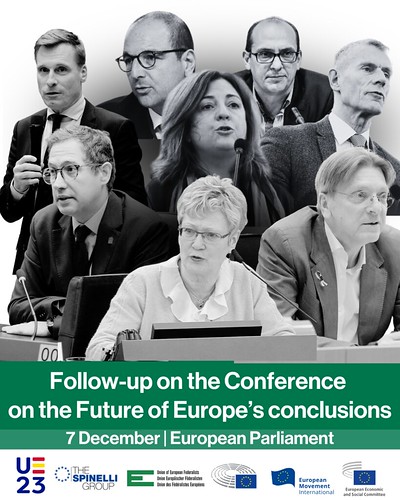
Original report in French by UEF France
A look back at the European Dialogue on 2 December ‘Election 2024: Meeting citizens’ expectations’.
On 2 December 2023, the Union of European Federalists and UEF France, Young Europeans and the European Movement hosted a European Dialogue at Europa Experience in Paris focusing on the 2024 European elections and how to meet citizens' expectations. After a welcome by Sandrine Amiel from the European Parliament Representation in France, the presidents and spokespersons of the associations Chloé Fabre, Marie Trelat and Laure Niclot introduced the discussions, which were moderated by Aurore Laloux, president of Jeunes européens Paris.
The first round table gave Frédéric Petit, Mercedes Bresso and Valérie Hayer the opportunity to address key issues relating to the future of Europe: the Common Foreign and Security Policy, the EU budget and welcoming new Member States.

Issues for the Future of Europe
-* Frédéric Petit, Député des Français de l’Étranger
Frédéric Petit raised an essential question: is Europe capable of enlarging while respecting democratic values and the rule of law? Comparing European expansion to the formation of a family, he stressed the need to understand the ‘why’ of enlargement and the will behind it.
Analysing existing models, Mr Petit distinguished between imperialism and cooperation, stressing that the EU, while successful, is not the first model in history. Historical examples such as the Republic of Yale Vodine were cited, highlighting the challenges of language, armed forces and borders. The deputy pleaded for Europe's capacity to adapt and enlarge, stressing that this was an inescapable necessity.

-* Mercedes Bresso, Member of the European Parliament
Mercedes Bresso highlighted the EU's crisis management and the growing need for strategic autonomy, particularly in the context of relations with NATO. She underlined the creation of the strategic defence compass in 2021 and the need to structure the States into a confederal area for a common and coherent voice.
Ms Bresso also addressed development aid policy, proposing that it be transformed into a strategic partnership for co-development.
She called for an effective response from Member States to meet the major challenges expected by citizens, making Europe a significant global player.
The EU's budgetary challenges
-* Valérie Hayer, Member of the European Parliament
Valérie Hayer stressed the need to strengthen the EU budget (currently 1% of European GDP) to achieve carbon neutrality by 2050. She pointed to the current imbalance where state contributions dominate EU funding, creating a negotiating mechanism that traps everyone in the hands of the Member States.
Ms Hayer highlighted the significant advances made, in particular the adoption of the Next Generation EU recovery plan in 2020, which has led to the creation of a common debt and the prospect of own resources. The plastic contribution is one of the first measures to be taken. She also highlighted the institutional challenges posed by the need for unanimity in the decision-making process, arguing for the necessary reform of the Treaties.
Towards a more democratic, efficient and united Europe in 2050
-* Christophe Chabrot, lecturer in Public Law at Lyon II, member of the UEF Scientific Council
Mr Chabrot spoke of the crucial role of the European Parliament as the chamber of European unity and democracy, which federalists have succeeded in having elected by direct universal suffrage. He underlined the current challenges, such as the emergence of new political divisions and the strengthening of the extreme and nationalist right in Europe. He stressed the need for a new European narrative to combat these extremes.
Mr Chabrot encouraged reflection on how to make the European Parliament more powerful while preserving the diversity of opinions. He opened the way towards a stronger political Europe, highlighting the fundamental issues of democracy and treaty reform.
A manifesto for the European elections
The afternoon concluded with a presentation of the Manifesto for the European elections put forward by the three associations, which structures the proposals around 5 axes:
For a more democratic Europe ready to welcome new members
For a Europe that provides social support for the ecological transition
For a Europe that gives itself the means to act
For a Europe capable of asserting itself as a global player and working for peace
For a Europe of solidarity, an area of freedom, capable of managing migration to provide a dignified welcome
We publish here the letter signed by the UEF President MEP Domenec Ruiz Devesa and the Chair of the Spinelli Group Sandro Gozi sent after the UEF Congress held in Brussels on 25-26 November 2023 on 29 November 2023 to the President of the European Council, Charles Michel, requesting to include in the Agenda of the European Council of 14-15 December 2023 the discussion on the European Parliament position on proposals for the amendment to the Treaties in order to reach a political agreement for the calling of the Convention.
In the letter is include also as attachament the "Manifesto For a Federal Europe: The urgency of overcoming the current treaties" adopted during the UEF Congress.
The UEF would like to thank the distinguished guests who took the time to participate in the Congress.
For the greetings: Hans-Gert Pöttering (LINK VIDEO) Former President of the European Parliament (2007-2009), President of the House of European History, Petros Fassoulas Secretary General of the European Movement International, Christelle Savall, President of Young European Federalists and Fernando Iglesias President of the World of Federalist Movement. In particular, we thank Josep Borrell High Representative of the European Union for Foreign Affairs and Security Policy, that have taken a time to follow the works of the first session of the Congress.
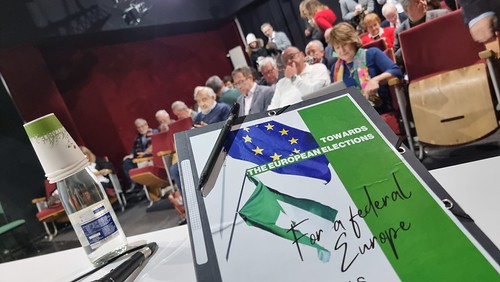
Then during the political debate the interventions of Raúl Santiago Fuentes (Representative of the Spanish Presidency of the Council of the EU), and the MEPs Brando Benifei, Rainer Wieland, Alin Mituta, Cyrus Engerer, Mercedes Bresso, Pietro Bartolo, and Thijs Reuten and the former European Parliament President Enrique Barón Crespo.
The five co-rapporteurs of the Report for the amendment of the treaties sent a pre-recorded video:
The delegates debated the challenges for the future of the European Union and exchanged opinions and ideas on the way forward for the Federalist movement and the European project.
The UEF Secretariat presented its activities for the 2021-2023 period (LINK HERE for report political activities), and Roland Hühn, Treasurer ad interim, presented the financial situation of the association LINK HERE. Giulia Rossolillo introduced the statutory changes required to transform the UEF from a Netherlands-based NGO to a Belgian-based Association Internationale Sans But Lucratif (AISBL). These changes were approved by the Congress. You can find the new statutes here (in English and French).
For more information on the change of seat of the UEF, please refer to the web page of the Congress.
The Secretariat hosted a workshop on the UEF strategy for the 2024 European elections. Here the presentation of the workshop (LINK). Due to time constraints, it was decided to postpone the discussions at a later meeting.
Therefore, the UEF invites all the delegates and the representatives of its sections to a meeting on 14 December (link to participate here).
Meena Fernandes, Policy analyst at the European Parliament Research Service, presented the results of the study on the costs of non-Europe. You can find the research paper here and the slide deck here.
Finally, it was announced that an extraordinary Federal Committee meeting (20 January, online) would call for an extraordinary Congress meeting for the Spring 2024 to revise the statutes of the association to draw new rules for the Secretary-General and make it a full-time professional. More information will follow.
If you wish to review the Congress, here is the collaborative photo album.
Political Documents approved by the Congress
The Congress approved several documents. You can find them below:
- Manifesto For a Federal Europe: the Urgency of Overcoming the Current Treaties LINK
- Resolution for Restoring Growth and Competitiveness in Europe LINK
- Statement The Atrocities of the Wars in Ukraine and Palestine Remind Us of the Urgency of Having a Federal European Government to be Able to Act on the International Stage LINK
- Political Declaration Reinforcing UEF-WFM Cooperation LINK
Other documents
- Financial Report 2021 -2023
- Activity Report 2021-2023
- Workshop on the UEF’s political strategy ahead of the 2024 European elections
- Presentation of the study "Mapping the cost of non-Europe (2022-2032)" by Meena Fernandes
- EPRS Study "Mapping the cost of non-Europe"
- Letter to Charles Michel, President of European Council co-signed by signed Domenec Ruiz Devesa UEF President and Sandro Gozi as Chair of the Spinelli Group LINK
- Draft resolution to propose to national parliaments to launch mobilization LINK
Result of the Elections
All bodies of the UEF found their members, all elected unanimously in an open ballot. Congratulations to newly elected and returning members of the following bodies:
- Executive Bureau
- President: Domènec Ruiz Devesa
- Vice-Presidents: Markus Ferber, Alin Mituta, Giulia Rossilollo
- Treasurer ad interim: Roland Hûhn
- Secretary-General ad interim: Luisa Trumellini
- Other EB members: Antonio Argenziano, Rafael Bez, François Leray, Daphne Gogou, François Mennerat, Eszter Nagy, Alejandro Peinado Garcia, and Wolfgang Wettach.
- ex-officio member of the EB: Christelle Savall, President of the Young European Federalists
- For the Arbitration Board: Ugo Ferruta, Daniel Frey, Marianne Huhn, Andreu Iranzo Navarro, Peter Osten, Stefano Spoltore, Daniela White.
- For the Federal Committee:
- Directly-elected Federal Committee members: Matilde Ceron, Aldecoa Francisco, Nikos Giannis, Angel Landabaso, Eva Lichtenberger, Jean Marsia, Hervè Moritz, Olalla Pastor del Valle, Luis Miguel Periza, Kati Sista, Flavia Gabriela Sandu
- Nominated members, the list is in the process of being completed LINK

Political message by the UEF President, Domènec Ruiz Devesa
Dear Federalist friends,
Just a few words from me before I leave you with this communication on the Congress that has just taken place.
First of all, let me thank you for the trust you have shown me by electing me as UEF President. It is an honour for me, as well as a great responsibility, because I am and feel first and foremost a federalist activist, who is currently in the institutions, but who lives the federalist commitment as his own priority, and in this sense also feels the relationship with the UEF.
These two years ahead of us will be important years to consolidate our organisation and find the right financial and administrative balance. They will be even more important politically, because they can be decisive for our Europe in taking the crucial steps towards a federal Union.
Our congress took place just three days after the approval by the European Parliament of the proposal to reform the treaties, the first one since the adoption of the Treaty of Lisbon in 2007, the first attempt at reforming the treaty in more than 15 years. We know the process that made it possible to arrive at this vote, through the Conference on the Future of Europe in which we participated directly; and we also know that it is a great opportunity, the only one today, and the first after 40 years since Altiero Spinelli's Draft Treaty, to realise the federal Europe.
Today, therefore, while we are committed to building a broad and widespread campaign in view of the European elections, we urgently need to mobilise ourselves for the success of the next step, i.e. the decision of the European Council in favour of launching a Convention to elaborate the reform of the Treaties. We have urged the Spanish Presidency to immediately transmit the European Parliament resolution to the European Council and asked to President Charles Michel to put it in the agenda of the European Council of the 15th of December, although resistance from national governments will probably force a postponement. Here it is very important the role of the national sections to involve their national parliaments and urge the governments to be in favour of the opening of the Convention. The letter signed by me as UEF President and Sandro Gozi as Chair of the Spinelli Group has just been sent (LINK), together with the Manifesto we approved in our Congress; and here (LINK) you can find a draft resolution to propose to your national parliaments, to launch the mobilization.
We have a very important job to do. I thank you once more very much for all your work, commitment and dedication in federalism. I am convinced that we will work together with confidence and commitment over the next two years, and that together we can make a positive difference in order to meet the challenge of federal Europe. And since it's a long process, by definition the best has always yet to come.
A long road begins to meet citizens' demands and build a more solid future of the EU.
The Union of European Federalists, who strongly supports these proposals of the European Parliament to amend the Treaties, launched a massive and successful outreach campaign encouraging citizen engagement and pressuring MEPs ahead of a crucial vote at the European Parliament.
On Wednesday 22 November, the European Parliament approved the Report on the proposals of the European Parliament for the amendment of the Treaties drafted by Spinelli Group members Guy Verhofstadt, Sven Simon, Gabriele Bischoff, Daniel Freund, and Helmut Scholz.
This was a historic vote, which sees the European Parliament once again playing a leading role after forty years, since the draft Treaty inspired by Altiero Spinelli, in an attempt to strengthen the political and decision-making architecture of Europe to make it a protagonist of the challenges of its time.
Today the vote falls at a time of serious international crisis and during a process of profound transformation of our societies that requires us to act united as Europeans, to strengthen our common house so that it is more effective and at the same time more capable of providing answers to the needs of citizens.
In support of this courageous initiative by the European Parliament, which is in line with the commitments made by the European institutions at the end of the Conference on the Future of Europe, the Union of European Federalists (UEF) and its sections all over Europe met citizens in more than 30 European cities and online to inform them about the crucial vote of Wednesday.
From 6 to 19 November 2023, Federalist activists organised demonstrations and debates, in the streets and on social media. To know more about our actions, visit the UEF website and watch the livestream of Monday 20 November, featuring the organisers of these local actions. See here also the photo action inside the European Parliament in Strasbourg on Tuesday 21 November.
UEF President Domènec Ruiz Devesa in view of the upcoming plenary sent a letter together with Spinelli Group Chair MEP Sandro Gozi to their colleagues of the European Parliament, stating: “An affirmative vote on Wednesday 22 November on the Report on proposals of the European Parliament for the amendment of the Treaties is exactly the answer that our Union and citizens need. I hope that together, as the European citizens’ representatives, we will show a wide majority in the Plenary vote, sending a clear message to the Council and urging its transmission to the European Council under the Spanish Presidency. Thus, we will have the opportunity to discuss the citizens' priorities for a more effective European Union already in the European Council meeting of 15 December 2023”
The UEF urges the Spanish Presidency of the European Union to immediately transmit the file to the Council of the European Union and asks Charles Michel, in his capacity as President of the European Council to put the decision on the call for a Convention on the agenda of its 15 December meeting.
Brussels, 22 November 2023
Context
The Union of European Federalists (UEF) is a pan-European, non-governmental political organisation dedicated to the promotion of European political unity.
The draft report on the amendment of the treaties is the European Parliament’s answer to the Conference on the Future of Europe, an unprecedented democratic exercise that gathered 800 European citizens. These citizens gave out recommendations for institutional reforms of the European Union, and several of them found their way into the report voted today.
Today's vote is the last step to formally call for a Convention to reform the treaty, but only the start of the reform process.
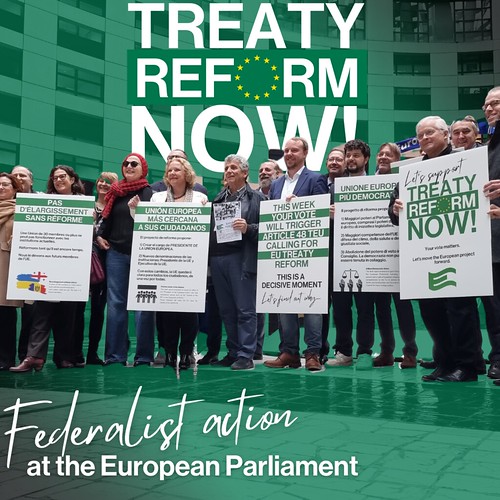
The UEF Secretariat togheter the staff of the MEP and UEF President Domenec Ruiz Devesa has organized a photo action inside the Agora of the Europan Parliament in Strasbourg, involving the MEPs Co-rapporteurs and MEPs of the Spinelli Group.
Rewatch here the photo action organized at the European Parliament in Strasbourg before the discussion on the report AFCO on the proposal of the Treaty Reform. There were present Guy Verhofstadt, Helmut Scholz and Daniel Freund. There were also present MEPs UEF President Domenec Ruiz Devesa, Brando Benifei, former UEF President Mercedes Bresso, Pietro Bartolo, Gwendoline Delbos-Corfield, Alin Mituta, Petras Austrevicius
We are pleased to announce that in 30 cities in Europe the action Saturdays For Europe was organized during the weekend of 17-19 November.
The cities are: Afragola (Italy), Alessandria (Italy), Ancona (Italy), Bassano del Grappa (Italy), Bergamo (Italy), Brescia (Italy), Budapest (Hungary), Brussels (Belgium), Faenza (Italy), Ferrara (Italy), Genoa (Italy), Hamburg (Germany), Latina (Italy), Lodi (Italy), Luxembourg , Madrid (Spain), Mainz (Germany), Memmingen (Germany), Milan (Italy), Monza (Italy), Padua (Italy), Paris (France), Pavia (Italy), Pinerolo (Italy), Rueglio (Italy), Stradella (Italy), Strasbourg (France), Turin (Italy), Verona (Italy), Valpolicella (Italy), Zwolle (Netherlands).
On 20 November 18:30-19:30, in Strasbourg at the Foyer de l'étudiant catholique F.E.C., the UEF Secretariat has scheduled a Live Streaming where our activists and local sections representatives will present their activities of the Saturdays for Europe.
Watch here the Live Streaming
We are pleased to announce that in 30 cities in Europe the action Saturdays For Europe was organized during the weekend of 17-19 November.
The cities are: Afragola (Italy), Alessandria (Italy), Ancona (Italy), Bassano del Grappa (Italy), Bergamo (Italy), Brescia (Italy), Budapest (Hungary), Brussels (Belgium), Faenza (Italy), Ferrara (Italy), Genoa (Italy), Hamburg (Germany), Ivrea, (Italy), Latina (Italy), Lodi (Italy), Luxembourg , Madrid (Spain), Mainz (Germany), Memmingen (Germany), Milan (Italy), Monza (Italy), Padua (Italy), Paris (France), Pavia (Italy), Pinerolo (Italy), Rueglio (Italy), Stradella (Italy), Strasbourg (France), Treviso (Italy), Turin (Italy), Verona (Italy), Valpolicella (Italy), Zwolle (Netherlands).

Would you like to share the results of the SaturdaysForEurope?