

We publish here the letter sent today Charles Michel, President of the EU Council, in view of the European Council of 21-22 March and co-signed by Domenec Ruiz Devesa MEP and President of the Union of European Federalists (UEF), Sandro Gozi chair of the Spinelli Group, Guy Verhofstadt President of the European Movement International (EMI) and Christell Savall President the Young European Federalists (JEF), together with a memorandum on the Treaty revision procedures.
With the letter is include also as attachament the Memorandum “Why we we need a Convention to change the Treaties”
STATEMENT OF THE SPINELLI GROUP
14 FEBRUARY 1984 - 14 FEBRUARY 2024
Today the federalist-minded members of our intergroup, celebrate the 40th anniversary of the approval by the Plenary of the European Parliament of the Draft Treaty establishing the European Union promoted and strongly pursued by Altiero Spinelli.
The Draft Treaty adopted by the European Parliament 40 years ago laid the foundations for the emergence of the first nucleus of a true European federation, starting with the Economic and Monetary Union. According to that, the European institutions would have had economy-related competences and powers, albeit limited, to govern the nascent European Union on a federal basis. In a world dominated by bipolar confrontation, and in a European continent divided by the Iron Curtain, Spinelli led the European Parliament to support a project capable of giving Europe the instruments of acting as a sovereign and autonomous global player.
40 years from that moment, we are honouring the legacy of Spinelli. Under the advocacy of the Spinelli Group, the European Parliament has put forward in November 2023, a historic proposal for the reform of the Treaties. Without a federal Europe, without new competences and without more democratic and effective decision-making procedures, the whole integration process launched in 1950 is in jeopardy.
The Board of the Spinelli Group reiterates its motivation to promote the European Parliament’s proposal for the reform of the Treaties as the cornerstone of a new constituent moment for Europe, which will soon enter a new crucial electoral phase, until the 6-9 of June. Therefore, we demand the European Heads of States and of Governments to discuss and to take a position on the Parliament’s proposal during the March EUCO, so that the convention for the revision of the Treaties can be launched after the next European elections. 40 years after the adoption of the Spinelli Project, we live up to the heritage and example of the father of European federalism.
VIDEO RECORDING
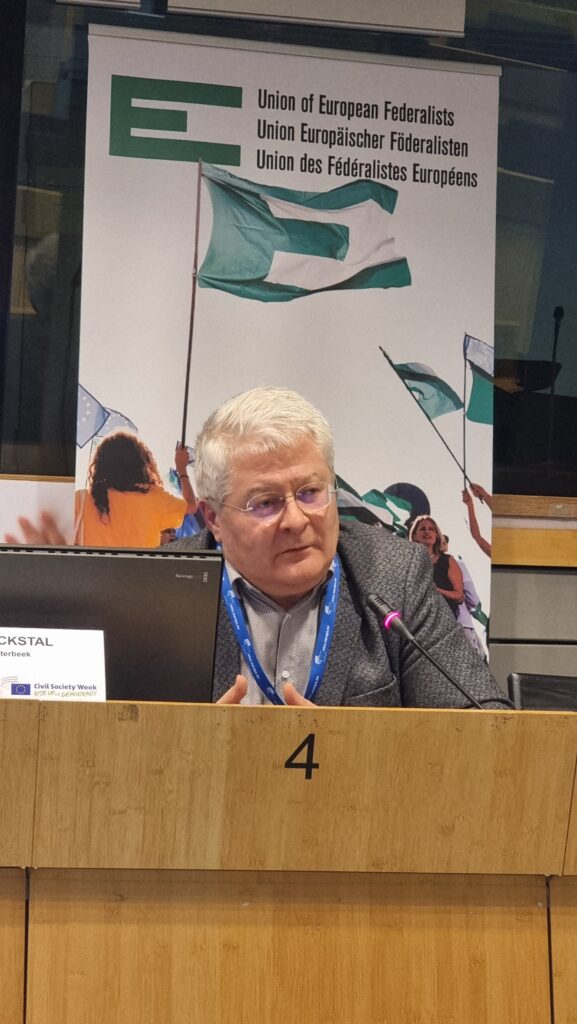
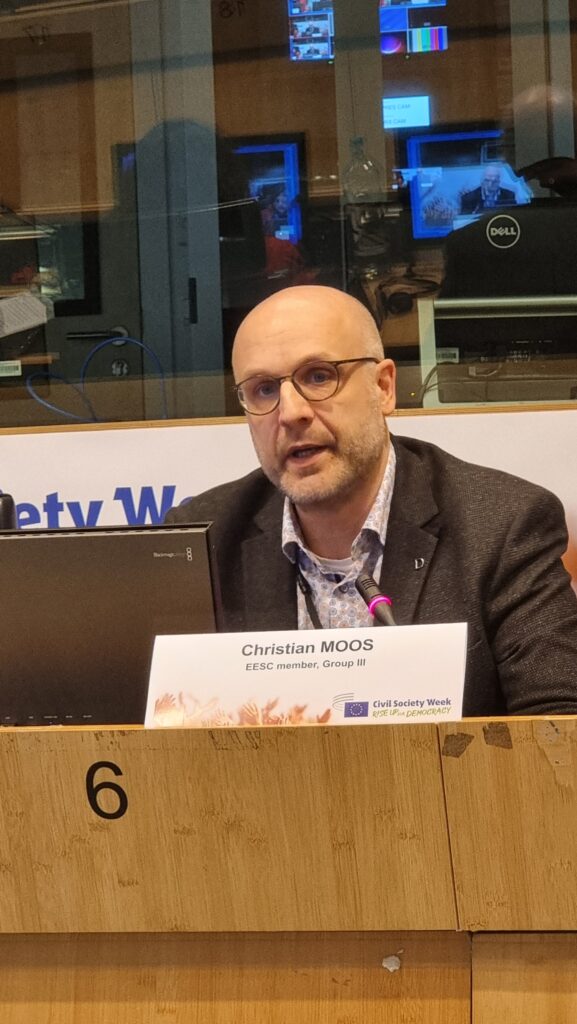
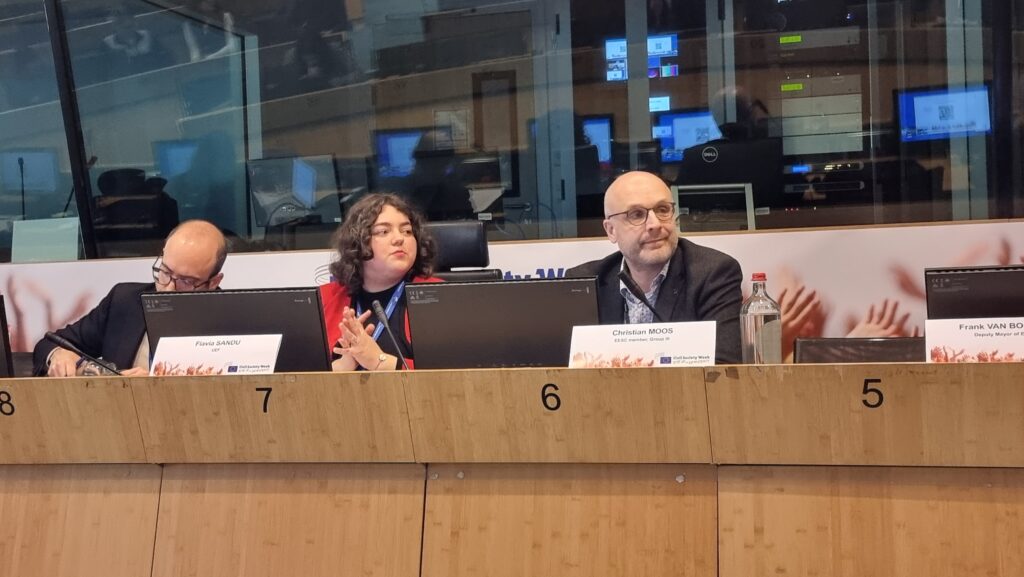


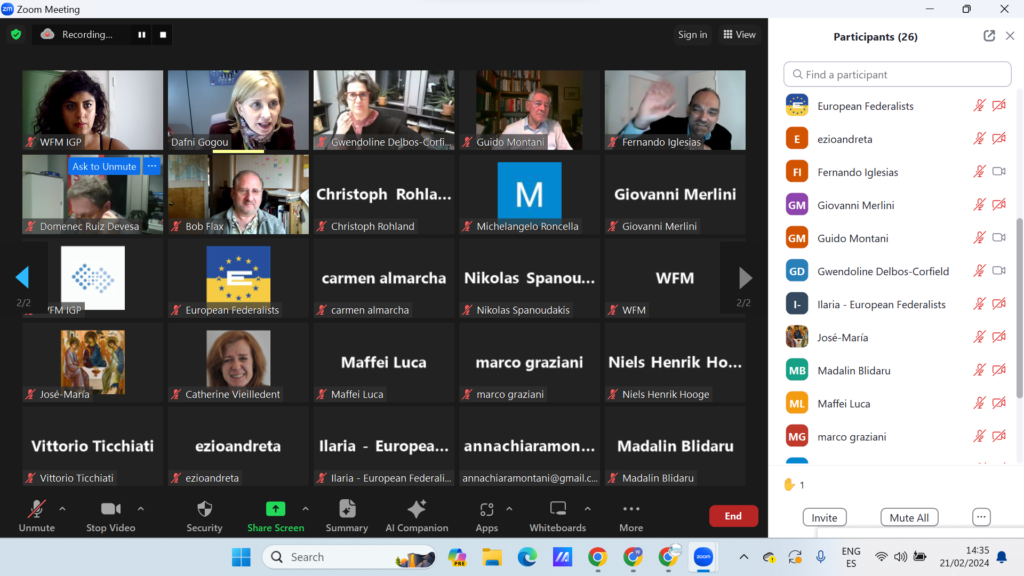
The President of Romania, Klaus Iohannis, in his speech to the European Parliament yesterday (Wednesday, 7 February) called for a reform of the Treaties to overcome the actual architecture of the European Union, for example overcome the veto mechanism, which he described as "unacceptable".
"I think three things need to be changed," says Klaus Iohannis, referring to the improvement of communication between the Union and the citizens, the amendment of the treaties to overcome the unanimity mechanism, and the urgency of a European foreign policy.
At the end of his speech, MEPs took the floor, including UEF President Domenec Ruiz Devesa, who emphasised the passage on the need for institutional reforms and then turned to Charles Michel, reminding him to put this debate on the agenda.
"I would also like to thank President Iohannis for his words. I congratulate him on his commitment to European integration and his Europeanism. I am also grateful that he mentioned the institutional dimension in his speech. It is clear that with an enlarged Europe, with the process of relaunching the enlargement process, we must accompany this process with the deepening of our political project in a federal key. You referred to the issue of not excluding the reforms of the Treaties, which I welcome, and I believe that we must also take a further step in that direction. You referred to the bridging clauses. That is true. They can be activated. They are in the Treaty of Lisbon so that more matters can be decided by qualified majority. But in 14 years the Council has not been able to activate a single one of them. I hope we do not have to wait another 14 years. Please support Parliament's proposal to reform the Treaties."
In the closing speech the President of Romania, said: "It is about the architecture of the Union. How do we make it better? And we have to improve it. Because if we take in Ukraine, Moldova and the Western Balkans we will be a large union and this decision making, especially in crisis, war, pandemic, and energy crisis, has to be correct, transparent but fast. So, I believe we have to work on our architecture. Some of it might be possible to change without opening the Treaties. But some issues have to be changed in the Treaties. They are not perfect. Since we have these Treaties, I hope you don't mind me telling you, years have passed. We are a different Union and we work towards a different union and I hope you very much agree, we work towards a better Union, so let's work on this."
We are pleased to present before the end of 2023, the new podcast "Repensando Europe: ideas para una Europa Federal" produced by the collaboration between UEF and UEF Spain, produced and moderated by Kevin Febres President of UEF Madrid, whom we thank for his commitment.
This podcast aims to help disseminate the contents of the European federalists in Spanish, in this historical moment of change for Europe and in view of the European elections of 2024.
The fourth episode is moderated by Kevin Fabres, who interviews Giulia Rossolillo the Vice-President of the Union of European Federalists, Full professor of European Law at University of Pavia, and director of the political review The Federalist.
Giulia explains the legal steps for treaty reform. She begins by pointing out that the process of reforming the Treaties began in an anomalous way that was not envisaged in the Treaties. In fact, the proposal we have today started with the Conference on the Future of Europe, a large assembly where citizens had a voice to say what to improve about the European Union.
The European Parliament used the results of the conference and used them to draft a reform proposal approved on 22 November, calling for Article 48 to be applied.
Then she explains how the real problem with Article 48 is in the European Council, which should unanimously approve this reform, but where consensus is lacking. That is why some believe that the EU could be reformed with Article 49 of the Treaty (the article that applies to EU enlargement), which allows for minimal Treaty changes.
She then recalls which points of the Treaty, for the European federalists, should be reformed.

We are pleased to present before the end of 2023, the new podcast "Repensando Europe: ideas para una Europa Federal" produced by the collaboration between UEF and UEF Spain, produced and moderated by Kevin Febres of the UEF Madrid section, whom we thank for his commitment.
This podcast aims to help disseminate the contents of the European federalists in Spanish, in this historical moment of change for Europe and in view of the European elections of 2024.
The third episode is moderated by Kevin Fabres, who interviews Domènec Ruiz Devesa the President of the Union of European Federalists, MEP S&D and member of the Spinelli Group.
Domenec Ruiz Devesa explains why treaty reform is essential at this historic moment. Reform is essential in order to endow the European Union with powers and competences in fundamental areas such as the European budget (the Next Generation EU is the result of a constructive and emergent interpretation of the current treaties that can be discussed), European defence (from a productive industrial point of view), a European Council decision-making system that is no longer a prisoner of the right of veto.
He then makes an assessment of the current term of the European Parliament.
What objectives pro-Europeans and federalists should have in view of the elections:
- explain the successes of these five years of the EU;
- take the field in the elections to fight disinformation and fake news;
- ask pro-European parties to campaign transnationally and to include the need for treaty reform in their programmes.
We are pleased to present before the end of 2023, the new podcast "Repensando Europe: ideas para una Europa Federal" produced by the collaboration between UEF and UEF Spain, produced and moderated by Kevin Febres of the UEF Madrid section, whom we thank for his commitment.
This podcast aims to help disseminate the contents of the European federalists in Spanish, in this historical moment of change for Europe and in view of the European elections of 2024.
The second episode is moderated by Kevin Fabres, who interviews Diego de Castro member of UEF Spain and Policy officer for Renew Europe, who commented the recent resolution on the reform of the Treaties approved by the EU Parliament last 22 November 2023.