

Brussels 21 March 2024
Almost two years after the end of the Conference on the Future of Europe, where citizens gave a clear mandate for EU Treaty reform, a convention has yet to be conveyed. On 22 November 2023, the European Parliament adopted its proposal to amend the Treaties and triggered the procedure of Article 48(2) of the Treaty on European Union. Yet, there has been a lack of reaction from the European Council and the Convention item requested by the EP is not yet on the agenda of any meeting. A simple majority in the European Council is enough to open the Convention, so this time the vetoes of a few states cannot be an excuse.
Together with our sections and our partners from the Spinelli Group, European Movement International (EMI) and the Young European Federalists (JEF Europe) we have written letters to the President of the European Commission Ursula von der Leyen and to the President of the EU Council Charles Michel, as well as the heads of each EU Member State. In light of the European Council meeting on 21-22 March, it is the duty of the European Council and the heads of State to respect the will of the citizens and strengthen the European Union.
Given the challenges we are facing, and keeping in mind the relaunch of enlargement, it is more necessary than ever to update our policies and initiate a reform of our institutional framework. Not only for the betterment of our current Union, but also, with an outlook to an European Union of possibly 36 Member States.
"You have a proposal from the European Parliament. The European Parliament activated Article 48, which is an article on the constitutional reform procedure. How long will the European Council continue to abuse our patience?" said Domènec Ruiz Devesa, MEP and UEF President in his intervention in the European Parliament debate of 12 March for Preparation of the European Council meeting of 21 and 22 March 2024.
The climate crisis, defence and foreign policy, enlargement, digitalisation, energy, healthcare, industrial policy, democracy and rule of law are just some of the challenges Europe needs to tackle. Every day, war, crises and great power politics demonstrate the urgent need to strengthen European institutions and better respond to global challenges and the needs of citizens.
Historically, the European project has always been ambitious and bold. To face the uncertain times of today, we must stay ambitious and give Europe the necessary tools to move forward and boldly face the challenges of our quickly changing world.
Links and references:
List of the letters sent by UEF or its national sections or JEF national sections to the members of the European Council in view of the EUCO meeting of 21-22 March 2024
- Austria, Letter to Federal Chancellor Karl Nehammer LINK
- Belgium, Letter to Prime Minister Alexander De Croo LINK
- Bulgaria, Letter to Prime Minister Nikolai Denkov LINK
- Croatia, Letter to Prime Minister Andrej Plenković LINK
- Republic of Cyprus, Letter to President Nikos Christodoulides, LINK
- Czech Republic, Letter to Prime Minister Petr Fiala, LINK
- Denmark, Letter to Prime Minister Mette Frederiksen LINK
- Estonia, Letter to Prime Minister Kaja Kallas LINK
- Finland, Letter to the Prime Minister Petteri Orpo LINK
- France, Letter to the President Emmanuel Macron LINK
- Germany, Letter to Federal Chancellor Olaf Sholz LINK
- Greece, Letter to Prime Minister Kyriakos Mitsotakis LINK
- Hungary, Letter to Prime Minister Viktor Orban LINK
- Ireland, Letter to The Taoiseach Leo Varadkar LINK
- Italy, Letter to Prime Minister Giorgia Meloni LINK
- Latvia, Letter to Prime Minister Evika Siliņa LINK
- Lithuania, Letter to President Gitanas Nausėda LINK
- Luxembourg, Letter to Prime Minister Luc Frieden LINK
- Malta, Letter to Prime Minister Robert Abela LINK
- Netherlands, Letter to Prime Minister Mark Rutte LINK
- Poland, Letter to Prime Minister Donald Tusk LINK
- Portugal, Letter to Prime Minister Antonio Costa LINK
- Romania, Letter to President Klaus Werner Iohannis LINK
- Slovakia, Letter to Prime Minister Robert Fico LINK
- Slovenia, Letter to Prime Minister Robert Gobob LINK
- Spain, Letter to Prime Minister Pedro Sanchez LINK
- Sweden, Letter to Prime Minister Ulf Kristersson LINK
- President of the EU Council, Charles Michel LINK
- President of the European Commission, Ursula von der Leyen LINK
Other relevant documents and webpages:
- Memorandum "Why we need a Convention to change the Treaties" LINK
- UEF Political Campaign "The urgency of overcoming the current Treaties" LINK
PRESS CONTACT
Flavia Sandu
Policy Officer
secretariat@federalists.eu


Read here the PRESS RELEASE of the Spinelli Group and the Union of European Federalists.

Rome, 2 march 2024 | The UEF Secretariat attended the extraordinaty Congress of European Socialist Party that voted on the political manifesto for the European elections and the common candidate, the Spitzenkandidat, Nicolas Schimt.
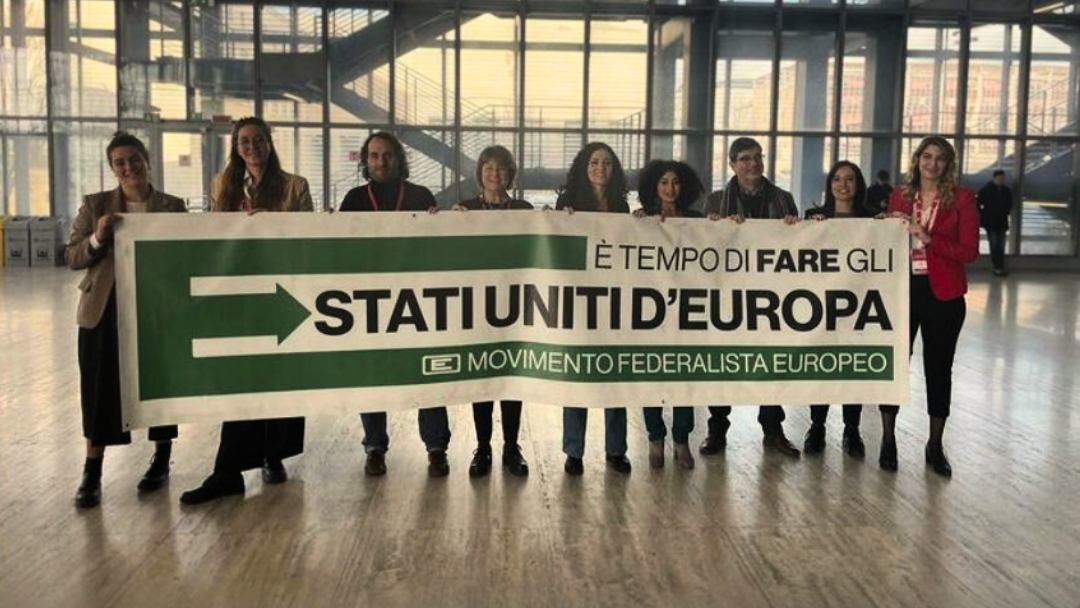
Members of the European Federalist Movement (UEF Italy) and European Federalist Youth (JEF Italy) also participated with their banner "It is time to do the United States of Europe" and presenting their political documents.
UEF Secretary General Luisa Trumellini handed over the UEF political documents to the common candidate Nicolas Schmit.
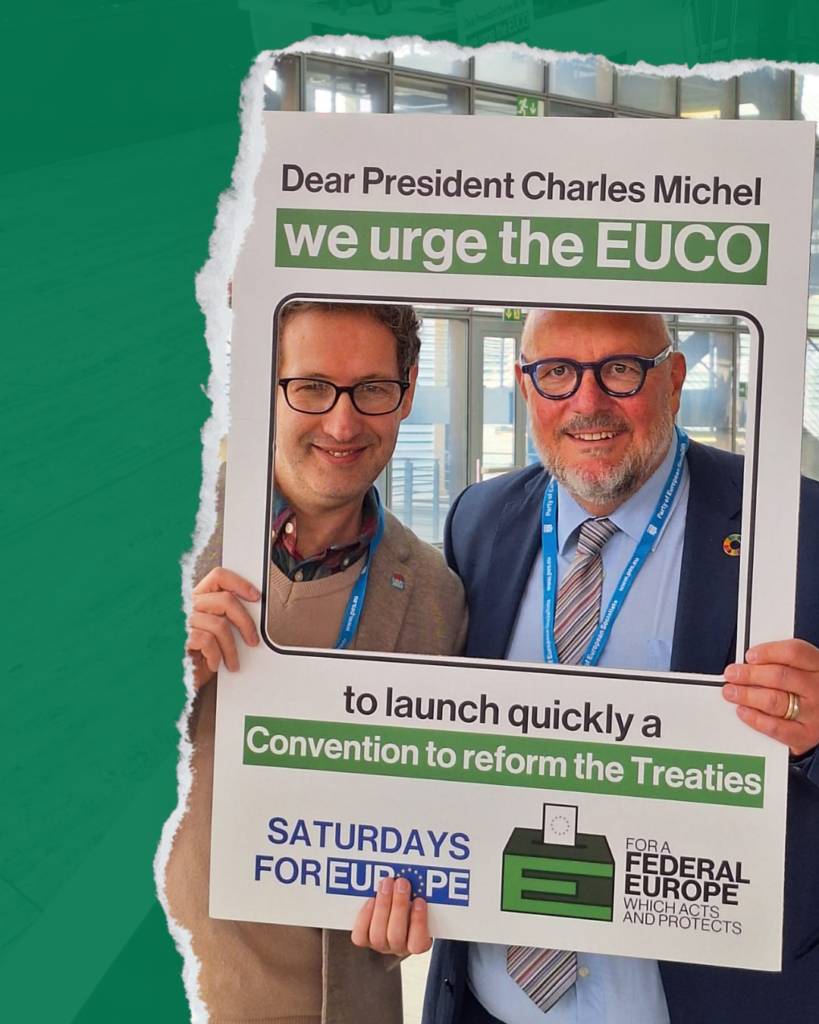
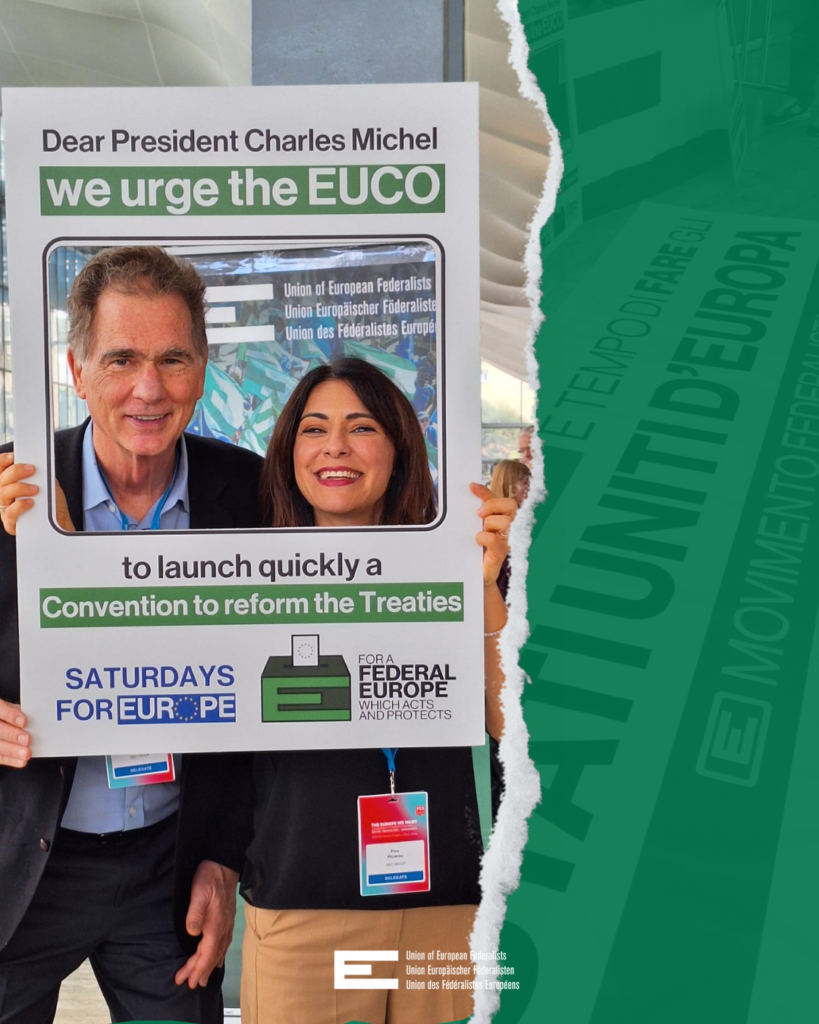
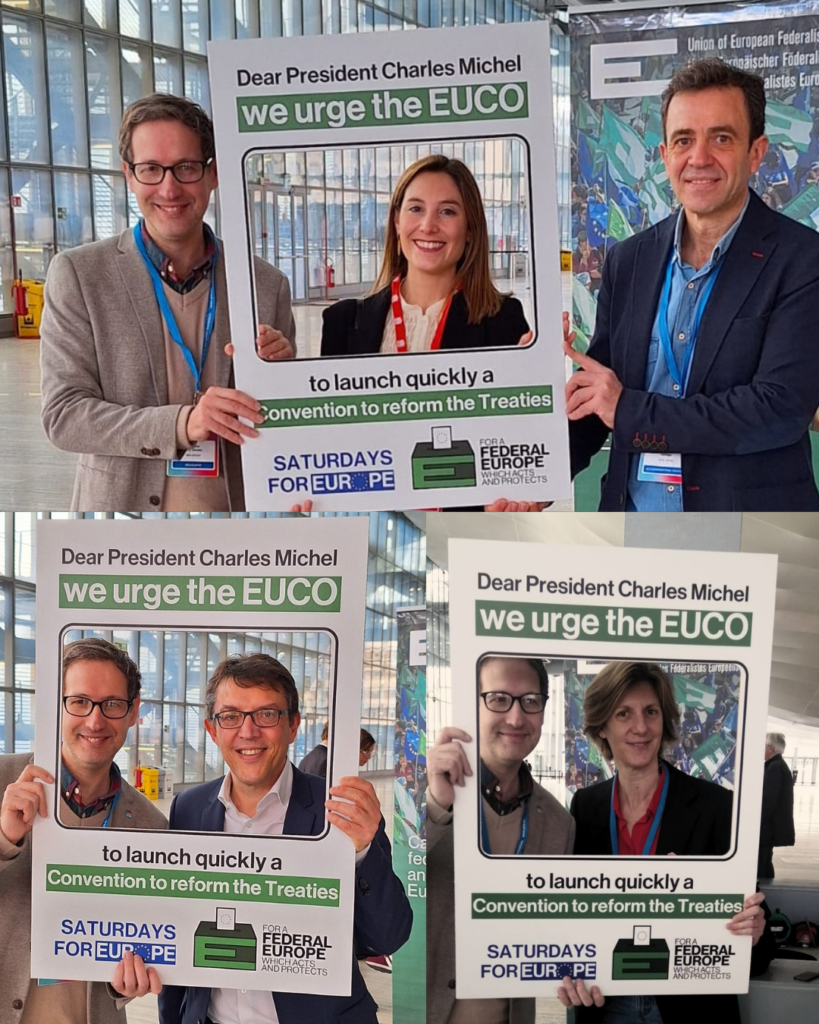
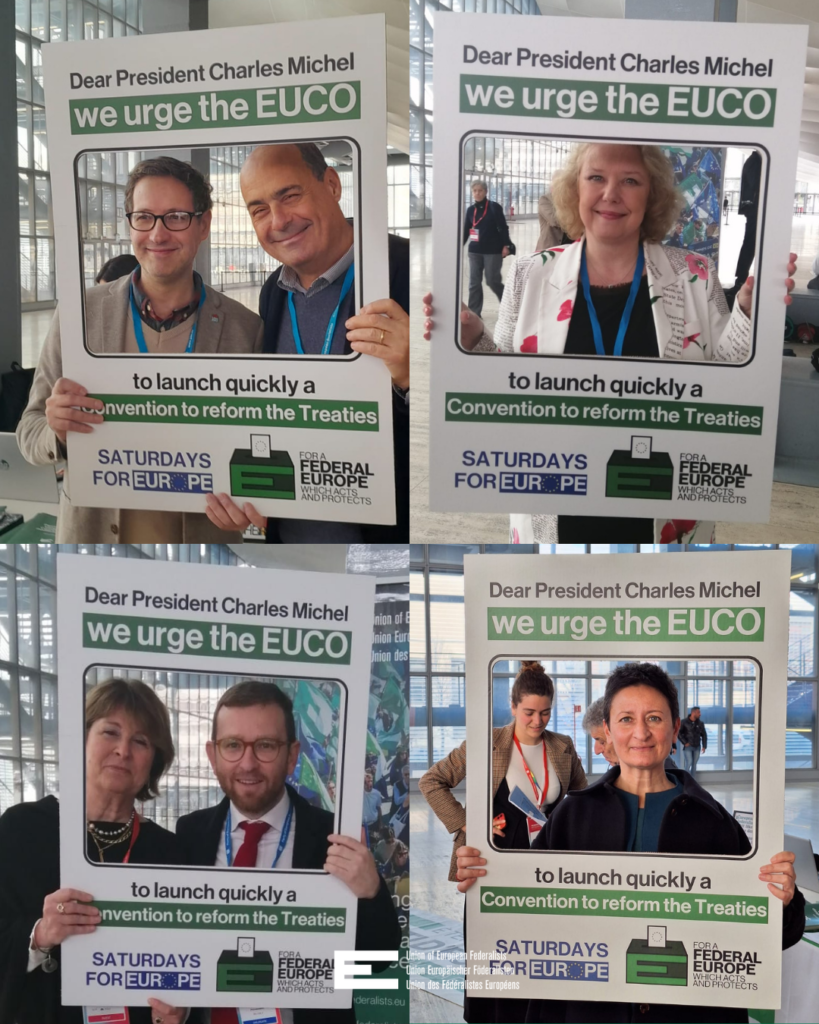
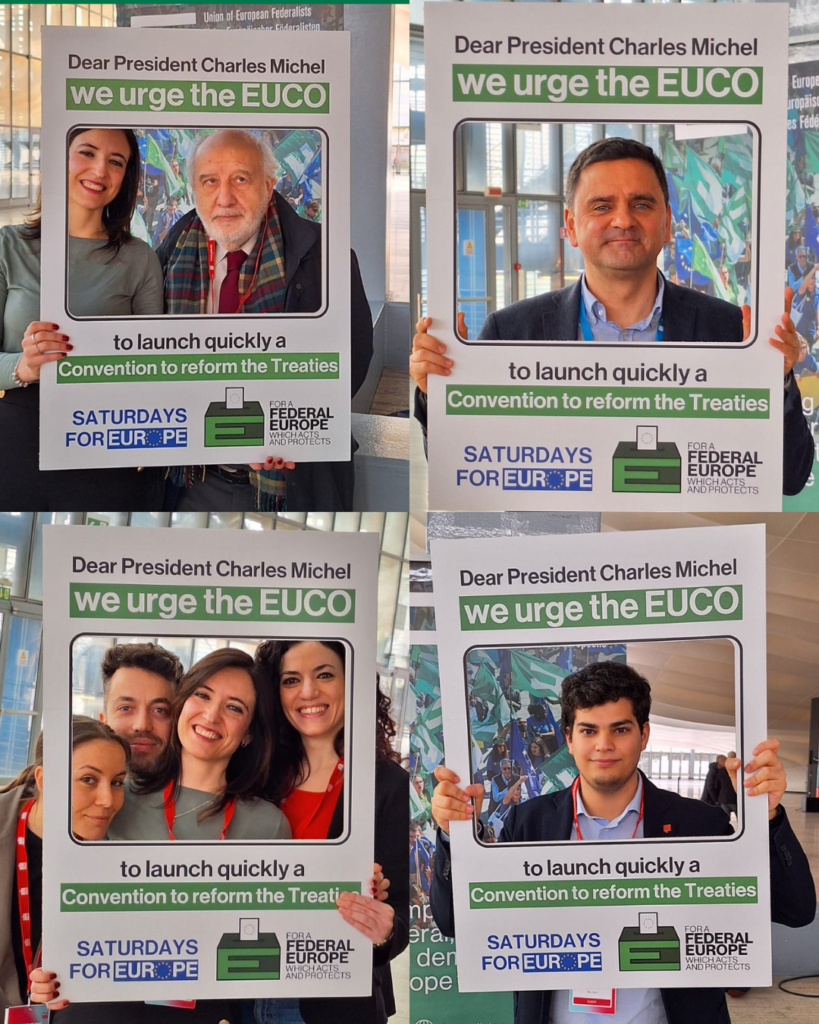
Throughout the congress, participants were invited to send a message to EU Council President Charles Michel: "Dear President Charles Michel, we urge the EUCO to launch the Convention to reform the Treaties", using the frame of the political campaign of the UEF.
"
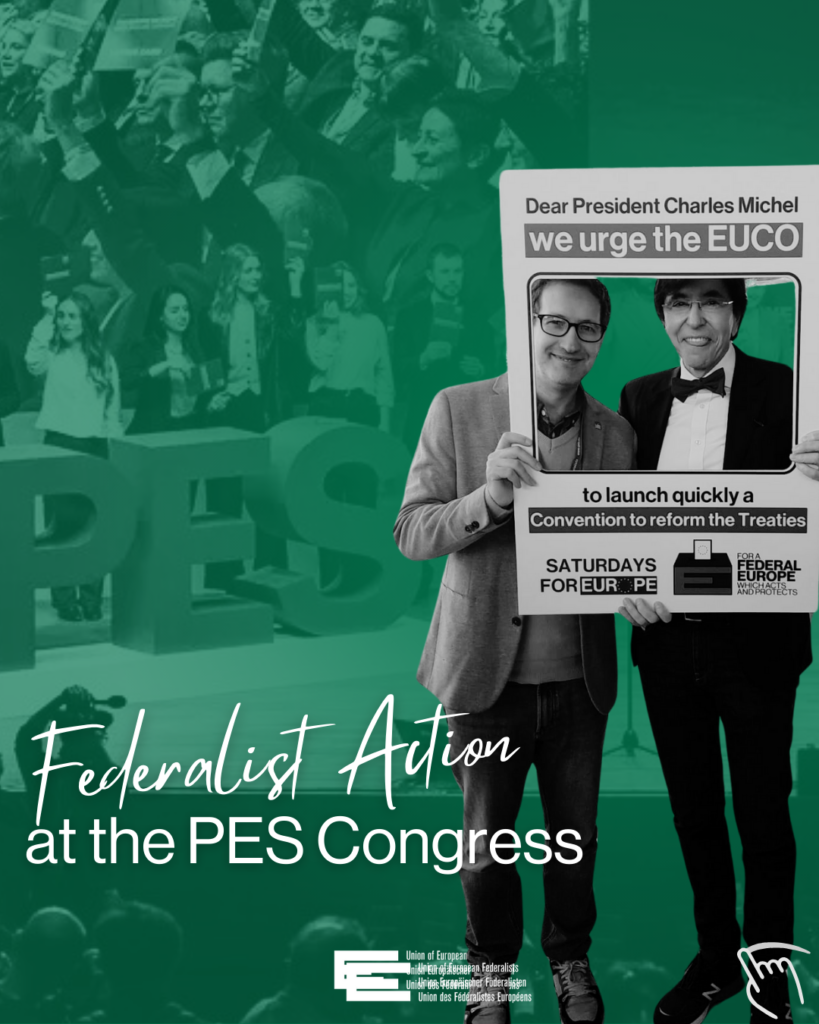
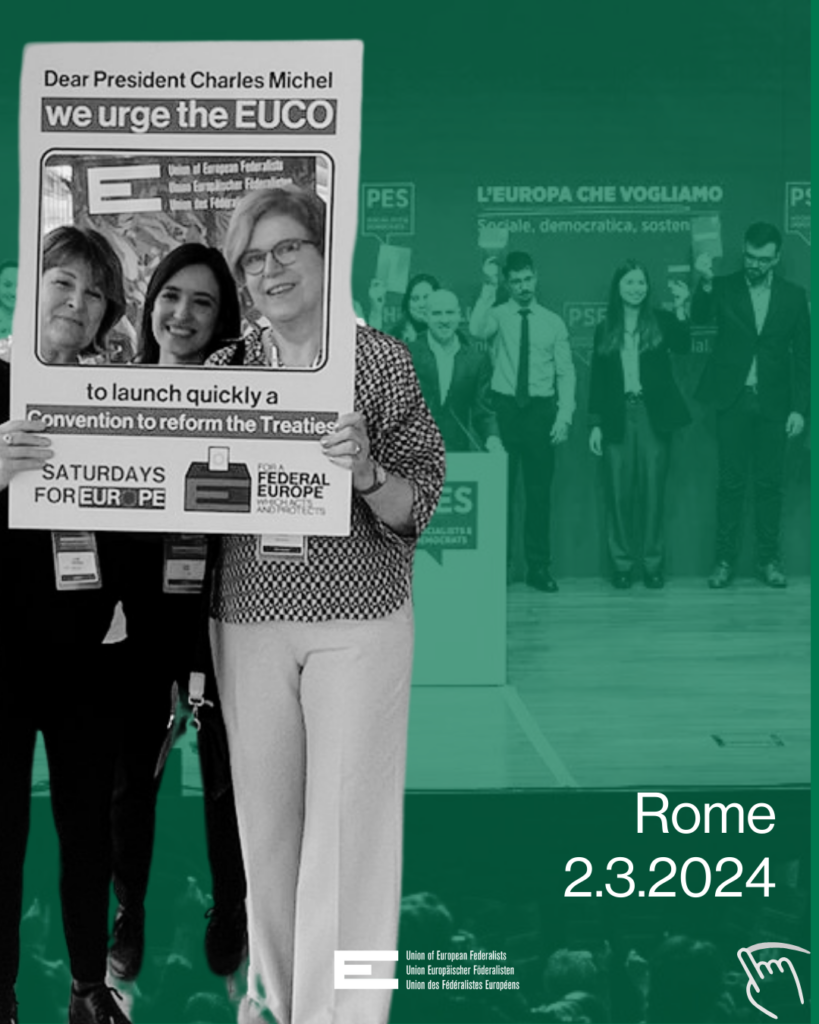
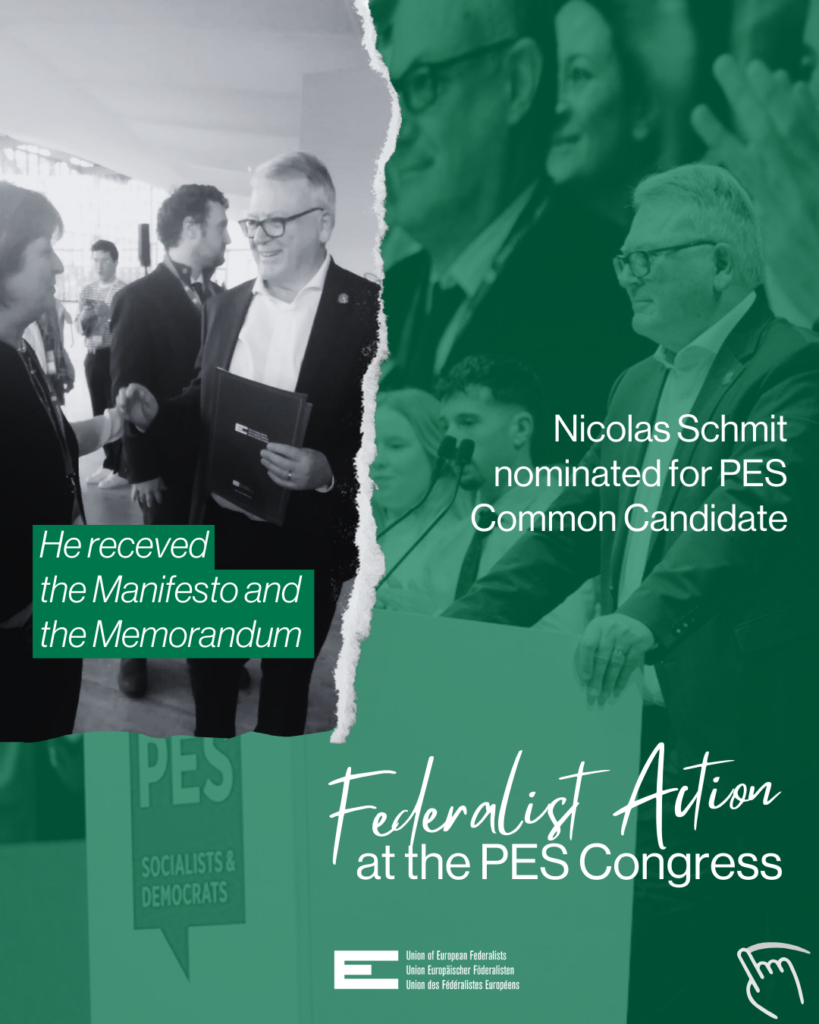
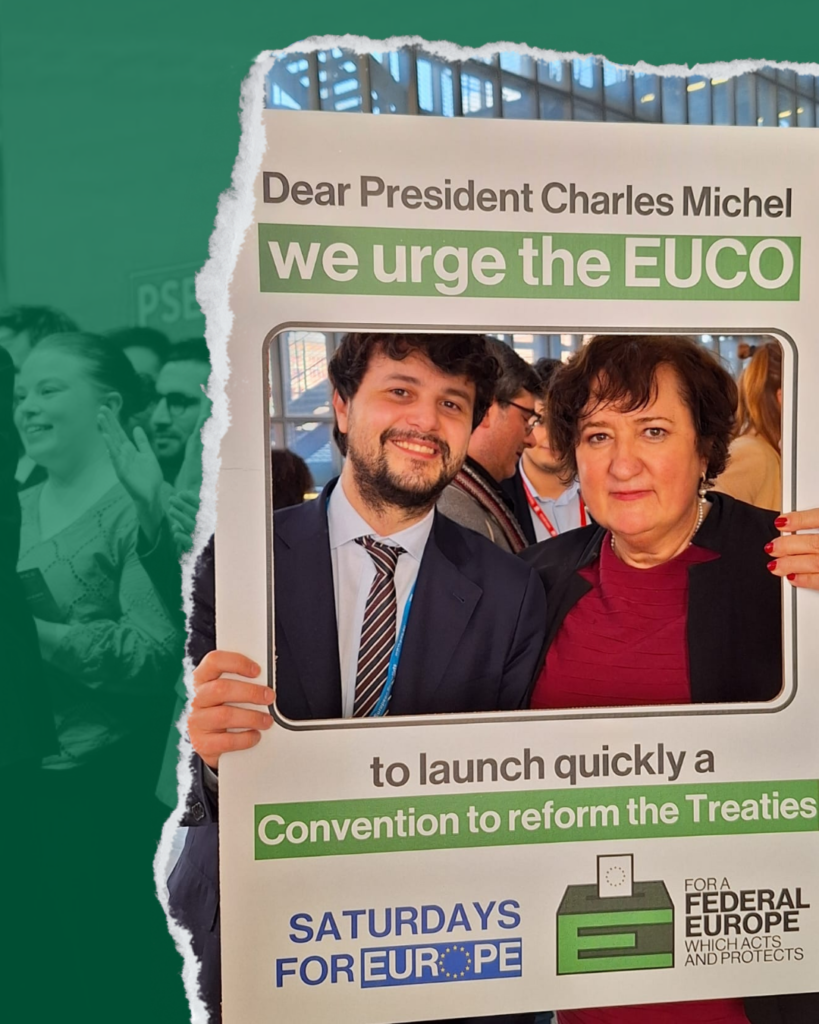
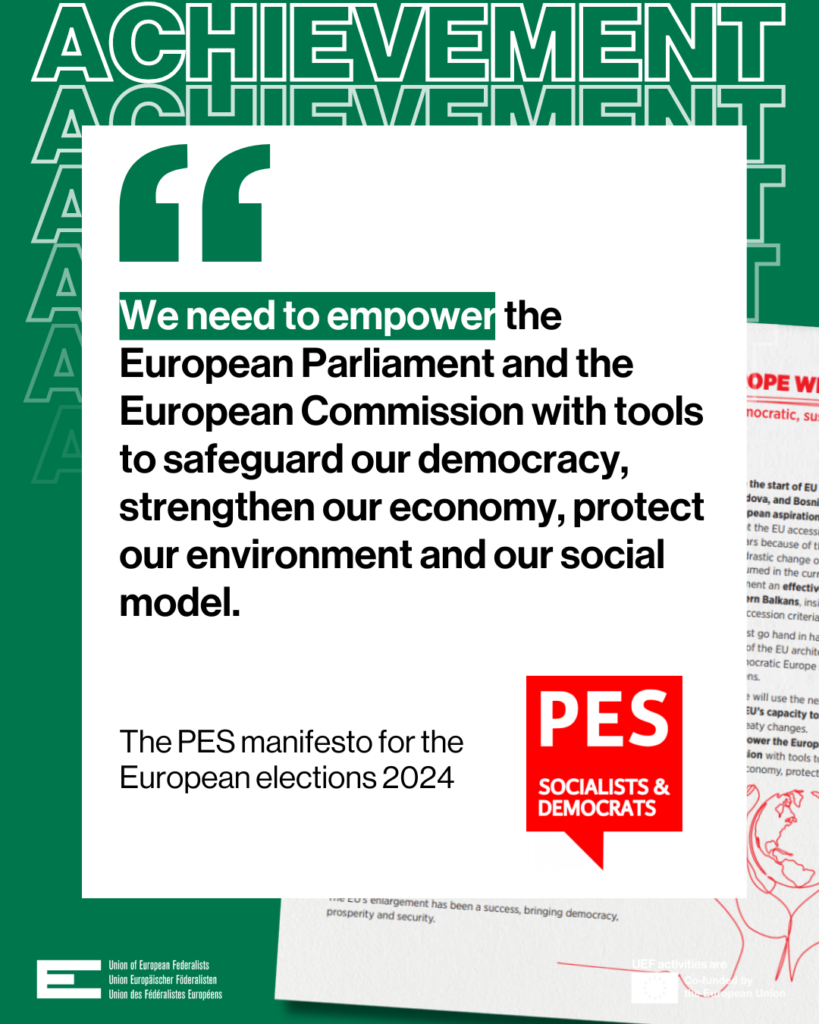
We point out that the PES Political Manifesto, on page 19, advocates treaty reform:
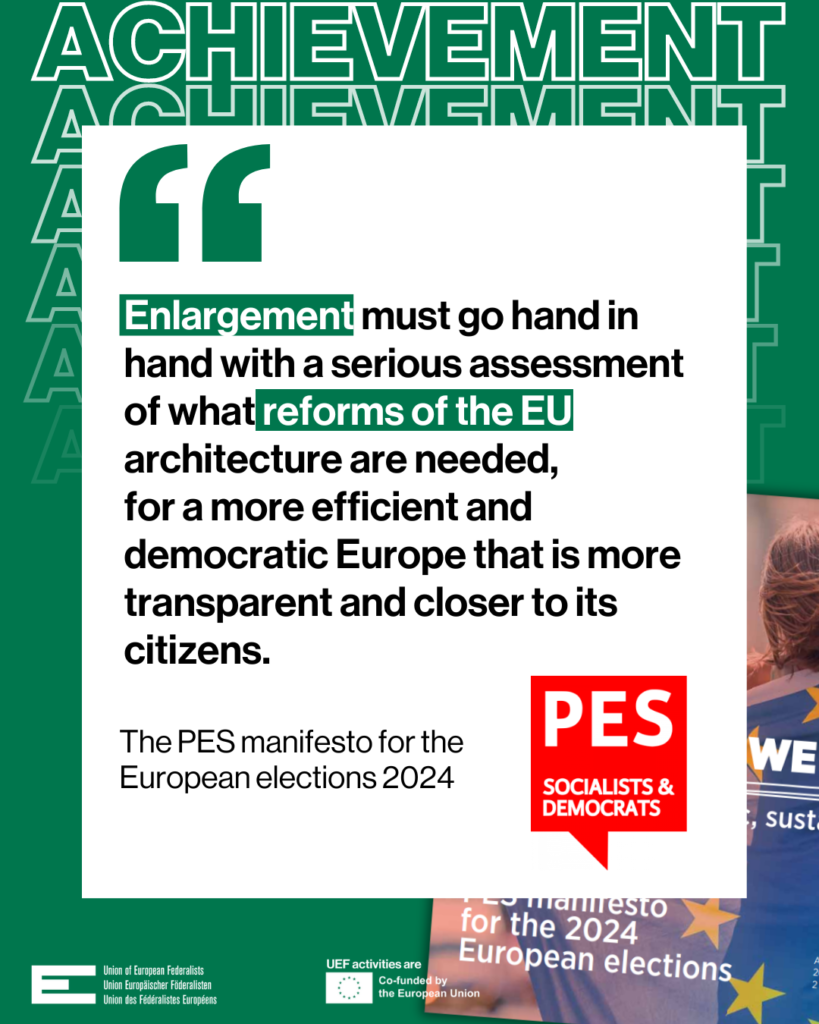
"Enlargement must go hand in hand with a serious assessment of what reforms of the EU architecture are needed, for a more efficient and democratic Europe that is more transparent and closer to its citizens.
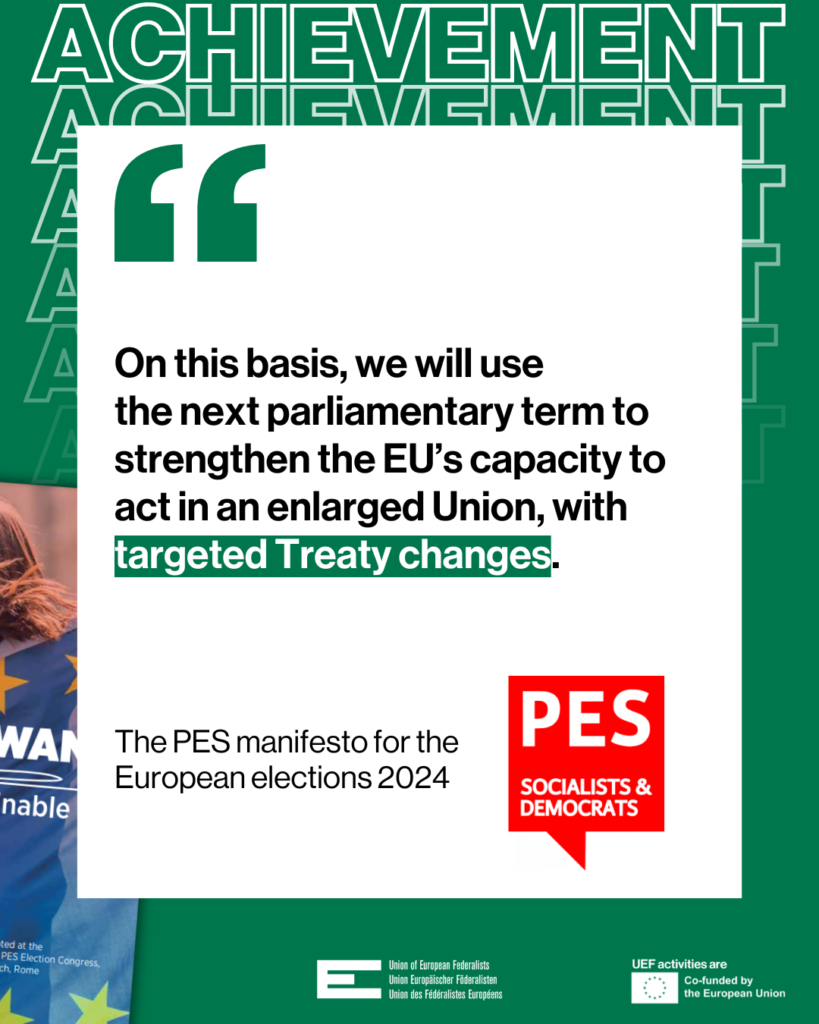
- On this basis, we will use the next parliamentary term to strengthen the EU’s capacity to act in an enlarged Union, with targeted Treaty changes.
- We need to empower the European Parliament and the European Commission with tools to safeguard our democracy, strengthen our economy, protect our environment and our social model."
The European Letter is back.
The European Letter is published in 7 languages - from this edition - under the auspices of the Luciano Bolis European Foundation in cooperation with the Union of European Federalists.
The European Letter is a periodical publication started in 1997 with the aim of stimulating political debate in national parliaments and governments, and in the European Parliament.
The European Letter 77 entitled "Only a sovereign Europe can protect its citizens and its member states in the new phase of instability and global competition", is sent to parliamentarians in the following legislative bodies:
- European Parliament
- Bundestag
- Parliament of the French Republic
- Parliament of the Italian Republic
- Cortes generales (Spanish Parliament)
- Nationalrat (Austrian Parliament)
- Belgian Federal Parliament
- Hellenic Parliament
- Parlamentul României
The European Letter 77 recall that on November 22nd, the European Parliament initiated the procedure for changing the EU Treaties. It is now up to the European Council to convene a Convention to discuss in detail the reform project of the European Union.
The European Letter has also pointed out the Memorandum Why we need a Convention to change the Treaties (LINK).
We publish here the letter signed by the UEF President MEP Domenec Ruiz Devesa sent today to his fellow MEPs to present the Memorandum Why we need a Convention to change the treaties.
Brussels, 22 Febraury 2024
Dear Members of the European Parliament,
On 22 November 2023, the European Parliament adopted its proposal to amend the Treaties and triggered the procedure of Article 48(2) of the Treaty on European Union.
The EP request has been forwarded by the Council of the European Union to Charles Michel according to the decision taken in the meeting on 18 December 2023. It is now up to the governments to open a discussion on our request to launch a Convention and make a decision.
Yet this item has not been put on the European Council Agenda so far. Moreover there are persistent voices proposing to circumvent the Convention and use the simplified procedures provided for in the Treaties to change certain aspects of the EU's decision-making system, also with a view to enlargement.
Taking all of this into account we send you our Memorandum where we outline the legal and political procedure through which Treaty change can be achieved. It explains clearly why, if we want to make the EU capable of acting effectively in those matters where we need to be united as Europeans, a true and coherent reform of the Treaties is necessary and we have no other option but the opening of a Convention.
A Convention is also the only way to meet the requirements and demands of citizens expressed in previous processes such as the Conference on the Future of Europe. If, on the other hand, governments will only try to touch marginal points of our system, moreover through non-public diplomatic negotiations, they will betray the trust of citizens and democracy.
We encourage you to distribute the Memorandum further and push for the change Europe needs.
Yours faithfully,
Domènec Ruiz Devesa
President of the Union of European Federalists
Member of the European Parliament
Today marks the second year of the Russian full-scale invasion of Ukraine. On this important date for Europe and the besieged country, the European federalists want to reiterate their support to Ukraine and its people.
One more year of war and immense loss has passed. Russia showcased yet again its disregard towards human rights and basic human dignity, committing war crimes against Ukraine and atrocities against its own citizens who dared take a stand against Putin’s regime.
The EU has a historical and moral responsibility to ensure peace in the area. Yet we saw once again how limited the current institutional framework is, where one man’s personal political interest can halt for months necessary sanctions and funding. Looking at the historical progress on Enlargement we have made so far, we also have to look at the reform the EU itself needs and the necessary changes its institutions, to bring the EU project to its next step. To stand with Ukraine now, and provide security to all current and future European citizens, the EU must become the kind of Union envisaged by the Conference on the Future of Europe, and moved forward by the Parliament's proposal for a Convention.
For the past months we have seen a raise in scepticism regarding Ukraine’s chances to win. This is a situation of our own making, where our frameworks do not allow for effective actions. Ukraine is currently shielding the whole of Europe against Russian onslaught at the cost of its own people’s lives and livelihoods. We must not give up on supporting them.
‘The Union of European Federalists remains committed to seeing a victorious Ukraine join the European Union.’ said Domènec Ruiz Devesa, UEF President.
UEF has and will continue to support Ukraine and its people through whichever means possible. With this occasion we are inviting everyone to join us for the march organized by Promote Ukraine in Brussels tomorrow 25 February and to watch our intervention with Promote Ukraine at the podcast organised by the YouTube channel The EU Made Simple.
LINKS AND REFERENCES
- PR | European Federalists welcome historic vote on EU Treaty reform LINK
- PR | Time for the European and national leaders to seize the urgency for Treaty reform LINK
- Memorandum "Why we need a Convention to change the Treaties" LINK
We publish here the letter sent today to the President of the European Commission, Ursula von der Leyen, in view of the European Council of 21-22 March and co-signed by Domenec Ruiz Devesa MEP and President of the Union of European Federalists (UEF), Sandro Gozi chair of the Spinelli Group, Guy Verhofstadt President of the European Movement International (EMI) and Christell Savall President the Young European Federalists (JEF).
With the letter is include also as attachament the Memorandum “Why we we need a Convention to change the Treaties”