

This article was written by Guy Verhofstadt, President of the European Movement International, Former MEP and Former Prime Minister of Belgium; Domènec Ruiz Devesa, President of the Union of European Federalists and Former MEP; and Enrique Barón Crespo former President of the European Parliament published on the 06 March 2025 in the weekly magazine El Pais, about the need for the United States of Europe to stop the TrumPutin axis.
Read the article in Spanish here: LINK.
A little over a month has passed since his inauguration as president, and he has already made it very clear that the United States of Trump are not our allies. Let's review: his imperialist statements about the Panama Canal, Canada, or Greenland; the tariff wars; his direct dialogue with Putin, a bloody dictator responsible for the most serious war of aggression in Europe since 1945; the attack of Vice President Vance on European democracy; the insinuations of the Secretary of Defense about the end of the security guarantee or the withdrawal of U.S. forces from the continent; the end of military aid to Ukraine; the probable lifting of sanctions on Russia, and the attempt to humiliate Zelensky in front of the cameras.
We see, on the other hand, the emergence of a new Trump-Putin (Trumputin) axis. It is the end of the transatlantic alliance founded in August 1941 by Churchill and Roosevelt against Nazi Germany: it is evident that we do not share the same vision of the world and we cannot trust the U.S. for the territorial defense of the EU.
What to do? Just like Great Britain in 1940, we must assume that Europe is alone in the face of a real danger and must assume its responsibility to help Ukraine, guarantee its competitiveness and security, and become a true federal power.
We propose integrating Ukraine into the EU economy (except for agriculture), signing an agreement on rare earth minerals, and intensifying our financial and military support. U.S. aid has been crucial so far, but it is not sustainable. The EU has one of the most developed economies in the world: Russia's GDP is barely equal to that of Spain. We have at least 200,000 million euros in financial assets managed by the aggressor State that we must confiscate to arm and rebuild Ukraine. Germany must provide long-range Taurus missiles, and we must eliminate any restriction on the use of weapons against Russian military objectives, deepen sanctions against the Russian petrochemical phantom, and close indirect trade through Central Asia that evades them. We must face the double geo-economic and geostrategic threat of Trumputin with a new European industrial plan financed by common debt and new own resources to cover the technological, investment, and competitiveness gap, and to boost our capacity in the defense industry with the creation of a European Armament Bank.
But we cannot guarantee our collective defense solely with the joint production of weapons. We must create a European Defense Community (EDC), with the participation of Ukraine. The new EDC will be responsible for our territorial defense as a European pillar in NATO, so that it can act independently of Washington, applying the legal bases of the Lisbon Treaty. For this, we must strengthen our political union to eliminate national vetoes through the federal reform of the Treaties proposed by the Parliament in 2023.
The undecided continue to doubt, but what more has to happen for a reaction to occur? Seeing Russian tanks at the gates of Kiev or Vilnius? We must choose between the United States of Europe or the Trumputin axis.
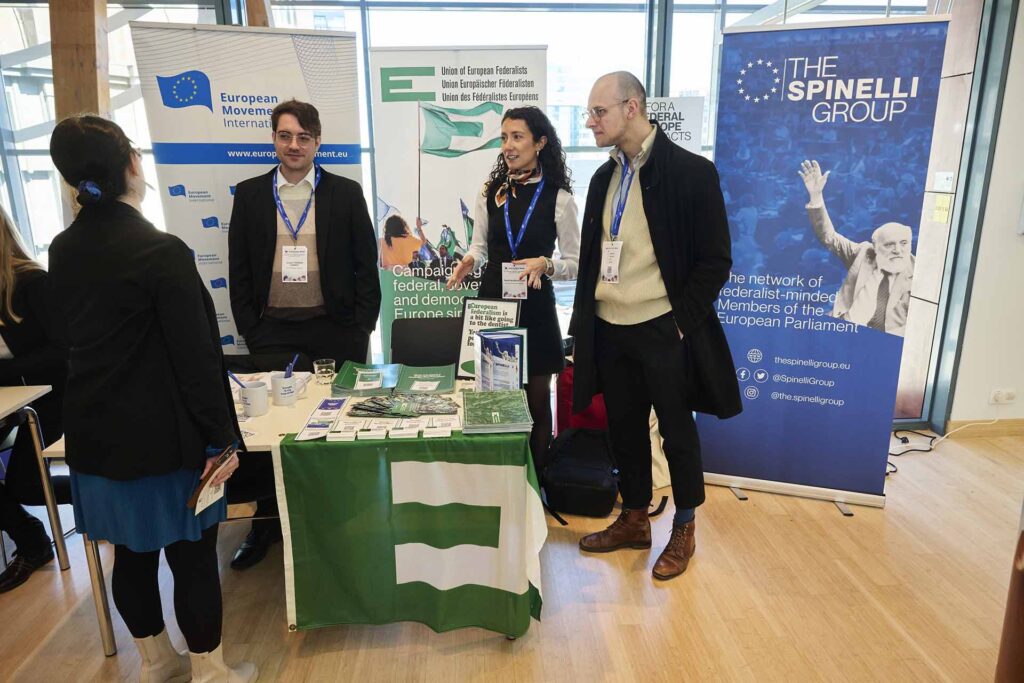
Last week, the Civil Society Week, organized by the European Economic and Social Committee, took place.
Just like in 2024, UEF was invited to participate in the CSW, an important platform where we discuss our activities and liaise with partners.
This year, the main focus was on strengthening cohesion and participation in polarized societies. Follow us throughout this week, filled with insightful discussions and enlightening exchanges of ideas and thoughts with colleagues.
We would also like to thank the Committee for organizing this successful event, all the speakers and contributors, and of course, our dear CSO colleagues. United, we are stronger!




Watch here the video about the event

This article was written by Guy Verhofstadt, President of the European Movement International, Former MEP and Former Prime Minister of Belgium and Domènec Ruiz Devesa, President of the Union of European Federalists and Former MEP, published on the 03 March 2025 in the weekly magazine il Venerdi di La Repubblica, about the need for the United States of Europe to stop TrumPutin.
You can read the article in Italian here: LINK.
Weapons Alone Are Not Enough: We Need the United States of Europe to Stop TrumPutin
The America of the tycoon can no longer be considered a partner. The EU needs more than just joint arms production; it needs defense and politics at the federal level.
Just over a month into his term, it is already abundantly clear that Trump's United States are no longer our allies. There is no need to recall the imperialist statements on the Panama Canal, Canada, or Greenland, the threats of trade wars, his direct dialogue with Putin—a bloodthirsty dictator responsible for the most severe war of aggression in Europe since 1945—the attack on European democracy by Vice President Vance, the insinuations by the U.S. Secretary of Defense about the end of American security guarantees or the withdrawal of U.S. forces from the continent.
With the verbal aggression and attempted humiliation of Zelensky in front of the cameras on February 28th, the U.S. President has certified the end of the transatlantic alliance born on the USS Augusta by Churchill and Roosevelt in the summer of 1941 against the Nazi threat. Instead, we see the emergence of a new Trump-Putin axis.
We no longer share the same vision of the world and the same values: defense of international law, multilateralism, and democracy. Regarding Ukraine, we disagree with his collusion with Putin to impose a solution that legitimizes the aggression and does not guarantee its long-term security and that of Europe.
It is clear that we cannot rely on the United States for the territorial defense and nuclear deterrence of Europe, and therefore not on NATO, at least as we have understood it so far. The military alliance is entering a period of hibernation for at least the next four years. What should we do in view of Thursday's European Council meeting?
First, we must collectively become aware of this new reality. Until February 28th, some EU leaders still denied it. Some refused to accept that the Americans are no longer our friends, continuing to repeat the Atlanticist mantra. This is unsustainable.
Like Britain in 1940, Europe stands alone in the face of a real and present danger and must take responsibility for helping Ukraine, ensuring its own competitiveness and security, and becoming a true federal power. Secondly, we must integrate Ukraine into the EU economy (except for agriculture), sign an agreement on the extraction of rare earths through the European Investment Bank, and intensify our financial and military support.
U.S. aid has been crucial so far, but it is not irreplaceable. In fact, the total amount of European aid is already higher than that of the U.S. Europe is one of the strongest economies in the world: Russia's GDP is barely equal to that of Spain. We have no less than 200 billion euros in frozen financial assets of the aggressor state, which we must seize to arm and rebuild Ukraine.
Germany must deliver the long-range Taurus missiles and remove any restrictions on the use of weapons against conventional Russian military targets. We must tighten sanctions against the Russian ghost oil fleet and close indirect trade through Central Asia that circumvents them.
Thirdly, we must address the dual geoeconomic and geostrategic threat posed by Trump with a new European industrial plan financed by common debt and new own resources to bridge the technological, investment, and competitiveness gap identified in the Draghi report and to strengthen our defense industrial capacity, including the creation of a European Armaments Bank.
An Existential Challenge
As with the pandemic, this is another existential challenge. But we cannot ensure our collective defense solely through the joint production of weapons. We must create a European Defense Community (EDC), with Ukraine's participation.
The EDC will be responsible for our territorial defense as the European pillar of NATO, which we can activate independently of Washington, applying the legal bases of the Lisbon Treaty on European common defense and Permanent Structured Cooperation. If Trump's allies in the Council were to block these possibilities, we would have to create them with a separate interim treaty, to be integrated into the EU framework as soon as possible.
We propose extending the scope of nuclear deterrence to all EU member states that wish to participate in financing the French arsenal. Simultaneously, we must strengthen our political union, eliminate national vetoes, and confer additional powers to the European Parliament through the federal reform of the treaties proposed by the European Parliament in 2023.
The well-intentioned still hesitate, but what else must happen for us to react? Russian tanks at the gates of Kiev or Warsaw? We must choose: the United States of Europe or TrumPutin.
The reconstituted Action Committee for the United States of Europe (USE) - originally created by Jean Monnet in 1955 - aims to stimulate reaching a political solution on such an urgent and critical question with a Memorandum on a European Defence Union, based on the establishment of a European Defence System (EDS), in view of the upcoming meeting of the European Council on 6th March, the Plenary of the European Parliament of 10th March, and the publication of the White Paper on Defence on 19th March, 2025.
In this regard, the Memorandum was sent by the Action Committee to the following policymakers: European Council President Antonio Costa, European Commission President Ursula von der Leyen, European Parliament President Roberta Metsola, High Representative for Foreign Affairs and Security Policy and Vice-President of the European Commission Kaja Kallas, European Commissioner for Defence and Space Andrius Kubilius, and the chairs of the pro-European political groups Valerie Hayer (Renew Europe), Manfred Weber (EPP) and Iratxe García Pérez (S&D).
The proposal of EDS consists of the national armies of the Member States and a 28th European Army, coordinated in a common structure. The EDS would be compatible with NATO and could serve as its European Pillar.
The proposal calls for :
- Massive joint defence investment, procurement, and research, as Russia’s military expenditure, calculated in purchasing power parity, has surpassed Europe’s combined defence spending last year
- Extension of Common Security and Defence Policy missions to territorial defence and security in our immediate neighborhood
- A Rapid Deployment Capacity of 60.000 soldiers, becoming a 28th European Army, complementary to the 27 national armies in charge of territorial defence
- Europeanisation of French nuclear capabilities with shared financing from willing EU member states.
To finance the EDS, as proposed yestarday, 4 March 2025, by the President of the European Commission, we recommend exempting defence investments from the deficit rule calculation of the Stability and Growth Pact, particularly for joint EU projects.
The Action Committee also call for new EU federal bonds backed up by additional own resources, and the use of the digital euro to set up a Defence Bank.
A European Defence System could be established either: by a unanimous decision of the European Council; by a large group of Member States that share a common vision through Permanent Structured Cooperation (PESCO); or, as a last resort, through an interim ad-hoc Treaty signed by willing Member States, to be integrated as soon as possible in the EU framework.
A democratic and fiscal reform, including the end of national vetoes in foreign and security policy, should be concluded as soon as possible in accordance with the European Parliament’s proposal of November 2023.
A European federation with a Common Defence will preserve national interests inside the EU and protect citizens and Member States against external aggressions.
As Friedrich Hölderlin said, “wherein lies the danger, grows the saving power”.
Now as in 1950, we need to develop creative efforts commensurate with the dangers that Europe is facing. The time is now.

UPDATE
The UEF has receved answers from the Chair of Renew Europe Valerie Hayer in data 5 March with the indication of this call of Renew sent to EU Leaders (LINK HERE)
Read the new UEF Policy Proposal on a Common European Defence
While there is broad recognition of the need for Common European Defence under the current geopolitical environment, including the collapse of the transatlantic alliance, there is still a lack of political leadership in both fostering it and in defining and implementing a concrete work plan within a short time frame. The main obstacles are political fragmentation, an undefined and therefore non-agreed end-goal, a lack of trust among member states, and, more significantly, the lack of political courage to pursue existing initiatives and institutional pathways. The absence so far of genuine political consensus among governments and European institutions on how to move forward is further complicated by institutional obstacles such as the unanimity rule.
The prevailing temptation is to simply increase national military spending within the NATO framework. However, accumulating national defence expenditures does not contribute to a truly European defence. Such an approach does nothing to improve Europe’s standing in power dynamics vis-a-vis Trump’s US, either within or outside NATO.
With this Proposal the Union of European Federalists aims to stimulate reaching a political solution on such an urgent and a critical question with a concrete proposal for a European Common Defence in accordance and in any event compatible with the Treaty of Lisbon, in view of the upcoming meeting of the European Council on 6th March, the Plenary of the European Parliament of 10th March, and the publication of the White Paper on Defence on 19th March, 2025.
Brussels, 4 March 2025
Domènec Ruiz Devesa
President of the Union of European Federalists and former Member of the European Parliament
Ilaria Caria
Secretary-General of the Union of European Federalists
EXECUTIVE SUMMARY
The Union of European Federalists proposes a Common European Defence
As war rages on European eastern borders and transatlantic alliance is in danger, the Union of European Federalists releases a proposal for a Common European Defence System (EDS), in view of the upcoming meeting of the European Council on 6th March, the Plenary of the European Parliament of 10th March, and the publication of the White Paper on Defence on 19th March, 2025.
The EDS consists of the national armies of the Member States and a 28th European Army, coordinated in a common structure. The EDS would be compatible with NATO and could serve as its European Pillar.
The proposal calls for :
- Massive joint defence investment, procurement, and research, as Russia’s military expenditure, calculated in purchasing power parity, has surpassed Europe’s combined defence spending last year
- Extension of Common Security and Defence Policy missions to territorial defence and security in our immediate neighborhood
- A Rapid Deployment Capacity of 60.000 soldiers, becoming a 28th European Army, complementary to the 27 national armies in charge of territorial defence
- Europeanisation of French nuclear capabilities with shared financing from willing EU member states.
To finance the EDS, as proposed today, 4 March 2025, by the President of the European Commission, we recommend exempting defence investments from the deficit rule calculation of the Stability and Growth Pact, particularly for joint EU projects.
We also call for new EU federal bonds backed up by additional own resources, and the use of the digital euro to set up a Defence Bank.
A European Defence System can be established by using the available provisions of the Treaty of Lisbon. A concrete progress with a group of willing countries is also possible to prevent a blockade by one or more Member States.
Setting up a Common European Defence is by nature a policy that defines, with monetary policy, a federal state. Therefore, whichever path will be the fastest and most effective, it will be a decisive step towards a European federation. This means an independent and democratic control of the EDS through the representatives of the European citizens and member States in the European Parliament and Council.
A democratic and fiscal reform, including the end of national vetoes in foreign and security policy, should be concluded as soon as possible in accordance with the European Parliament’s proposal of November 2023.
A European federation will preserve national interests inside the EU and protect citizens and Member States against external aggressions. The time is now.
The Union of European Federalists (UEF) has launched a petition to the European Parliament’s Committee on Petitions (PETI) to demand that the reform process of the European treaties—already initiated by the Parliament itself—finally moves forward.
Europe today faces an unstable and dangerous world: Russia’s aggression against Ukraine, the conflicts in the Middle East, the rise of authoritarian powers, and the prospect of a new Trump presidency aligned with Putin. In this context, a stronger and more united European Union is not only desirable, but necessary for survival.
The reports of Enrico Letta, Mario Draghi, and Sauli Niinistö clearly show that the EU, in its current intergovernmental form, is unable to ensure security, strategic autonomy, and competitiveness. The unanimity rule and the national vetoes block decision-making and weaken Europe’s capacity to act, threatening the European model of democracy, social justice, education, environmental protection, and fundamental rights.
The European Parliament, representing the citizens, has already taken a historic step with its Resolution of 22 November 2023 calling for a Treaty reform through Article 48 TEU. But the European Council has so far ignored its legal obligation to act. This is unacceptable: democracy requires that the voice of citizens and their Parliament be respected.
With this petition, the UEF and its members across Europe call on the European Parliament to:
- reaffirm its demand for a Convention on Treaty reform;
- use all its powers, including budgetary leverage, to oblige the Council to respect Article 48 TEU;
- forward its draft Treaty reform to national parliaments;
- and, if necessary, bring the Council before the Court of Justice of the EU.
This is a battle for democracy, for security, and for the future of Europe. We invite all citizens, associations, and institutions that believe in a federal, democratic, and sovereign Europe to support this petition and help us make sure that Europe finally becomes capable of acting and protecting its citizens.
Read here the Petition and the first signatories
The European Letter is back.
For Europe, the long season of illusions is over: the belief that it could count indefinitely on American protection, that the globalised world could guarantee peace and stability thanks to trade liberalisation and economic interdependence, that the democratic model would inevitably spread throughout the world. Europe thus finds itself exposed to very serious threats to its security, while experiencing a sharp economic decline and weakened by a political crisis that is seeing a growing consensus of nationalist, anti-European and anti-democratic forces. If these multiple crises are not used as an opportunity to strengthen political integration, there is a real risk that the European Union will break up. Only a politically united Europe will be able to survive and prosper again in the new context.
To confront the threats posed by the US and Russia, European democratic governments must demonstrate the political will to take concrete steps towards building an effective autonomous defense. This defense will enable Europeans to ensure their own security and that of Ukraine.
The European Letter is published in 7 languages - from the edition 77 - under the auspices of the Luciano Bolis European Foundation in cooperation with the Union of European Federalists.
The European Letter is a periodical publication started in 1997 with the aim of stimulating political debate in national parliaments and governments, and in the European Parliament.
The European Letter 84 entitled "Making Europe truly great", is sent to parliamentarians in the following legislative bodies:
- European Parliament
- Bundestag
- Parliament of the French Republic
- Parliament of the Italian Republic
- Cortes generales (Spanish Parliament)
- Nationalrat (Austrian Parliament)
- Belgian Federal Parliament
- Hellenic Parliament
- Parlamentul României
- Eduskunta (Parliament of Finland)
Here the version avaiable:
SPANISH
ROMANIAN
Read the new UEF Federalist Paper 1/2025 about the meaning of the so-called Report Draghi in the federalist perspective.
From the Preface
Never in the history of the integration process have Europeans stood on the brink of the abyss as they do today.
In a global context in which geopolitical powers of continental dimensions compete fiercely with each other for resources, markets and spheres of political influence, and which is characterized by instability and wars, the European Union, if disunited and weak, risks being like a sheep among wolves, and having to choose, unable to determine its own destiny, which master it will obey.
In this context, Donald Trump's election as President of the United States constitutes a disruption of the transatlantic relation and therefore should be a wake-up call for the European Union. While the U.S. supported and encouraged European integration in the aftermath of World War II and ensured the continent's defense, the Trump administration has the clear objective of advancing a national-populistic agenda, and to this effect, dividing the Europeans and weakening them.
Elon Musk's immense economic power, coupled with his attempts to influence election outcomes in European countries by encouraging support for far-right movements, the allure for some nations to rely on his satellites for their security, and the lack of a cohesive political vision among European states—some of which, out of fear of a Russian advance under Putin, would dream of keeping a close alignment with the Trump administration—are all factors creating the perfect storm. A storm that Europeans can weather only if they decisively demonstrate the will to unite politically and take concrete steps in this direction.
Mario Draghi's report on the future of European competitiveness underscores this urgency. The report highlights the weaknesses and lack of competitiveness that plague Europe when it remains divided, as well as the immense potential it could unlock through political unity, including a proper European Defence System that is not dependent on US.
It is no longer enough to advance through small, incremental steps under the current treaties, especially in an unstable international environment. Europe's reliance on external powers for energy, technology, and defense is unsustainable.
All the proposals put forward in the Draghi Report require that Europe endows itself with a political head, a budget worthy of the name financed through a European taxation system, and decision-making mechanisms that are democratic and no longer based on unanimous agreement between governments.
This is the core message that we, as the Union of European Federalists, through this paper, want to emphasize, with the aim to contribute to the process of reflection started by the Report.
But these goals can only be achieved if a discussion is opened on a thorough overhaul of the Union's decision-making mechanisms and institutional set-up, and thus on a comprehensive, federal reform of the existing Treaties, as called for by the European Parliament in its November 2023 reform proposal for the convening of a Convention, which the European Council has so far chose to ignore, in breach of its legal obligations under article 48 of the Treaty of the European Union.
Europeans must take their destiny in their own hands. If they do not, decisions on Europe’s future will be taken by others, and its achievements in terms of democracy, freedom, the welfare state, and the protection of rights will be in danger. In fact, they are already at risk.
Brussels and Pavia, 3 February 2025
- Domènec Ruiz Devesa, President of the Union of European Federalists and former Member of the European Parliament
- Giulia Rossolillo, Vice-President of the Union of European Federalists and Professor of European Union Law of University of Pavia
The Executive Bureau of the UEF decided to join the initiative proposed by the Italian section of the UEF Movimento Federalista Europeo to try to identify the symbolic date of February 24 as the European day of resistance, 3 years after the beginning of the war of Russian aggression in Ukraine.
You can support this appeal signing here
24 FEBRUARY | EUROPEAN RESISTANCE DAY
APPEAL TO THE EUROPEAN UNION
On 24 February 2022, with the invasion of Ukraine, Russia declared war on the whole of Europe.
The project of European unity was born during the Resistance against Nazi-fascism, in order to ensure peace, democracy and freedom for the peoples of Europe, with shared sovereignty in various areas, through the creation of common institutions and policies.
Ukraine has chosen to be part of this process. Their resistance to Putin’s war, which is also a war to divide Europe, is therefore that of all Europeans who reject nationalism and imperialism, believe in freedom and democracy, and share the battle for a free and united Europe.
The European Federalist Movement therefore calls for the proclamation of 24 February as ‘European Resistance Day’, symbolising the struggle for freedom, democracy and peace.
Long live the Ukrainian Resistance! Long live European Unity!
24 ЛЮТОГО | ЄВРОПЕЙСЬКИЙ ДЕНЬ ОПОРУ
ЗВЕРНЕННЯ ДО ЄВРОПЕЙСЬКОГО СОЮЗУ
Вторгненням в Україну 24 лютого 2022 року Росія оголосила війну всій Європі.
Проект європейської єдності народився за часів руху опору наци-фашизму з метою забезпечення миру, демократії та свободи для народів Європи завдяки об’єднанню суверенітету в різних сферах, створенню спільних інституцій та запровадженню спільної політики.
Україна вже давно вирішила стати частиною цього процесу. Тому її спротив путінській війні, яка націлена не лише на захоплення України, а й на розподіл Європи, є спротивом усіх європейців, які відмовляються від націоналізму та імперіалізму, вірять у свободу та демократію і прагнуть боротися за вільну та об’єднану Європу.
Тому Європейський федералістичний рух пропонує проголосити день 24 лютого “Європейським днем спротиву”, як символ боротьби за свободу, демократію і мир.
Хай живе український Опір! Хай живе Європейська Єдність!
24 FEBBRAIO | GIORNATA DELLA RESISTENZA EUROPEA
APPELLO ALL’UNIONE EUROPEA
Il 24 febbraio 2022, con l’invasione dell’Ucraina, la Russia ha dichiarato guerra a tutta l’Europa.
Il progetto dell’unità europea è nato durante la Resistenza al nazifascismo, al fine di assicurare la pace, la democrazia e la libertà per i popoli europei, con la condivisione della sovranità in diversi settori, grazie alla creazione di istituzioni e politiche comuni.
L’Ucraina ha scelto da anni di essere parte di questo processo. La sua Resistenza alla guerra di Putin, che è guerra anche per dividere l’Europa, è perciò quella di tutti gli Europei che rifiutano il nazionalismo e l’imperialismo e credono nella libertà e nella democrazia, e condividono insieme la battaglia per un’Europa libera e unita.
Il Movimento Federalista Europeo propone pertanto di proclamare il 24 febbraio “Giornata della Resistenza Europea”, simbolo della lotta per la libertà, la democrazia e la pace.
Viva la Resistenza Ucraina! Viva l’Unità Europea!
24 FÉVRIER | JOURNÉE EUROPÉENNE DE LA RÉSISTANCE
APPEL À L'UNION EUROPÉENNE
Le 24 février 2022, avec l'invasion de l'Ukraine, la Russie a déclaré la guerre à l'ensemble de l'Europe.
Le projet d'unité européenne est né pendant la Résistance contre le nazisme et le fascisme, afin d'assurer la paix, la démocratie et la liberté pour les peuples d'Europe, avec une souveraineté partagée dans divers domaines, par la création d'institutions et de politiques communes.
L'Ukraine a choisi de faire partie de ce processus.
Leur résistance à la guerre de Poutine, qui est aussi une guerre visant à diviser l'Europe, est donc celle de tous les Européens qui rejettent le nationalisme et l'impérialisme, croient en la liberté et la démocratie, et partagent le combat pour une Europe libre et unie.
Le Mouvement Fédéraliste Européen appelle donc à la proclamation du 24 février comme « Journée Européenne de la Résistance », symbolisant la lutte pour la liberté, la démocratie et la paix.
Vive la Résistance Ukrainienne ! Vive l'Unité Européenne !
24 DE FEBRERO | DÍA EUROPEO DE LA RESISTENCIA
LLAMAMIENTO A LA UNIÓN EUROPEA
El 24 de febrero de 2022, con la invasión de Ucrania, Rusia declaró la guerra a toda Europa.
El proyecto de unidad europea nació durante la Resistencia contra el nazismo y el fascismo, con el objetivo de asegurar la paz, la democracia y la libertad para los pueblos de Europa, con soberanía compartida en diversas áreas, mediante la creación de instituciones y políticas comunes.
Ucrania ha elegido formar parte de este proceso.
Su resistencia a la guerra de Putin, que también es una guerra para dividir Europa, es, por lo tanto, la resistencia de todos los europeos que rechazan el nacionalismo y el imperialismo, creen en la libertad y la democracia, y comparten la lucha por una Europa libre y unida.
El Movimiento Federalista Europeo, por lo tanto, hace un llamamiento para la proclamación del 24 de febrero como «Día Europeo de la Resistencia», simbolizando la lucha por la libertad, la democracia y la paz.
¡Viva la Resistencia Ucraniana! ¡Viva la Unidad Europea!
24. FEBRUAR | EUROPÄISCHEN WIDERSTANDSTAG
AUFRUF AN DIE EUROPÄISCHE UNION
Am 24. Februar 2022 erklärte Russland mit der Invasion in der Ukraine dem gesamten Europa den Krieg.
Das Projekt der europäischen Einheit entstand während des Widerstands gegen den Nationalsozialismus und Faschismus, um Frieden, Demokratie und Freiheit für die Völker Europas zu gewährleisten, mit geteilter Souveränität in verschiedenen Bereichen durch die Schaffung gemeinsamer Institutionen und Politiken.
Die Ukraine hat sich entschieden, Teil dieses Prozesses zu sein.
Ihr Widerstand gegen Putins Krieg, der auch ein Krieg ist, um Europa zu spalten, ist daher der Widerstand aller Europäer, die Nationalismus und Imperialismus ablehnen, an Freiheit und Demokratie glauben und den Kampf für ein freies und vereintes Europa teilen.
Die Europäische Föderalistische Bewegung ruft daher zur Proklamation des 24. Februar als „Europäischer Widerstandstag“ auf, der den Kampf für Freiheit, Demokratie und Frieden symbolisiert.
Es lebe der ukrainische Widerstand! Es lebe die europäische Einheit!