

Brussels, 24 June 2026
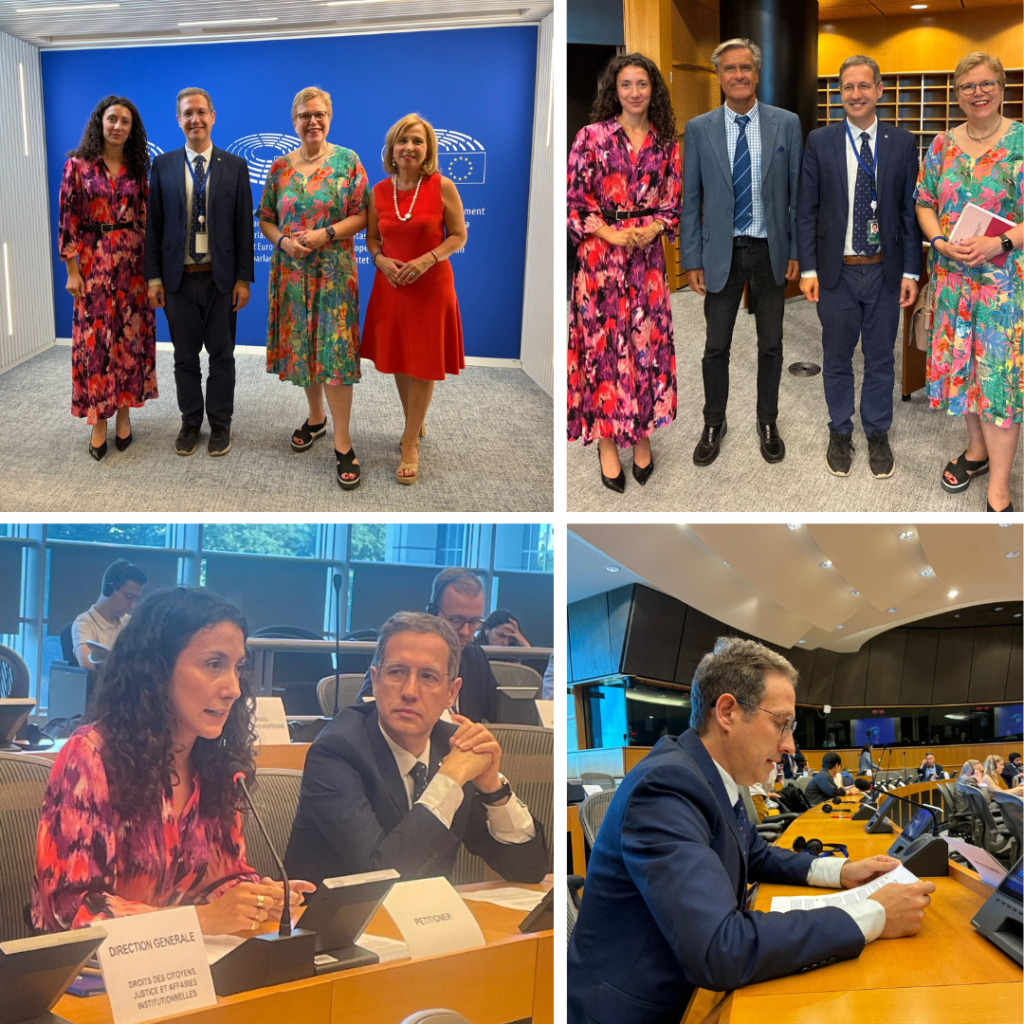
The Union of European Federalists (UEF) welcomes the decision of the European Parliament's Committee on Petitions (PETI) to declare open Petition No. 0456/2025 on the Reform of the Treaty of Lisbon, following a public hearing held yestarday, on 23 June 2026.
The petition was presented before the Committee by UEF President Domènec Ruiz Devesa and Secretary General Mathilde Baudouin, in the presence of the UEF Vice-President Daphne Gogou. The PETI Committee's decision to keep the petition open represents a significant step forward in the campaign Treaty Reform Now! and reinforces the UEF's call for a federal, democratic and sovereign Europe capable of acting decisively on the global stage.
During the hearing, the petition received the explicit support of eight Members of the European Parliament spanning multiple political groups: MEPs Andrea Wechsler, Brando Benifei, Raquel García Hermida-Van der Walle, Gabriele Bischoff, Nikolas Farantouris, Vasile Dîncu, Juan Fernando López Aguilar, and Thijs Reuten. Their cross-partisan backing demonstrates growing parliamentary consensus around the urgent need for institutional reform.
Speaking before the Committee, UEF President Ruiz Devesa stressed the existential urgency of the moment: "The EU faces an increasingly unstable world. The decision-making processes, often conditioned by vetoes, paralyze our ability to respond to crises. This is unacceptable." Secretary General Baudouin underlined the democratic dimension of the petition: "The European Parliament is the only institution directly elected by European citizens, and its proposals must not be ignored."
The petition urges the PETI Committee to keep the matter open as a priority, to request an implementation report from the Committee on Constitutional Affairs (AFCO) to track progress on Treaty reform, and to address institutional reform in the context of the MFF negotiations and the 2027 budget, using Parliament's budgetary powers to press the Council into action.
The UEF recalls that the European Parliament has already twice reaffirmed its commitment to Treaty change since the petition was submitted in April 2025 — through resolutions adopted in October and November 2025 — while the European Council has continued to ignore Parliament's calls to open a Convention under Article 48 TEU.
"Citizens across Europe are calling for a stronger, united Europe capable of defending democracy, providing security, and acting with one voice," said Ruiz Devesa. "Today's hearing shows that an increasing number of MEPs are willing to stand with them, and that the European Commission is ready to move forward. The European Council must no longer delay."
PRESS CONTACT
Mathilde Baudouin, Secretary General of the UEF
Please find the attachments below
Brussels, 23 June 2026
European security is under threat, together with the world order, as shown by four years of Russian aggression on Ukraine. However, progress on European defence is very insufficient, both at the industrial and political dimensions, which in fact are closely connected. The collapse of the Franco-German-Spanish Future Combat Air System (FCAS) is a very illustrative case in point of a political gap masked by industrial failure, due to the disagreements between privately owned Dassault and the semi-state-owned Airbus, over control of the programme and workshare, access to sensitive technology, and ownership of the intellectual property developed during the project.
The collapse of FCAS pushed German and Spanish companies to propose a new “Team Gen 6”, outlining plans to pursue a next-generation fighter architecture outside the original SCAF framework. All of this, while the alternative Global Combat Air Program (GCAP) by Italy, UK and Japan is going ahead. We risk having three competing projects, where we need just one.
However, the industrial deadlock between Dassault and Airbus was not merely a commercial dispute over workshare and intellectual property, but the expression of different national political preferences and defence postures: France's doctrine of full military self-sufficiency - encompassing not only independent nuclear deterrence, but also carrier aviation, and sovereign control over its entire defence industrial base - clashed with Germany's different operational requirements and its preference to operate with allied systems. Ultimately, the governments proved either unwilling or unable to impose a compromise on the companies - unwilling, because the positions each company defended largely reflected what their respective governments considered non-negotiable national interests, and unable, because forcing a concession would have meant overriding those very interests.
In other words, this case shows once again, very clearly, that neither industrial companies nor national governments to which they are linked, can lead on military integration. A greater role for the European Commission and the European Defence Agency operating within the framework of a Common European Defence System, and stricter requirements to access EU funding is needed to go towards joint procurement and the reduction of the European weapons system. The fact that the 27 Member states have around 130 types of major land, air and naval weapon systems and the US around 30, is a key reason why we spend 30% of the US with a 10% capacity, thus wasting most of our expenditures ineffectively. The EU should incentivise the merging of these projects to create one European sixth generation fighter jet.
To reach strategic autonomy Member states must accept to go beyond voluntary industrial cooperation toward limited but real centralised procurement authority for major defence systems, alongside clearer allocation of industrial leadership based on capability rather than political return. Successful EU defence procurement is in the end dependent on setting up a European Common Defence. A European multinational force, starting with the Rapid Deployment Capacity, to whom to allocate EU-funded defence equipment is thus a crucial step.
Such an EU supranational authority must define what we need, and thus the technical specificities of the future weapon system, and the open procurement to procedures, instead of national enterprises that reflect private interests or narrow national interests.
While national defence expenditures are increasing, joint procurement is stuck at 20 per cent. However, the new Security Action for Europe (SAFE) threshold for joint procurement is even lower than the European Defence Industry Reinforcement through Common Procurement Act (EDIRPA) ones. If SAFE 150 billion € were used to strengthen EDIRPA, the European Defence Fund and the European Defence Agency to finance joint programs (for example to merge the Anglo-Japanese Global Combat Air Programme and the FCAS), this would allow significant progress. But SAFE only finances national military expenditures, which continue to benefit mainly US enterprises, with US weapons exports to Europe doubling between 2021 and 2024.
An EU defence is essential to gain deterrence capacity and ensure the EU security, spending more efficiently and reducing US dependencies. This requires identifying our capability gaps – an exercise regularly done both within NATO and the EU – developing tools to fill them, starting with the strategic enablers, for which we depend massively on the US. The Joint Undertakings could be a tool for the Commission, Members states and private actors to cooperate in developing European satellite monitoring and communication systems, air defence, troop transport, and cyber-defence capacities.
The EU must rise to the challenge of the reduced US commitment to European security, amplified and accelerated by the current administration, but started much earlier. The NATO New Force Model, approved under Biden Presidency, foresees that in the case of an attack against a European NATO member, NATO should mobilise 300.000 troops in a month, all of them Europeans. Only at later stages US troops could eventually be mobilised. With a possible significant reduction of the US troops in Europe, the need to strengthen EU capacity for territorial defence is evident. Permanent Structured Cooperation on Defence (PESCO) could be used by willing Member states to upgrade the Rapid Deployment Capacity into an EU permanent multinational force – already agreed by the European Council in Helsinki in 1999 but never made fully operational – to communitarise existing bi-lateral and multinational military cooperation among Member states, like the Baltic Naval Squadron, the Franco-German Brigade, the Eurocorps, etc, and to develop a true EU command-and-control system, possibly linked to NATO.
As Mario Draghi said in Aachen “external hardness requires internal depth”. Progress in common defence, a common industrial policy, and investments (which require resources), and federal political union, are closely interlinked. Achieving them requires the political will of at least some Member States to proceed in a unified manner across all these sectors. If steps are not taken along this path soon, citizens’ confidence in Europe’s ability to protect them will further erode, and nationalist forces will gain ground.
Domènec Ruiz Devesa, President of the UEF
Mathilde Baudouin, Secretary General of the UEF
Brussels-Madrid, 29 May 2026
The Union of European Federalists Spain (UEF España), the Union of European Federalists (UEF), and the Spanish Federal Council of the European Movement (CFEME) welcome the approval by the Spanish Congress of Deputies of a Resolution (Proposición No de Ley) calling on the Government of Spain to declare, with irrevocable character, Spain's membership of the European Union, and support for the federal reform of the Treaties.
On 28 May 2026, the Plenary of the Congress of Deputies approved Resolution 162/000767, ext negotiated across parliamentary groups, which instructs the Government of Spain to:
- Reaffirm and advance Spain's commitment to the European project as guarantor of democracy, the rule of law, human rights, security and economic stability;
- Declare with irrevocable character Spain's membership of the European Union;
- Support in the European Council the project for reform of the Treaties to strengthen European sovereignty and independence, endowing the Union with greater capacity to act in foreign policy, security, defence, energy, industry and the ecological, digital and social transitions, while guaranteeing social and territorial cohesion and the principle of subsidiarity;
- Promote the full development of the Treaties and the Charter of Fundamental Rights with regard to regions and peoples of the European Union;
- Work with fellow Member States towards the recognition of Basque, Galician and Catalan as official languages of the European Union.
The resolution was approved with the support of several parliamentary groups and marks the 40th anniversary of Spain's accession to the then European Communities, formalised on 12 June 1985.
A Milestone in Spain's European Vocation
UEF España, UEF and CFEME welcome this resolution as a significant political statement. Spain has consistently been one of the most pro-European societies in the Union, and this declaration consolidates that tradition at the highest level of democratic representation.
The resolution is also notable for its explicit endorsement of the reform of the EU Treaties proposed by the European Parliament in November 2023 — a proposal that has long formed part of the agenda advocated by European federalist organisations. Moving beyond unanimity rules and strengthening the Union's capacity to act in key policy areas is not a federalist aspiration alone: it is, as the resolution rightly states, a functional necessity for a Union that must remain credible and effective in an increasingly complex world.
The Role of Civil Society
Our organisations have long argued, through publications, public debate and engagement with political actors, that Spain's commitment to the European project should be stated clearly and durably — not as a mere political preference but as a foundational orientation of the Spanish state.
We are pleased that these debates have found their way into the legislative process, and we acknowledge with appreciation the initiative of the Socialist Parliamentary Group (GPS) and the other parliamentary groups that supported or contributed to the final text. This is, above all, a success of Spain's democratic institutions and of the broad pro-European consensus that underpins them.
Looking Ahead: From Parliamentary Resolution to Government Declaration
A parliamentary resolution is a powerful political signal. Its full potential, however, will be realised only when the Government of Spain acts upon it. We call on the Government to follow through on the mandate of the Congress by issuing a formal, solemn declaration of Spain's irrevocable commitment to the European Union — a step that, under the principles of international law governing unilateral declarations of States, would carry legal weight beyond the domestic political sphere.
We equally urge the Spanish Government to translate its support for Treaty reform into active, constructive engagement within the European Council, where this proposal has yet to receive the attention it deserves.
Quotes
Enrique Barón Crespo, President of the UEF España: "Forty years after accession, Spain is not merely a member of the European Union — it is one of its most committed builders. This resolution reflects that spirit and sends a clear message: Spain's place is in Europe, and that place is not up for debate."
Domenec Ruiz Devesa, President of the UEF: "We congratulate the Spanish Congress of Deputies for this forward-looking resolution. At a time when the European project needs friends who speak clearly, Spain has done so. We hope other national parliaments will follow this example in supporting the proposal to reform the Treaties"
Francisco Aldecoa , President of the CFEME: "The European Movement has worked for decades to make European integration irreversible not just in law but in the hearts and minds of citizens. This resolution is a step in that direction, and we encourage the Government to give it the fullest possible effect."
About the organisations
- UEF España (Unión de Europeístas y Federalistas de España) is the Spanish section of the Union of European Federalists, advocating for a democratic, federal and united Europe.
- UEF (Union of European Federalists) is a pan-European citizens' organisation with members across all EU Member States, working towards a federal Europe based on the rule of law, democracy and fundamental rights.
- CFEME (Consejo Federal Español del Movimiento Europeo) is the Spanish national council of the European Movement International, the oldest pro-European civil society network in Europe.
For media enquiries, please contact:
- UEF Secretariat, secretariat@federalists.eu
Forty years after the death of Altiero Spinelli, President of the Italian Republic Sergio Mattarella paid tribute to one of the founding fathers of a united and federal Europe with a powerful and deeply meaningful declaration.
Remembering Spinelli as “a free spirit” and a tireless advocate for democracy, freedom, and European unity, President Mattarella highlighted the enduring relevance of the vision born in Ventotene: a Europe capable of overcoming nationalism, war, and division through political integration and supranational democracy.
From the Ventotene Manifesto to the “Spinelli Plan”, Altiero Spinelli dedicated his entire life to the construction of a federal Europe founded on peace, solidarity, and democratic values. His political courage and intellectual legacy continue to inspire generations of Europeans committed to strengthening the European project.
The Union of European Federalists warmly welcomes and deeply appreciates this important declaration by President Mattarella honouring Altiero Spinelli, co-founder of the UEF and one of the most influential architects of European integration.
At a time when Europe faces war, geopolitical instability, and growing challenges to democracy, Spinelli’s message remains more relevant than ever: European unity is not only an aspiration — it is a necessity.
His legacy lives on in all those who continue to work for a stronger, more democratic, and truly federal Europe.
Here the original declaration in Italian: LINK
Here below the translation in English
“Altiero Spinelli, a free spirit, was a leading figure in the struggle for a democratic and united Europe.
He paid dearly for defending his ideals, enduring years of imprisonment and internal exile as an opponent of the Fascist regime and, later, expulsion from the Communist Party for his criticism of Stalinism.
Freedom and democracy were the cornerstones of Spinelli’s thought and public commitment, later reflected in his role within Italian social democracy after the war.
It was precisely during his confinement on the island of Ventotene that, together with Ernesto Rossi and Eugenio Colorni, Spinelli conceived the idea of a united and federal Europe as an innovative system of regional cooperation and an effective mechanism to prevent further wars among states.
The Manifesto for a Free and United Europe outlined several founding principles of what would later become the common European order, including the removal of barriers to trade and the establishment of an advanced supranational organisation capable of adopting directly effective decisions.
For Spinelli, that Manifesto marked the beginning of a lifelong commitment to strengthening the idea of an integrated Europe. This dedication was reflected in the founding of the European Federalist Movement, his appointment by the Rumor Government as a member of the Commission of the European Communities, and his subsequent political engagement following his election to the Italian Parliament with the Independent Left and to the European Parliament as an independent candidate on the Communist Party lists.
Re-elected in 1979 during the first direct universal elections to the Strasbourg Assembly, he launched the Draft Treaty establishing the European Union.
The ‘Spinelli Plan’ revived the process of European integration, laying the foundations for the future negotiations that led to the adoption of the Single European Act — a decisive step toward an even more integrated Europe.
Forty years after his passing, Altiero Spinelli’s legacy remains a precious heritage of values and ideals for both Italy and Europe.
The Republic is grateful to him.”
Rome, 23 May 2026 (Second term)
The Dutch Renew and D66 MEP Raquel García Hermida-van der Walle will take over the rotating presidency of the parliamentary intergroup.
Strasbourg, May 21, 2026
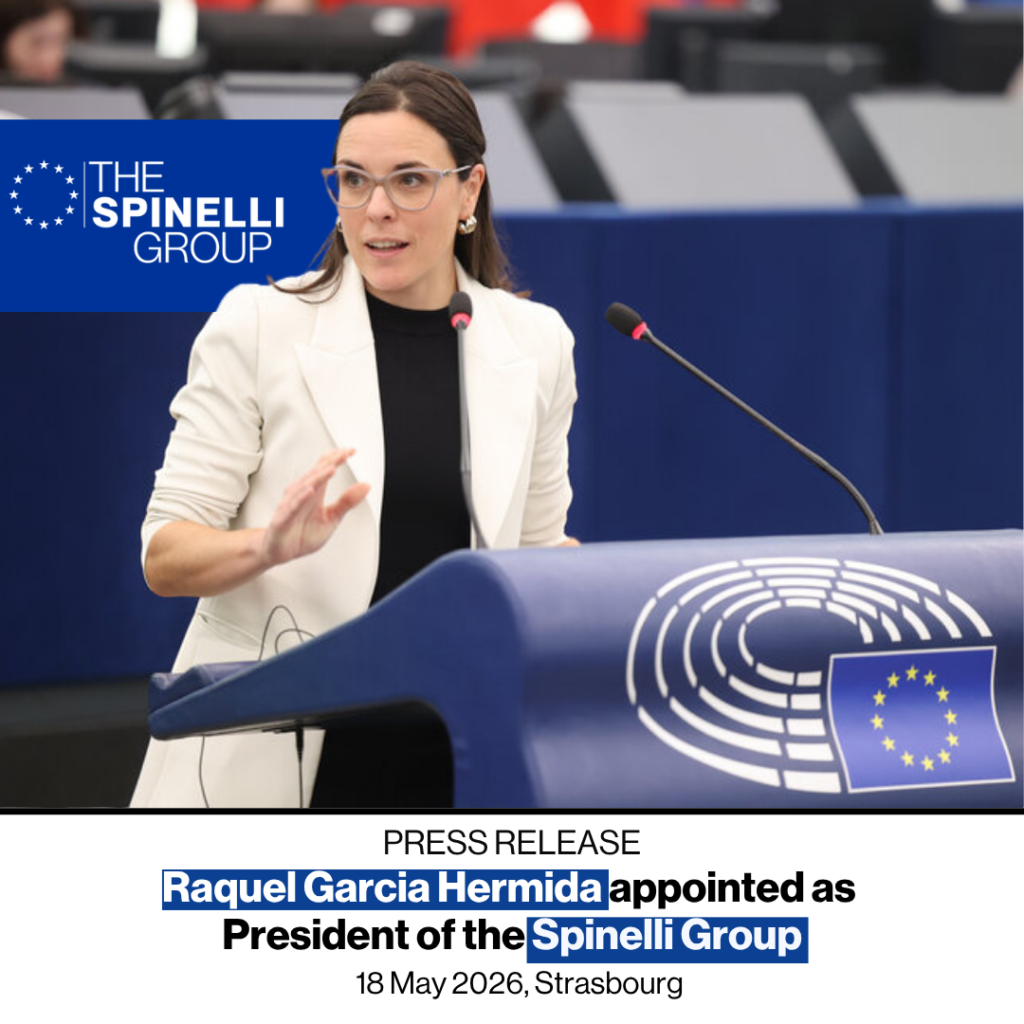
Dutch Renew Europe and D66 MEP Raquel García Hermida-van der Walle will take over the rotating presidency of the parliamentary intergroup. She was elected by acclamation on Monday 18th May by the Spinelli Group Board in Strasbourg.
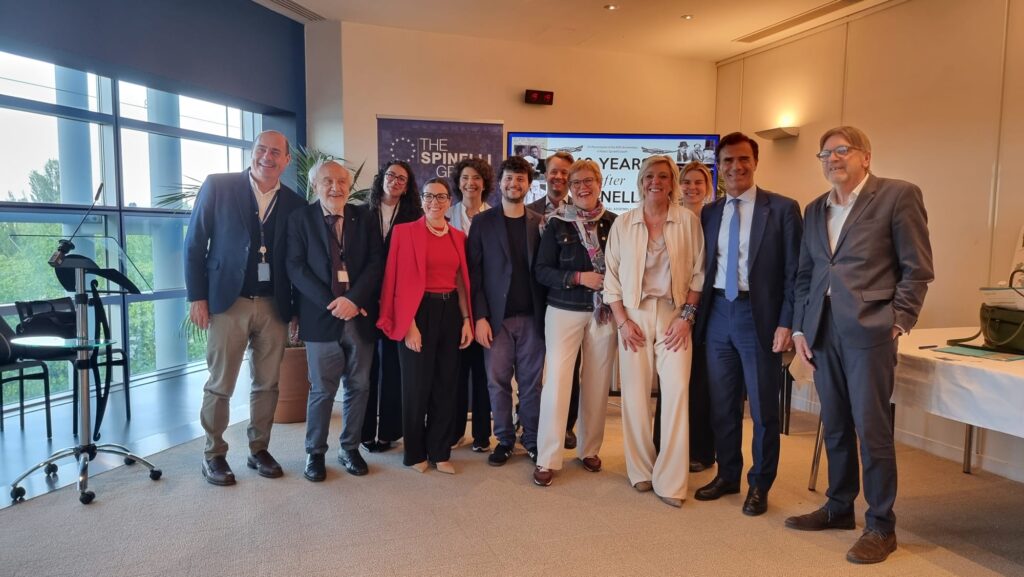
The appointment was announced during the Public General Assembly “40 Years After Spinelli”, held at the European Parliament to honour the legacy of Altiero Spinelli and his vision for a federal Europe promoted by the UEF and European Movement France.
As Raquel García Hermida-van der Walle succeeds Gabriele Bischoff, S&D and SPD MEP and First Vice-President of Europa-Union Deutschland, in the rotating presidency of the Spinelli Group, the Union of European Federalists (UEF) expresses its full support for her leadership and its continued commitment to working closely with the Group in advancing the federalist cause.
The Spinelli Group and the Union of European Federalists warmly thank Gabriele Bischoff for her dedicated chairwomanship since July 2025 and her commitment to strengthening the federalist movement within the European Parliament.
“Serving as Chair of the Spinelli Group has been a profound honour. At a time when Europe faces existential geopolitical, democratic and social challenges, our responsibility has been to defend and strengthen the European project with courage and ambition.
As the first woman ever to chair the Spinelli Group, I am particularly proud to have contributed to broadening and strengthening our federalist coalition across political families and national borders. Europe’s future will only be secured through unity, democracy and a stronger capacity to act together.
The European moment is now. Europeans expect us to move beyond fragmentation and vetoes, and to build a Union capable of protecting its citizens, defending its values and shaping its own destiny.” Gabriele Bischoff said.
During Bischoff’s presidency, and in addition to regular Board meetings, the Spinelli Group organised several politically significant events dedicated to the future of European integration and institutional reforms.
These included:
- The high-level conference “For a Stronger, More Democratic and Inclusive European Union – Towards a European Federation” in November 2025 in the Hellenic Parliament in Athens, which brought together policymakers and civil society representatives to discuss democratic reform and the future architecture of the European Union.
- The initiative “Bring a European Federalist” reception at the European Parliament in Strasbourg, aimed at fostering dialogue between Members of the European Parliament and inviting them to join the Spinelli Group.
- The round table held during the UEF European Congress in Barcelona, entitled “Is Draghi’s Pragmatic Federalism enough to face current challenges?”
- The event in May 2026 in the European Parliament in Strasbourg celebrating 40 years after Altiero Spinelli’s passing.Under Bischoff’s leadership, the Spinelli Group also adopted and promoted an updated political manifesto, “The European Moment is Now”, calling, in a concrete and pragmatic proposal, for a more sovereign, democratic and federal European Union capable of acting decisively in an increasingly unstable global environment.
The new President, Raquel García Hermida declared after her appointment: “Forty years ago, Spain joined the European Union. Today, as a Spaniard who became a Dutch citizen and now serves as a Dutch Member of the European Parliament, I see my own story as part of the European story itself.
The European Union gave me the freedom to live, work, and participate politically across borders. That is the European dream: a Europe where everyone can benefit from freedom, opportunity, and shared citizenship.
But our freedoms, prosperity, and security cannot be taken for granted. I deeply believe that only a stronger and more federal Europe can protect future generations and preserve the values that define us.
We do not need the American dream. We have our own European dream. And in that dream is the future of civilization as we know it.”
The federalist movement is deeply grateful to have such dedicated individuals supporting its cause.
Thank you very much Gabriele, Good work Raquel!
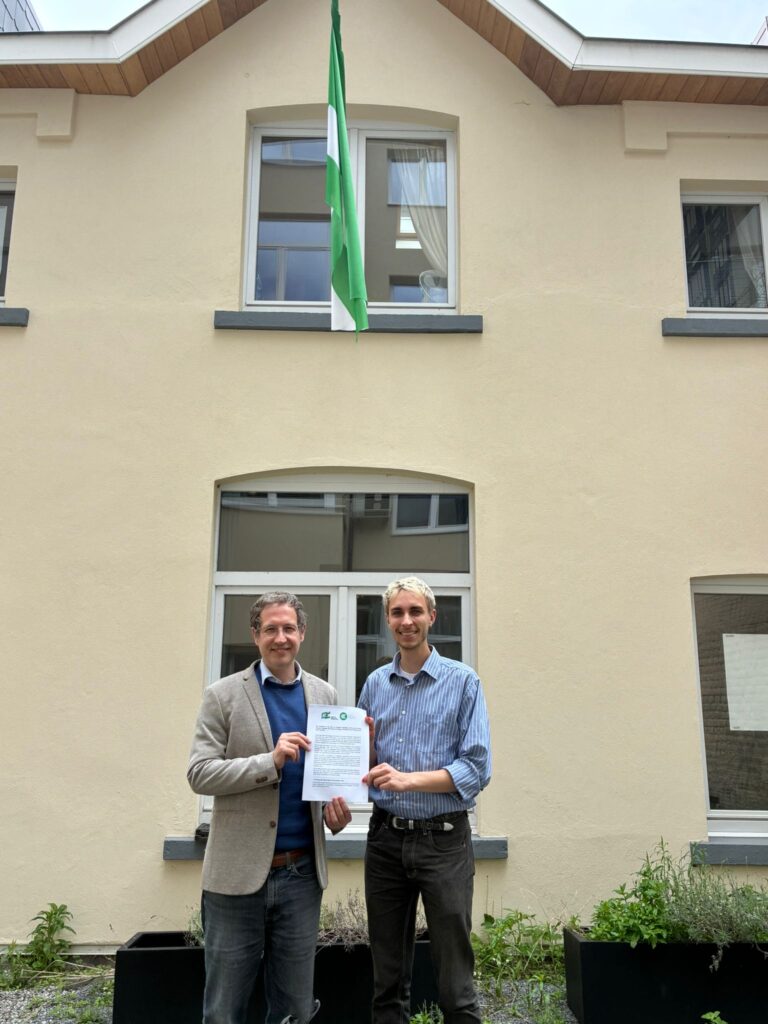
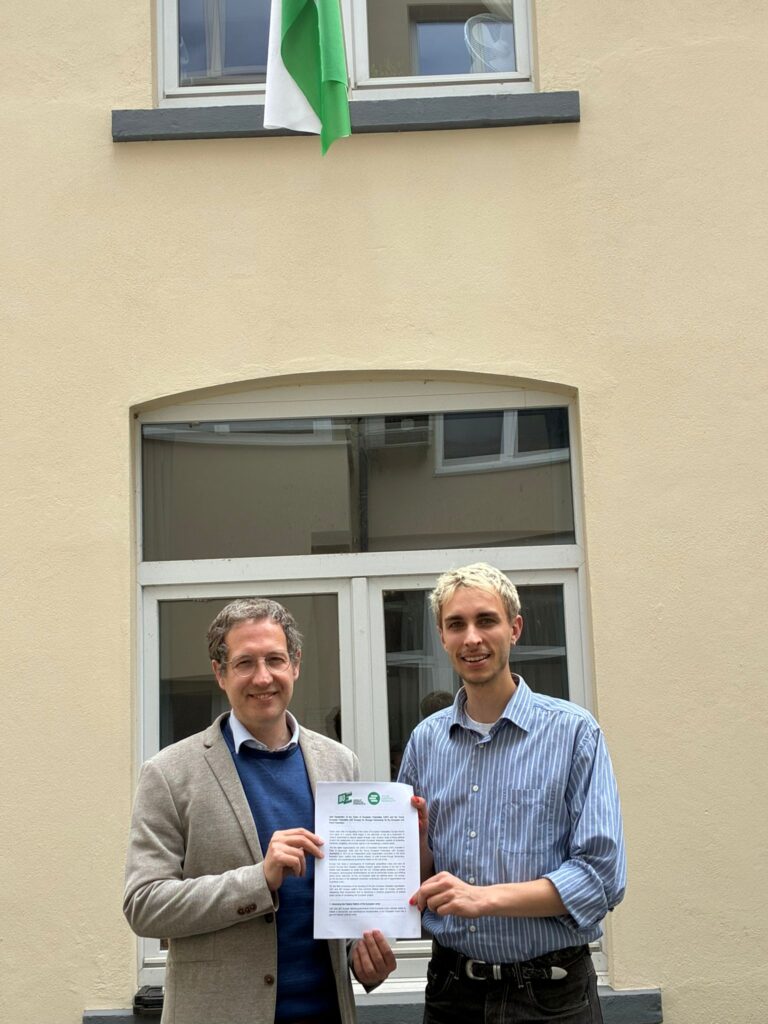
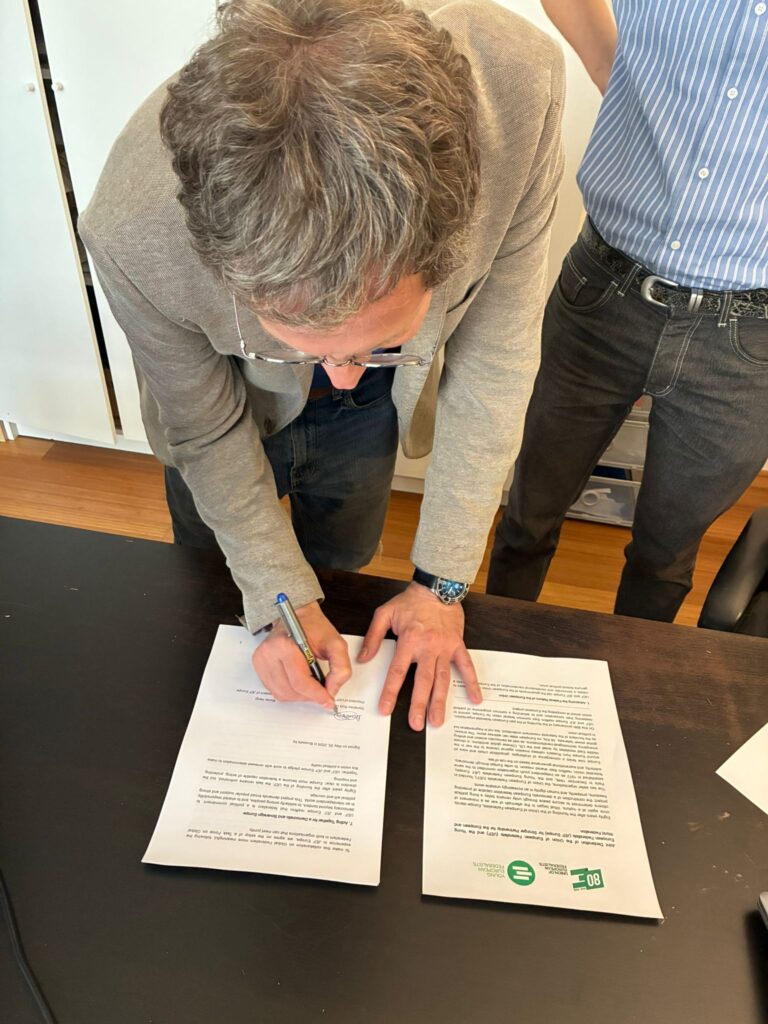
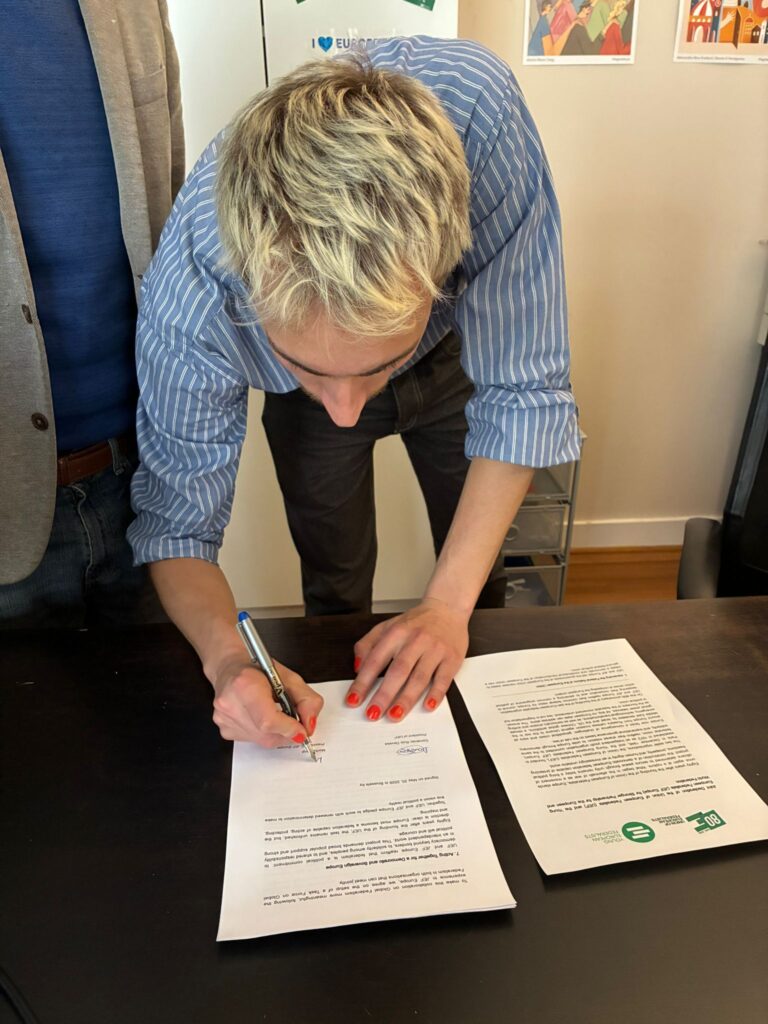
The Union of European Federalists (UEF) and the Young European Federalists (JEF Europe) have adopted a Joint Declaration reaffirming their shared commitment to strengthening cooperation in pursuit of a European Federation and, ultimately, a democratic World Federation.
The declaration builds on the long-standing partnership between the two organisations, united by a common federalist vision and by the conviction that the major challenges of our time—from war and geopolitical instability to climate change and democratic backsliding—require democratic governance beyond the nation-state.
At a time when Europe faces unprecedented security, economic and political pressures, UEF and JEF Europe stress the need for a stronger, more democratic and more sovereign European Union, capable of acting effectively both internally and on the global stage. The declaration highlights the importance of federalism as the political framework best suited to guarantee peace, democracy, the rule of law and solidarity among peoples.
The two organisations also recognise that global challenges increasingly transcend national and continental borders. For this reason, the declaration reaffirms support for the gradual development of democratic global governance structures and for closer cooperation with the worldwide federalist movement, with the long-term objective of building a World Federation based on democracy, human rights and the rule of law.
The Joint Declaration commits UEF and JEF Europe to intensify their cooperation through common campaigns, advocacy initiatives, political action and educational activities. It also underlines the importance of engaging new generations of Europeans in the federalist cause and strengthening the federalist movement at local, national, European and global levels.
As the federalist movement approaches the eightieth anniversary of the founding of the UEF, this declaration sends a clear message: the pursuit of a united, democratic and federal Europe remains inseparable from the broader aspiration for a more peaceful, just and democratic world order.
Read the full Joint Declaration: LINK HERE
We are publishing the remarks made by members of the Spinelli Group during the debate in the European Parliament’s plenary session on May 19, 2026, on “EU governance under pressure – institutional responses to global challenges” at the presence of the EU Commissioner Šefčovič and the Member of Cyprotic Goverment in representation of the Council of the European Union.
The members of the Spinelli Group that have done an interventions are: Sven Simon EPP AFCO Chair, Juan Fernando López Aguilar S&D, Sandro Gozi, Renew Group, Reinier Van Lanschot, Verts/ALE Group, Gabriele Bischoff S&D, Damian Boeselager (Verts/ALE), Hilde Vautmans (Renew), Daniel Freund (Verts/ALE), Brando Benifei (S&D), Benedetta Scuderi (Verts/ALE), Raquel García Hermida-Van Der Walle (Renew), Klára Dobrev (S&D), Kai Tegethoff (Verts/ALE), Lukas Mandl (EPP), Anna Strolenberg (Verts/ALE)
Sven Simon, author. – Mr President, Vice‑President Šefčovič, dear colleagues, when citizens look at Europe today, many of them see two contradictory realities at the same time. On the one hand, they expect Europe to protect them. Protect them from war, from economic dependency, from geopolitical pressure, from insecurity in an increasingly unstable world. On the other hand, many people also feel that European decisions are becoming more distant from their own democratic influence. That Europe is often strong in producing rules, but too weak in making political responsibility visible.
It is precisely between these two expectations that the European debate now takes place because the real question is no longer: do we need Europe or do we not? The real question is: how do we organise European capacity to act in a way that remains democratically accepted? Because one thing is clear: the world around us has fundamentally changed. War has returned to Europe. For the first time in decades, Europeans again understand that peace, prosperity and security cannot be taken for granted.
Strategic dependencies are increasingly being weaponised and, in such a world, national capacity alone, colleagues, is no longer sufficient in many key areas. That is obvious. No Member State, colleagues – and I speak to this side, and I think you agree – on its own will be large enough to fully control geopolitical risks. Not in energy, not in technology, not in security.
But something else is equally true. European integration can only succeed in the long term if citizens continue to feel that political decisions remain understandable, accountable and, where necessary, correctable. That is why we are holding this debate today, because the experience of the past decades also shows something important: where Europe has created clear common decision‑making procedures and structures, Europe is capable of delivering. The single market, trade policy, competition policy, the common currency – in these areas, Europe carries international weight because decisions can be taken jointly and implemented effectively.
Where Europe remains institutionally fragmented, however, common strategic action becomes far more difficult. We see this in parts of foreign policy, security policy, energy policy. And yet, colleagues, we should be careful not to draw the wrong conclusions from this. Europe will not become a centralised unitary state and it does not need to become one.
The motto of the United States of America is 'E pluribus unum'. 'Out of many, one'. Europeans have not achieved that, nor do they want to. Our motto is 'United in diversity' and that is a significant difference. Europe's strength has always been its ability to build common solutions where common action is necessary while preserving political and national diversity where diversity matters. That is why we must now have a pragmatic and honest discussion about how the European Union can become more capable of acting without losing democratic acceptance.
In my view, this requires, above all, three things. First, European decisions need clear political responsibility. Citizens must be able to understand more clearly who prepares decisions, who supports them and who is politically accountable for them. The European Commission has evolved to a kind of government. It therefore needs to become both electable and removable, which is largely not the case today.
Second, the European Parliament must be strengthened wherever democratic oversight and political correctability are concerned because democratic systems remain stable only if they remain capable of learning and adapting.
And third, we should openly recognise that differentiated integration has always been part of the European project. Schengen did not begin with all Member States. Neither did the euro. Europe has often advanced precisely because some Member States were willing to move forward together in specific areas without undermining the unity of the Union as a whole.
So, the key question today is not whether Europe should act. The key question is how Europe can remain capable of acting while also remaining democratically legitimate and politically accountable. This, colleagues, is why we turn today to the Council and the Commission with several questions.
To conclude, the questions are: where do you see the greatest institutional limits to Europe's capacity to act within the current framework? Which reforms do you consider feasible with the existing Treaties? Where do you believe further institutional adaptation may become necessary? And how will you ensure that stronger European action always remains linked to democratic accountability, parliamentary oversight and a renewed trust of European citizens? Because, colleagues, Europe will only remain strong externally if it remains democratically trusted internally.
Marilena Raouna, President-in-Office of the Council. – Mr President, honourable Members, Commissioner, thank you to the honourable Member Sven Simon for this oral question on behalf of the Committee on Constitutional Affairs. As a Union, we are indeed faced with a new geopolitical reality, a changed security landscape and an increasingly complex multitude of challenges, both on the internal and the external front. This context renders it essential to work together for a safer, more resilient and more united Union, a Union cooperating, open to the world as a predictable, reliable and credible partner from a point of internal unity and strength. It is also now more vital than ever that the Union speaks with one voice to defend its values and interests and promote multilateral solutions.
Following the recent war in Iran, the Union demonstrated its reliability, predictability, and credibility in response to this challenging environment as well as its economic repercussions. In fact, in the face of recent crises and challenges, the Union has demonstrated time and again its ability to act in a timely, efficient and effective manner, as we have done in the past four years to support Ukraine. We have also taken bold decisions to ramp up Europe's defence readiness, notably with the adoption of the SAFE instrument, as well as to strengthen our competitiveness. That is, of course, not to say that it is not at times very challenging to build consensus among our 27 Member States, and, as we have experienced on many occasions, effort and time are needed to achieve this consensus, to achieve unity, which is, in essence, our greatest strength.
Honourable Members, our Union is a project that has constantly evolved not despite crises, but because of them, in many cases, because those are the moments that have driven deeper integration of the European Union. Enlargement is an indispensable commitment of this evolution. Our most successful foreign policy tool, a strategic investment in the future of our Union – enlargement was at the heart of the informal ministerial meeting of Europe ministers that was held a couple of weeks ago in Nicosia with the participation of our enlargement partners. In that discussion, we focused on the fundamentals, the backbone of enlargement, the rule of law, democratic institutions, economic criteria. Discussions highlighted that geopolitical urgency does not lower the bar for accession. Quite the contrary, enlargement partners are expected to deliver sustained and measurable results, while the Union must ensure clarity, predictability and fairness, and the Cyprus Presidency has diligently worked and has delivered concrete progress on enlargement despite the challenges, while upholding the credibility of the established methodology and its merit‑based character.
Mr President, honourable Members, the EU also needs to be ready at the time of accession. In parallel to the enlargement process, the Union needs to lay the necessary internal groundwork for reform and address key questions related to its priorities and its policies, as well as its capacity to act. In its June 2024 roadmap for future work on internal reforms, and more recently, in December, the European Parliament invited the Commission to present these reviews containing operational elements on the four strands of work: values, policies, budget and governance. On EU governance, the presidency has taken good note of the European Parliament's work, in particular recent resolutions on the institutional consequences of the enlargement process and the institutional aspects of the Draghi report.
I wish to conclude by saying that the response to global challenges is not limited to governance issues. Our recently agreed 'One Europe, One Market' roadmap, signed in Nicosia in April, represents a concrete and ambitious step to enhance our strategic autonomy by strengthening our competitiveness, completing our single market and making it simpler for people and businesses. This is an urgent, shared responsibility on which we are acting decisively, and we are working together for a true energy union on solutions to ensure affordable energy and achieve the energy transition. At the same time, to be more strategically autonomous, we must have the means to do it. Advancing the work on the next MFF is therefore key to match our ambitions with the necessary resources.
As Council presidency, we have driven the European agenda forward in an inclusive manner, with a very clear objective for a Union that is more strategically autonomous. This work is an investment in the future of our Union.
Maroš Šefčovič, Member of the Commission. – Mr President, honourable Members, Madam Minister, President of the Council, first and foremost, I would like to thank you and especially esteemed chairman of the AFCO Committee, Mr Simon, for having the opportunity to discuss the important question of EU governance in the context of the global challenges facing the Union. I am fully aware of how important this topic is for this House and especially for the Committee on Constitutional Affairs in particular. I would like to thank the members of the AFCO Committee for the excellent debate we had under the structured dialogue on these topics just three weeks ago.
As laid out in President von der Leyen's political guidelines, it is clear that we must pursue an ambitious reform agenda to ensure that our Union functions effectively, both as it grows and in order to keep up with a new geopolitical reality. Our decision-making processes must evolve if we are to retain the ability to act swiftly and decisively, both at home and on the world stage.
The Commission is ready to engage in this reflection, working hand in hand with Parliament and the Member States. We should approach these discussions with an open mind, whether the solutions lie within the existing Treaties or require deeper reform. Parliament's resolution of November 2023 has already set in motion the Treaty revision process. The ball is now in the Council's court, and the Commission stands ready to fulfil its institutional role, including by providing our opinion if and when consulted by the Council.
But we do not need to wait for Treaty change to act. We must use the existing tools to their full potential. For example, the passerelle clauses provide a pathway to shift from unanimity to qualified majority voting in key areas, including on foreign and security policy. The Commission has long advocated moving in this direction, including through our proposal in 2018 for the common foreign and security policy. We must also explore other mechanisms, such as the enhanced cooperation mechanism, in situations where progress is blocked by the lack of unanimity. This instrument has already proven its worth in several cases, most recently in delivering the EUR 90 billion support loan to Ukraine.
We must be ready for enlargement and to this end, the Commission has been gradually strengthening its methodology for preparing and admitting new Member States. We must be ready to face systemic geopolitical and economic shifts, which requires a strong and forward looking response. For the next multiannual financial framework, the Commission has therefore proposed a fundamental overhaul of the EU budget that will be more streamlined, flexible and impactful. In particular, the proposal on Global Europe provides predictable support, while at the same time increasing the margin of flexibility to respond to rising geopolitical challenges, crises and opportunities.
Honourable Members, whether through Treaty reform, passerelle clauses or enhanced cooperation, the Commission is committed to working with this House to build a Union that is swifter, stronger and more united.
Juan Fernando López Aguilar, en nombre del Grupo S&D. – Presidente, comisario Šefčovič, «La gobernanza de la Unión bajo presión» es el título de este debate en un desorden global, entre turbulencias geopolíticas que desafían como nunca antes la razón de ser de Europa, fundada, regida y limitada por su propio ordenamiento, es decir, por el Derecho.
Y, en paralelo, una Europa con una legalidad internacional, aprendiendo de las lecciones de la devastación de la Segunda Guerra Mundial.
Europa se desmorona ante nuestros ojos bajo la presión de quienes reivindican el unilateralismo y la ley del más fuerte. Es imprescindible que la Unión Europea tenga así una voz digna de ser escuchada —ojalá respetada, pero sobre todo una Europa con algo que decir—.
Y esto no es posible bajo las actuales reglas de la unanimidad. Si no es posible con los 27 Estados miembros actuales, menos aún lo será ante la perspectiva de la ampliación, con diez Estados en la lista de espera. Por eso, es imprescindible que reformemos los Tratados, que es lo que pidió el Parlamento Europeo en 2023.
Se trata de realizar una reforma institucional que supere la regla disfuncional de la unanimidad e imponga —por fin— mayorías cualificadas, no solamente para dotar a la Unión Europea de sus propios recursos y recursos propios, sino para utilizar el endeudamiento que financie las nuevas ambiciones sin desmoronar lo que ha sido la razón de ser de Europa —que son su solidaridad, política regional y política de cohesión—.
Pero, sobre todo, una reforma institucional que además refuerce al Parlamento Europeo —por fin— con una iniciativa legislativa propia en sus poderes de investigación, de control de la Comisión, turno de preguntas, control parlamentario. Se trata, por tanto, de regular un relanzamiento en toda regla del Parlamento Europeo.
La conclusión está al alcance de cualquiera: nunca como ahora la Unión Europea ha estado tan sola y al mismo tiempo ha sido tan dependiente de sí misma en la globalización; de sí misma y de los Estados miembros, que no pueden ser solamente una coalición o una Unión dentro de la Unión, como se ha propuesto últimamente, sino que tiene que ser la voluntad política de ser la Europa de los Estados miembros y de quienes aspiran a serlo.
De eso depende, ahora más que nunca, el futuro de la UE.
Sandro Gozi, on behalf of the Renew Group. – Mr President, Europe must become independent. To achieve this, a true European defence is no longer a choice; it is an emergency.
But arms alone will not secure Europe's future. Without political and democratic unity, there can be no European power. That is why new European governance and also Treaty revisions are now indispensable. We need a new transnational coalition, cross-party, across institutions, uniting leaders, pro-European forces and citizens across the continent. So my question is whether the Commissioner and the Minister are ready to join this coalition.
We stand for a Europe of political freedom, a Europe where those ready to move forward are no longer held hostage by national vetoes. Without flexibility, we would still be waiting for the single currency. The moment has come to build up a new political union within the current Union. A Union finally fit for the global challenges. History will not wait. Europe must choose: power, unity and action – or decline. There is no more time for hesitation.
Reinier Van Lanschot, on behalf of the Verts/ALE Group. – Mr President, there is a man living in a cave. He has a piece of paper saying this is his cave and that he has sovereignty. But what will he do when people enter his cave and threaten to kick him out? Europeans don't want a sovereign cave. They understand real sovereignty is only achieved when you can actually shape your surroundings.
This debate is about the EU's institutional response to global challenges. That's the understatement of the year! Europe is under attack and the institutional response is zero. No Treaty change, no extra democracy, and we remain paralysed. Meanwhile, Trump, Putin, Xi and the tech oligarchs have one thing in common: they are all afraid of a united Europe, so they are trying to destroy us. And the far right nationalists in this parliament are helping them do it.
But what do we want? Nine out of ten Europeans want a more united Europe. How? Decide faster without vetoes. Defend ourselves with a European army. Elect a European Government that answers to all Europeans. The European moment is now. National leaders: losers have excuses, winners have a plan. So climb out of your caves and make a plan. If you care so much about sovereignty, make us sovereign. The only way to do it is together. From Portugal to Ukraine, let's create the United States of Europe!
Gabriele Bischoff (S&D). – Herr Präsident! Erich Kästner hat mal gesagt: Es gibt nichts Gutes, außer man tut es. Und ich glaube, die Bürgerinnen und Bürger spüren, dass die EU derzeit sehr schwach aufgestellt ist in der Welt gegenüber Trump, Putin und anderen. Aber sie spüren auch, dass Europa eigentlich die Kraft hätte, dass es eigentlich die Möglichkeit hätte zur Stärke und zu mehr Handlungsfähigkeit. Aber, und das ist ein dickes Aber, es fehlt an Mut. Und leider muss ich sagen, es fehlt Europa auch an Selbstbewusstsein. Dabei ist der europäische Moment jetzt. Der ist nicht morgen. Und er ist auch nicht übermorgen. Und wir diskutieren, sorry, Passerelle, Vertragsänderungen seit mehreren Legislaturperioden. Aber, um zurück zu Kästner zu kommen, wir tun nichts.
Und deshalb erwarten wir von der Kommission schon mehr Unterstützung, mehr Initiativen und hier nicht weiter so zu zaudern. Denn wir hören die Worte, aber wir sehen die Taten nicht. Wir erwarten vom Rat auch tatsächlich nicht einfach business as usual – denn was Sie beschrieben haben, ist ja nichts anderes –, sondern wirklich auch Schritte und Mut zu Reformen. Ich finde es gut, dass Sie die Erweiterung genannt haben. Aber dann auch mit Konzepten zu kommen. Und an all die, die sagen, ach, nur die Einstimmigkeit: Wir haben doch gesehen, zu welchen wirklichen Herausforderungen es kommt, wenn Einzelne alles blockieren können in einem Moment, wo Europa geeint handeln muss. Und deshalb ist es wichtig, diese Veto-Optionen für Blockierer und deren Trittbrettfahrer zu beenden.
Europa kann mehr und es kann seine Bürgerinnen zusammen besser schützen. Aber, um noch einmal mit Schuman zu reden, ohne schöpferische Anstrengungen, die der Größe der Bedrohungen entsprechen, kann Europa nicht aus seiner Dauerkrise kommen. Und deshalb – mehr Mut und mehr Selbstbewusstsein.
(Die Rednerin ist damit einverstanden, auf eine Frage nach dem Verfahren der „blauen Karte“ zu antworten.)
Damian Boeselager (Verts/ALE), Frage nach dem Verfahren der „blauen Karte“. – Frau Bischoff, erst mal wollte ich mich bedanken, weil Sie sich im letzten Mandat und auch in diesem für die Veränderungen der europäischen Verträge so stark einsetzen.
Ich frage mich aber trotzdem: Wir haben als Europäisches Parlament schon Vertragsveränderungen verlangt. Wir haben Artikel 48 ausgelöst. Es ist eigentlich gar keine Wahl mehr, ob der Rat, ob die Regierungschefs sich zusammensetzen und tatsächlich darüber abstimmen, dass wir diese Verträge verändern oder eben nicht. Also, ist es nicht das große Versagen des Rates, dass er eigentlich gerade vertragsbrüchig ist, weil er eben nicht darüber abstimmt, ob wir die Verträge öffnen?
Und was muss in Deutschland noch passieren, damit die Bundesregierung das auch versteht?
Gabriele Bischoff (S&D), Antwort auf eine Frage nach dem Verfahren der „blauen Karte“. – Ich habe das ja beschrieben: Wir haben es mit einem Aussitzen zu tun im Rat. Deshalb ist es wirklich auch die Verantwortung des Rates, und zwar auch der Staats- und Regierungschefs, dass sie dafür, dass Europa im Moment nicht handlungsfähig ist, dass es so eine schwache Rolle abgibt, auch die Verantwortung übernehmen.
Wir plädieren ja seit Langem dafür, dass sie endlich die Vorschläge aufgreifen und zumindest mal diskutieren – selbst dazu ist es nicht gekommen. Wir hatten in Deutschland Initiativen – Deutschland und Frankreich zusammen – für Vertragsänderungen, und ich hoffe, dass es auch weiter neue Vorschläge der jetzigen Regierung gibt.
Hilde Vautmans (Renew). – Mr President, Commissioner, colleagues, what a lively debate. I heard very good interventions. The first one, of course, from my colleague Sandro Gozi and then from Van Lanschot. Very good. I also heard some interventions which I didn't like. I don't know where to look, but it was more on that side.
(The speaker gestured to the right)
I think colleagues Sandro and Van Lanschot, you were right. It is the moment now. Europe has to deliver – and we're not delivering: we are always too little, too late, too slow, not big enough. The time has come to renew Europe. Renew Europe, reform Europe! And we know what we have to do. Because that is also what our citizens ask; our citizens said deliver.
So we have to abolish unanimity, make Europe strong and united again. And then last week we had the child born: we have the working group on a European army, here in this House. So for me, I just came back from Africa. There there is a lion, President, a lion. Let's have the political courage of a lion and decide on the European army.
Daniel Freund (Verts/ALE). – Mr President, dear colleagues, when we as Europeans last discussed how the European Union should function was 25 years ago. It was a very different world. It was a world where we could still entrust our lives to the Americans, where democracy, social market economy, freedoms were still spreading in this world.
Well, we live in a different world now. We have seen since, for example, a head of state offer his veto to our adversaries, to wield the veto at the negotiation table on behalf of Vladimir Putin. In this situation, citizens are realising that we need to change the European Union. We have never had such majorities for changing the European Union, for working closer together.
But also, we have never had such weak answers to that from the governments and from the heads of state. We have adopted Treaty change proposals and you don't even discuss it with us. You can dismiss these proposals, you can qualify them as bad ideas, but at least sit down and discuss these proposals with us – how to make Europe stronger.
Brando Benifei (S&D). – Mr President, Europe's moment is now. Forty years after Altiero Spinelli has died, his message remains as clear as ever: Europe moves forward only when it finds the courage to become a federal union.
I want the European Commission, the President of this Commission, Ursula von der Leyen, not just to come here every September for the State of the Union, saying that we need to reform the Union, that we need the Treaty change, and then nothing happens because the Council does not listen to the Commission. Challenge publicly the Council on starting this Treaty reform – that is what is needed today to deliver on what the citizens are asking us – to not have any more a veto-driven confederation. Instead of deciding on fiscal capacity, on defence, on decarbonisation, on protection of their living standards, we want the Treaty reform.
But we can also start with some pragmatic moves: passerelle clauses, enhanced cooperation, even intergovernmental cooperation under the democratic control of the European Parliament. But please do something – do something.
Benedetta Scuderi (Verts/ALE). – Signor Presidente, onorevoli colleghi, eccoci a Strasburgo, dove dobbiamo venire ogni mese spendendo centinaia di milioni di soldi pubblici, perché, per meri egoismi nazionali, non abbiamo una sede unica.
Ma un'Europa così dove pensa di andare? L'Europa di 27 governi che continuano a bloccare le decisioni che il popolo chiede, dai diritti sociali alle libertà civili, dalla politica estera alla fiscalità comune.
State mettendo il veto a un'Europa libera e indipendente, difendendo una sovranità assoluta ci impoverite e ci rendete fragili. E così, davanti a guerre, genocidi e la distruzione del sistema di diritto che avevamo creato, l'Europa rimane inerme, schiacciata dalla sua burocrazia, dalle sue divisioni.
Ma è proprio nelle crisi che dobbiamo trovare il coraggio di andare oltre. L'Europa è nata dal coraggio di chi, combattendo contro il fascismo, ha immaginato un progetto di pace e giustizia.
Presidente von der Leyen, si assuma la responsabilità che questo momento storico richiede: un processo costituente per un'Europa federale, dove il Parlamento sia il cuore pulsante di questa democrazia, con un governo eletto senza veti e con una voce unica.
Klára Dobrev (S&D). – Elnök Úr! Hogy mennyire elegem van a populista jobboldal hazug szövegeiből! Szuverenitás, nemzeti érdek, harsogják, miközben kizárólag csak a saját pecsenyéjüket sütögetik. Ja és nem, még egyébként segítségül hívják azokat a nagy milliárdos cégeket és multikat, akik imádják, hogy gyengítik Európát, hiszen csak egy erős Európa tudná megvédeni a bolygót és az embereket a profitéhségüktől, és közben nem veszik észre, hogy a világ körülöttünk kezd szétesni.
A gazdagok gazdagabbak, a szegények szegényebbek lettek az elmúlt évtizedekben. A bolygónk haldoklik, Trump egymás után indítja el a nemzetközi konfliktusokat, és egyiket sem tudja lezárni. Ráadásul, mondjuk a mesterséges intelligencia vágtat felénk, mint egy fekete ló, és nem látom senkiben a bátorságot, hogy meg merné fogni a kantárt. Mondják már meg nekem, melyik az a nemzetállam, amely képes ezektől a problémáktól egyedül megvédeni az állampolgárokat? Az európai pillanat most jött el! Meg kell szabadulnunk az Európát gyengítő vétótól, meg kell erősítenünk az európai együttműködést! Én Európai Egyesült Államoknak hívom.
Kai Tegethoff (Verts/ALE). – Mr President, a young woman in Madrid stares at her phone at midnight, wondering how rent suddenly takes 70 % of her of her salary. Thousands of kilometres away in Berlin, a young man is doing the exact same maths, feeling the exact same panic in his stomach.
Because despite what national leaders and far-right politicians are telling you, your struggles are European struggles. From Porto to Tallinn, from Naples to Kraków, Europeans face the same reality: energy bills rising fast, AI destroying jobs and calling it progress, climate anxiety, wars burning across the world and governments that have no answers to any of this.
When national leaders think small, the winners are always the same: multinational landlords, corporate polluters, billionaires profiting from our division. The European moment is now. The moment for a United States of Europe is now. Our struggles are the same. Our solutions must be too.
Lukas Mandl (PPE). – Herr Präsident! Liebe Kolleginnen und Kollegen! Der Zwischenapplaus in der Rede des ehemaligen österreichischen Bundeskanzlers heute hier im Europäischen Parlament kam auf, als er von der Verteidigungsunion, die wir brauchen, gesprochen hat. Ein gutes Zeichen. Vor zwei Wochen hat mit der deutschen Regierung eine wichtige europäische Regierung – jede Regierung eines Mitgliedstaates ist wichtig, Deutschland ist groß – klargemacht: Das Einstimmigkeitsprinzip, wenn es blockiert, ist so nicht haltbar. Ein wichtiger Schritt. Warum? Weil die Europäische Union sich immer weiterentwickelt hat durch neue Verträge, in struktureller Hinsicht. In menschlicher Hinsicht natürlich durch Generationen vor uns, die ganz viel geleistet haben, auf deren Schultern wir stehen, sprichwörtlich.
Und jetzt ist es an uns, etwas zu leisten, damit die Europäische Union nicht nur besteht, sondern mehr Stärke nach außen entwickelt auf dieser Welt, mehr Freiheit nach innen für die Bürgerinnen und Bürger möglich macht. Und deshalb ist es so wichtig, nicht nur wieder an eine Vertragsreform zu denken, sondern an dieser Vertragsreform zu arbeiten. Wir hier im Europäischen Parlament können Verhandlungen führen, gute Kompromisse schließen über die politischen und nationalstaatlichen Grenzen hinweg und gute Entscheidungen fällen. Aber wir brauchen in der zweiten Kammer der europäischen Gesetzgebung, bei den mitgliedstaatlichen Regierungen, auch Bewegung. Und das wird so wichtig sein, dass eine Vertragsreform das hervorbringt. Und zukünftige Generationen werden uns fragen: Was habt ihr denn getan dafür, dass der Plan A eines vereinten Europa umgesetzt wird? Der Plan B wäre ein Europa verschiedener Geschwindigkeiten, auch ein Plan. Aber Plan A ist besser.
Damian Boeselager (Verts/ALE), blue-card question. – Dear colleague, I have to say, I do not understand a word of what you are saying because you say that we want less power for the nation states, but that is completely wrong.
We have all lost power. All of us. The nation states, the European Union. We are not able to defend ourselves. We are not able to act. So, what we need to do is to make sure that everyone can take decisions on the European level, on the national level, regional and local, and we need to fix this. This is the institutional response.
You said you want more democracy. That is what we are asking for. We want the Commission to be elected by the European citizens, not randomly being the friends of the prime ministers at the time.
How are you going to ensure that there is actually power for anyone in this European Union without reform?
Raquel García Hermida-Van Der Walle (Renew). – Mr President, Europe is the greatest place on earth to be born. Not the US. Our infant mortality rates are the lowest worldwide. The best and most affordable education, whether vocational or academic, is a founding principle of our societies. And our Erasmus+ programme is the envy of many. Europe is the best place to work. We have the right to mind-blowing things like family leave or vacation. In Europe we can work to live and not live to work. Our collective life expectancy is unmatched, worth much more than raw GDP, if you ask me.
Europe is, simply put, the place to be. And the EU is the foundation for that greatness. But like every great project, it requires maintenance. It requires courage to reform. It requires vision to integrate further towards an ever closer Union, towards a federal Union. We do not need an American dream. We have our own homemade European dream. The moment is here. The European moment is now.
Anna Strolenberg (Verts/ALE). – Mr President, we are wasting money on defence. Our armies are big enough to be expensive, but too small and fragmented to keep us safe. I am critical of this waste of money because every euro that we spend on defence is a euro less on schools, on hospitals, on housing.
So, if we spend money, let's spend it wisely. We can do so by building a European army. We stop spending money insufficiently on 27 armies, we spend it as one and we can save up to EUR 100 billion a year.
That is massive because I want peace more than anything. I want a peaceful future for every European – one filled with parks, playgrounds, healthcare, good housing. But if we want to get there, we have to do it differently because peace that we cannot defend is peace that is decided on the terms of the aggressor.
So, colleagues, the time for Europe is now. Let's build a European army guided by one European democracy, with a true united states of Europe.
Damian Boeselager (Verts/ALE). – Mr President, dear colleagues, I'm incredibly grateful that we are having a strong debate about the institutional changes that Europe needs now. But I also have to say that I'm a bit tired of the false narratives that come up here in this House every time we discuss this topic.
People on the far right and on the far left say Europe is undemocratic. Then we propose to make it democratic with institutional changes, and then they speak against it. They say it's too far away from the citizens. Then we say, let's reform it and bring it closer to the citizens, and then they're against that.
Then they say we should look into the history books. When I look into the history books, what do I see? I see a history of blood and violence in our past. And I see that when the European Union, the European project, started, this stopped. I see that actually in the past, those that fought for nation states were the ones that were fighting for a better future. But they do not follow this. They follow looking into the past and preserving something that cannot exist anymore.
What we need now is honesty. And the truth is that now is the moment for Europe. Now is the moment for the United States of Europe.
Maroš Šefčovič, Member of the Commission. – Mr President, honourable Members, Madam Minister, first and foremost I would like to thank you for this important discussion generated by the good debate we had with the Constitutional Affairs Committee and by the questions presented at the beginning of our debate by the chairman, Mr Simon. I think that this debate, as well as the question which was tabled, clearly confirms Parliament's commitment to the issue of institutional reform. I have heard the calls for the Commission to take a more proactive role! The colleagues Mr Benifei, Mr van Lanschot and also Lukas Mandl clearly highlighted how important this is, and I also would like to thank Madam García Hermida for reminding us that, indeed, Europe is the best place to be born, to grow up, to study and to work. I totally agree with her, and therefore would like to reassure you that we in the Commission are ready to do what is necessary. But we also have to be realistic: questions on governance and institutional reform are core elements of the European Union. And these questions are very sensitive for the Member States, as Madam Minister explained in her introductory remarks. As you know, activating passerelle clauses requires unanimity in the Council. So we must acknowledge that there are concerns in some Member States with regard to moving away from unanimity, and we should find constructive and creative ways to overcome these concerns. That being said, I totally agree with you that this debate is timely. The external challenges that the Union is currently facing are putting pressure on our capacity to act. I think Mr Gozi and Madam Bischoff have been also very clear in their remarks and described the situation extremely well. And, of course, we are going to discuss in greater detail the process of enlargement, and decision making with 30 or more Member States is likely to become even more difficult. If we maintain the status quo, decision making will be slower and our capacity to act will be weakened. So, therefore, I very much look forward to continuing our exchanges on this very important topic and would like to thank you for your remarks and for today's debate.
Marilena Raouna, President-in-Office of the Council. – Madam President, honourable Members, Commissioner, thank you very much for this very engaging debate. Thank you very much to honourable Member Simon Sven. These were actually many of the issues that we touched upon when I had my hearing at the beginning of the Cypriot Presidency at the AFCO Committee, which was extremely fruitful and useful for us as presidency. These are the kinds of debates that undoubtedly we need at this moment of great shift that we all acknowledge and as we evolve as a European Union towards an even closer Union.
Thank you for reminding us that this is the greatest political project there has ever been. And while we remember that, we also reflect together, in the framework of this temple of democracy, about how we improve and how we move forward as a European Union. I think the discussion has also confirmed that the issues related to EU governance are particularly important for all of us and at the same time, I think we've all acknowledged that these are very sensitive and they are very complex and that is why they merit discussion. This is a matter that, as the Commissioner said, requires unanimity at the Council.
While we are navigating this environment that is defined by instability and technological disruption – in the morning, I was in a debate on AI and cybersecurity, energy uncertainty and global competition – we need to always remember that we possess, as a Union, extraordinary strength and despite the confines that there are at times, we have also, within the framework of the Treaties, delivered time and again. The examples are many. I enumerated some of them in my opening remarks, whether that is supporting over the past four years Ukraine in fighting Russian aggression, whether it is responding to the war in Iran and the repercussions, whether it is migration and many other crises. This is the space we have used for greater integration, and this is what we need right now.
Work on internal reforms, on EU internal reforms, is clearly needed to make the European Union more strategically autonomous, more competitive, more secure, defence-ready, while also preparing our Union for future enlargements. We need to do the necessary internal groundwork. We need to do the necessary reforms in parallel with the enlargement process to address the key questions that concern priorities, policies and above all, our capacity as a Union to act.
And while we are having this discussion on governance, we also should not lose sight of what is already happening. Reforms are also about deepening the single market, they are about having an ambitious and balanced new multiannual financial framework, advancing military mobility, and creating the framework that will allow our innovators and our businesses to thrive. And these are already ongoing.
I will end with this: nothing is more viable for the European Union right now than our unity, and this should inform our work across the board.
Ahead of the European Parliament plenary discussion titled “EU governance under pressure – institutional responses to global challenges”, Domenec Ruiz Devesa, President of the UEF and Moritz Hergl, President of the Young European Federalists addressed MEPs member of the Committee on Constitutional Affairs with a joint letter calling for institutional reform of the European Union.
On Tuesday 19 May, the deputies will question Commissioner Maroš Šefčovič on the topic, with one key actor notably absent from the debate: the member states that in the Council have stalled any progress so far.
In the letter, JEF Europe and UEF argue that the European Union must become more democratic, sovereign, and capable of acting in response to growing geopolitical instability, democratic backsliding, economic coercion, disinformation campaigns, climate challenges, and increasing pressure on the international rules-based order. The organisations call for a number of key reforms, including extending qualified majority voting in strategic policy areas, strengthening the powers of the European Parliament, reinforcing rule of law mechanisms, advancing towards a genuine fiscal union, reforming Eurozone governance, and launching a democratic treaty reform process leading towards a European Constitution. The letter also emphasises the importance of transnational democracy, stronger European political parties, and closer democratic links between European elections and the leadership of the European Commission, while upholding subsidiarity and Europe’s territorial diversity.
JEF Europe and UEF encourage the European Parliament to place institutional reform back at the centre of the European political agenda and to act as the democratic driving force behind a stronger, more united, and more democratic Europe.
It is now the job of the MEPs and the Commission to push national governments to move forward.
The following opinion editorial is published in the spanish newspaper El Pais, the french Les Nouvel Obs and the italian Focus Europe.
“We are in difficulties. That is a good sign. If we were not, we would never change anything.
And making Europe means changing things.”
— Jean Monnet
The European Union has delivered more than seventy years of peace and prosperity. However, it was not designed to operate in a world dominated by continental empires. A stronger core Union must now emerge. Europe is an ageing continent, lagging the United States and China in growth and productivity, suffering from low investment, and struggling to sustain its social model. At the same time, it faces a profound geopolitical shift: Russia threatens its security from the East, while its traditional ally, the United States, is becoming at best an unreliable partner and at worst a hostile power.
With just 5 per cent of the world’s population and a (so far) declining share of the global economy, only a more united Europe—economically and politically, capable of ensuring its own security and defence—can effectively confront the three continental powers seeking to divide the world into spheres of influence amid the collapse of the multilateral order. Yet, even after the aggression against Ukraine and Trump’s threats over Greenland, European leaders have not launched any bold initiative to scale up the Union.
The problem is not a lack of plans, but a lack of consensus among the twenty-seven. Letta and Draghi have proposed an important policy package to relaunch growth and competitiveness: completing the single market and mobilising public and private investment in key sectors. This should be a no-brainer. Removing national barriers in financial services, telecommunications, digital markets, and energy would deliver a major boost to the EU economy. The same applies to the harmonisation of bankruptcy and corporate law.
We must also complete the Capital Markets Union and the Banking Union to retain European savings for investment within Europe. Such an economic programme would not only relaunch prosperity and improve living standards but also provide the technological and financial base needed to project power globally in defence of our values and interests.
However, this is not enough. Europe must build its own defence system, given the unreliability of the United States—and therefore of NATO—and must be able to take decisions by majority in foreign policy. The Treaty of Lisbon already provides avenues for both objectives, including the possibility of reform. Yet there is no progress.
Recent events illustrate the urgency. The war in Iran, the blockade of the Strait of Hormuz, and the bombing in Lebanon showed how even issuing a joint statement can be paralysed by the veto of a single Member State. Earlier, Orbán’s latest veto—blocking a €90 billion Eurobond-financed loan to Ukraine and the 20th sanctions package against Russia—put the entire continent’s security at risk, despite Hungary representing just 1 per cent of EU GDP and 2 per cent of its population.
Furthermore, the Council has so far failed to agree on a single regulator for digital, telecommunications, and financial services—essential for a true internal market—or on a European Deposit Insurance Scheme, let alone tax harmonisation. Powerful national interests continue to defend cross-border barriers and have effectively captured their governments, forming blocking minorities. Meanwhile, the Council often applies unanimity even where it is not legally required.
Is there a way forward? For some single market reforms, the Council can act by qualified majority voting. However, major initiatives in taxation, debt, foreign policy, and defence will likely remain blocked by national vetoes. Therefore, unless we are prepared to accept the status quo—and risk Europe’s future as an independent actor—the time has come to create a federal vanguard of willing Member States. This is how we created Schengen and the single currency.
This vanguard would complete the internal market; pool sovereignty over the euro, taxation, and large-scale investments in technology, climate policy, and energy independence based on renewables, and defence products. It would establish a European Security Council, and a Defence System with civilian capabilities and its own chain of command, and adopt majority-based decision-making across the board, including in foreign policy, defence, taxation and financial matters. This “Union within the Union” could be established through a combination of enhanced cooperations with a homogeneous membership, supported by an instrumental treaty to regulate decision-making rules and ensure democratic accountability.
In such a dangerous world, where our security and survival are clearly at stake, we cannot accept that a single capital can hold everyone back. We are convinced that if Germany, France, the Benelux countries, Poland, and Spain take the lead in proposing this Union 2.0—open to all—it will act as a powerful magnet for other Member States that have so far been reluctant to support necessary reforms.
We therefore call on citizens to mobilise and on European leaders to act in the innovative spirit of the 9 May 1950 Declaration.
On behalf of the Action Committee for the United States of Europe:
- Guy Verhofstadt, President of European Movement International and former Prime Minister of Belgium.
- Domènec Ruiz Devesa, President of the Union of European Federalists and former Member of the European Parliament, Spain
- Moritz Hergl, President of the Young European Federalists, Germany.
- Rosen Plevneliev, former President of Bulgaria.
- Petre Roman, former Prime Minister of Romania.
- Danuta Hübner, former Commissioner, Poland.
- Josep Borrell, President of CIDOB and former EU High Representative for Foreign and Security Policy, Spain.
- Willy Claes, former Secretary General of NATO, Belgium.
- Andrea Wechsler, Member of the European Parliament, Spinelli Group, Germany.
- Monica Frassoni, former Co-President of the European Green Party, Italy and Belgium.
- Thijs Reuten, Member of the European Parliament, Spinelli Group, Netherlands.
- Jo Leinen, former Member of the European Parliament, Germany.
- Sandro Gozi, former Secretary of State for Europe, Spinelli Group, Member of the European Parliament, Italy and France.
- Pierre Larrouturou, former Member of the European Parliament, France.
- Richard Corbett, former Member of the European Parliament, Britain.
- Christelle Savall, former President of the Young European Federalists, Luxembourg.
- Giulia Rossolillo, Professor of European Union Law, Italy.
- Francisco Aldecoa, Professor of International Relations, Spain.
- Lieven Taillie, Honorary President of the European Journalist Association in Belgium.
- Michele Fiorillo, Philosopher, Civico Europa, Italy.
- Eric Pestel, Advisor to the President, Association Jean Monnet, France.
More news about the Action Committee for the USE here: LINK