

9.15 | WELCOME MESSAGE
- Sandro Gozi, MEP (Renew, France), President of the Union of European Federalists and Chair of the Spinelli Group
Video message from 00:00:00 to 00:04:00
THE NATO SUMMIT IN VILNIUS: EXPECTATIONS AND PERSPECTIVES FOR THE EUROPEAN SECURITY ARCHITECTURE AND FOR THE ROLE OF THE EU IN THE INTERNATIONAL SECURITY POLICY
- 9.30 | Petras Auštrevičius, MEP (Renew Europe, Lithuania), Member of the Subcommittee on Security and Defence
interviewed by Dr. Nana Walzer, Journalist, University Lecturer, Chairwoman of europe:united
- 10.15 | Lukas Mandl, MEP (EPP, Austria), Deputy Chair of the Subcommittee on Security and Defence, President of UEF Austria
interviewed by Dr. Nana Walzer, Journalist, University Lecturer, Chairwoman of europe:united
Video message from 00:04:00 to end
11.00 | ON THE EVE OF THE VILNIUS NATO SUMMIT: GEOSTRATEGIC DECISIONS TO SECURE UKRAINE’S FUTURE
In the light of ongoing brutal Russian war of aggression against Ukraine, NATO member states are more united than ever and persistent in their support to Ukraine, as well as strengthening NATO defence capacities and readiness. Last year NATO adopted its new Strategic Concept, in which all Members stated that ,,the Russian Federation is the most significant and direct threat to Allies security and to peace and stability in the Euro–Atlantic area”. Now, on the eve of Summit in Vilnius, it is crucial to ensure that the Alliance is fully prepared to address this threat and to send a clear signal that Ukraine’s future in NATO is inevitable.
Therefore, the Union of European Federalists, together with European Movement Lithuania, kindly invite participants to discuss objectives of the NATO Summit in Vilnius, methods of strengthening European security architecture and the Ukraine’s Euro-Atlantic aspirations.
- Yehor Cherniev, Head of the Ukraine Delegation to the NATO Parliamentary Assembly, (tbc)
- Markus Ferber, MEP (EPP, Germany), President of the Hanns Seidel Foundation & Vice-President of the Union of European Federalists
- Sandro Gozi, MEP (Renew Europe, France), President of the Union of European Federalists
- Žygimantas Pavilionis, MP (Homeland Union – Lithuanian Christian Democrats, Lithuania), Chair of the Parliamentary Committee on Foreign Affairs of the Republic of Lithuania
- Dr. Hanna Shelest, Head of Security Programmes at the Foreign Policy Council “Ukrainian Prism”, Editor-in-chief at UA: Ukraine Analytica
- Dr. Marie-Agnes Strack-Zimmermann, MP (FDP, Germany), Chair of the Defense Committee in the Bundestag, Germany (tbc)
- Moderator:
- Prof. Dr. Margarita Šešelgytė, Director at Institute of International Relations and Political Science, Vilnius University
12.30 | Lunch Break
- THE NATO SUMMIT IN VILNIUS: EXPECTATIONS AND PERSPECTIVES FOR THE EUROPEAN SECURITY ARCHITECTURE AND FOR THE ROLE OF THE EU IN THE INTERNATIONAL SECURITY POLICY
- 13.30 | Professor Dalia Bankauskaite, Associate Professor at the Vilnius University, Lithuania, and Senior Fellow at the Center For European Policy Analysis CEPA, Board member of European Movement Lithuania
- 14.15 | Christian Moos, Member of the European Economic and Social Committee, Group III (S&D), Secretary General of Europa Union Deutschland & Board Member of European Movement Germanyinterviewed by Dr. Nana Walzer, Journalist, University Lecturer, Chairwoman of europe:united
Video message from 00:31:28 to 01:05:04
15.00 | THE NATO SUMMIT IN VILNIUS: WHAT IS THE ROLE OF EUROPEAN CIVIL SOCIETY IN THIS CONTEXT AND WHAT CAN IT DO TO SUPPORT CIVIL SOCIETY IN UKRAINE?
Debate with
- Kati Schneeberger, District Councillor (The Greens) City of Vienna, designated Federal Director BEJ Austria, President of VIENNA goes EUROPE
- Klaus Klipp, President of Europa Union FrankfurtModerator:
- Dr. Nana Walzer, Journalist, University Lecturer, Chairwoman of europe:united
Video message from 01:05:05 to end
15:45 | End of the Theme Day
Watch here the event debate recording
The EUD delegation from Tarp had a first review meeting with Anett Bösz (Deputy Mayor of Budapest). “We learned a lot how the media politics and the corruption, especially the corruption of the Hungarian political elite, is working here” stated Richard Schade, a member of the EUD delegation. Anett explained with the example “BIODOME”, how the Hungarian government is overruling the people in Budapest, who will probably never get any benefit from this investment, but have to pay a horrible price for the annual maintenance.
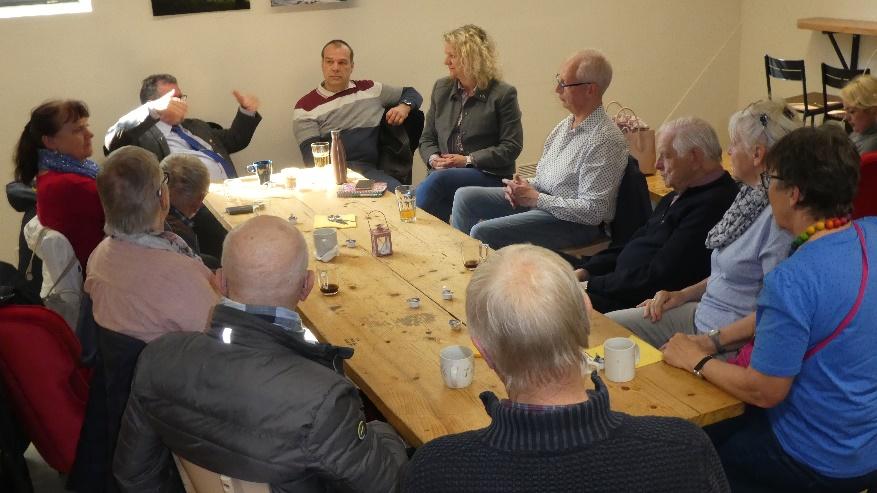
The local EU Commission welcomed the delegation with Bori Szigeti. She gave a brief overview on the complexity managing sanctions. “Now we have a better understanding on what is a request from an MEP, and how to manage the sanction in reality” was the conclusion from the EUD delegation.
The meeting and discussion with Desi Andras went around media politics. Desi expressed his situation, how his newspaper was “closed” from one day to the next day. The way the Hungarian Government is treating the press is horrendous. There is no free press in Hungary anymore.
Ambassador Dr. Heinrich Kreft, Professor for Diplomacy at Andrassy University completed the review planned for the visit at Budapest. The Andrassy University is one of the last Universities in Hungary where academic freedom is secured. This because the support from Austria and Germany (here especially from Bavaria, Nordrhein-Westfalen and Baden-Württemberg). All other universities are no more under public, but under private control. The control is given to Orbán’s friends, not only for a given period, no for their whole life. The academic freedom is endangered. When looking on the former Central European University, founded by G. Soros, will become under Chinese control. We asked ourself what is the future for Hungarian students?
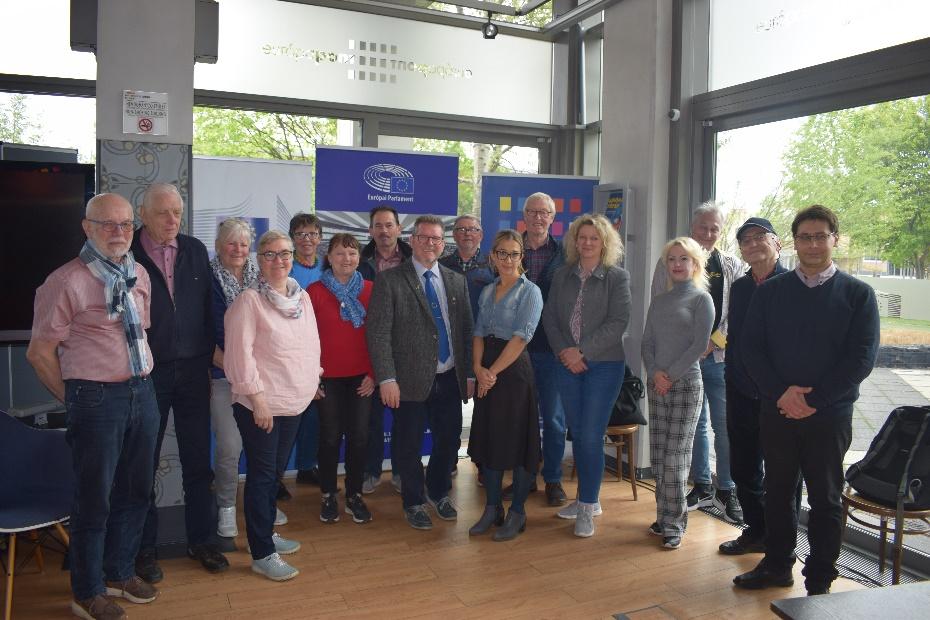
Recommendations
- No-Veto
- EU as member of the NATO, no longer the individual EU Countries
- Sustainability as priority to all consumers
- More collaboration and integration between the countries, exchange between regions is fruitful
- Higher impact on geopolitical level
- Constitutional legality is an advantage to all investors in the world
- One voice is a must for any activity in terms of external affairs
- European cyber security program
- Enlarge the competence of the European parliament (most important FINANCE)
- Continue with the CoFoE
- Let the convent get started
MEP’s Niklas Herbst (EVP) Rasmus Andresen (EFA) and former MEP Eva Lichtenberger provided during the podium conference a valuable input. They gave their opinion, about their individual experience with the CoFoE and the major output they had recognized after the CoFoE.
After the entry question the podium went into more detail and the given focus with this review: What are the requests on security and constitutional development, especially in regards to the development in your region and European coherence and solidarity? Where do you see progress, which topics are already addressed by the European Commission? Where do you see the priorities in terms of unblocking the ongoing activities in regards to EU Treaties?
From the podium members as well as from the people in the plenum the Veto right was understood as non-democratic. The Veto right was useful in times when the EU was with 6 nations only, today the democratic states should fight against the veto right, each and every European Citizen should clearly request their national government not to mislead this right, but to cancel it!
Better democratic approach is requested. Also, in conferences like this one it should be a must to have more than one nationality around the table.
To protect the EU the EU should become member of the NATO, instead of individual European countries. This would make it much easier for the European federalists in Austria but also in Sweden.
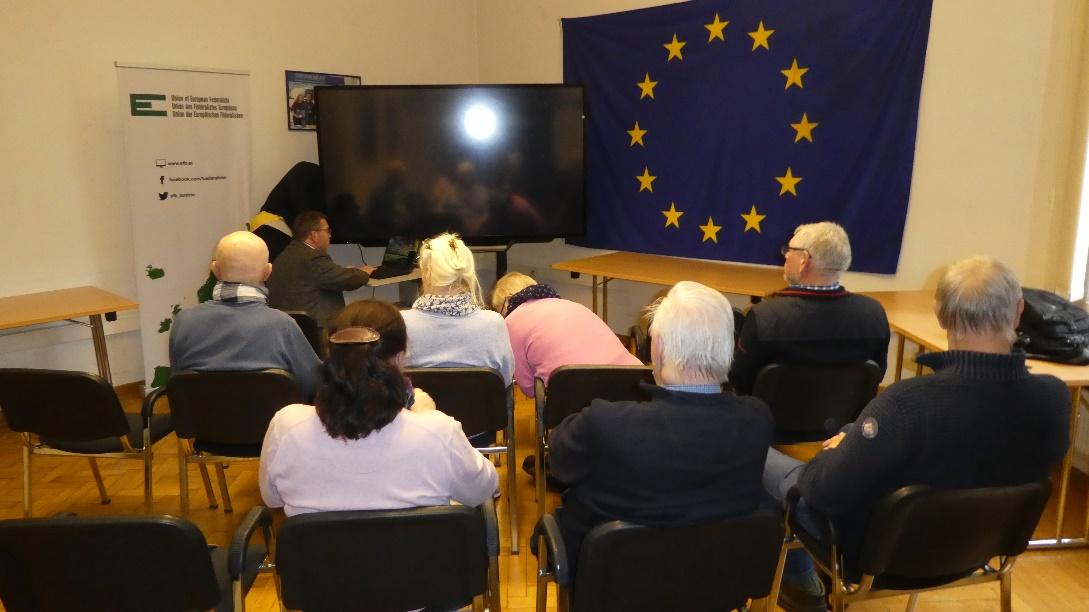
The European compass must be implemented fully. The capabilities to manage crisis’s, equal if natural catastrophes or pandemies must be improved drastically. We need to understand more the question, what industry, service providers and public services request from EU in terms of rules.
Our consume of goods need to be reflected. Sustainability must become priority. Europe must speak with one voice, when talking about external affairs.
Today marks the first year of the Russian aggression on Ukraine. On this important date for Europe and the besieged country, the European federalists want to reiterate their support to Ukraine and its people. The Union of European Federalists (UEF) remains committed to seeing a victorious Ukraine join the European Union.
Since the start of the conflict, the UEF stood beside Ukraine. On the day of the aggression, the UEF condemned “in the strongest possible terms the aggression [...] against Ukraine, a free and sovereign country in the heart of Europe.” On 4 March, the UEF partnered in the Europe-wide gathering in support of Ukraine organised by its German section of Europa-Union Frankfurt. On this occasion, Ukrainian President Volodymyr Zelenskyy gave a moving speech and thanked the Europeans for their solidarity, while thousands of people gathered, at the same time, on major European city squares, such as in Frankfurt, Prague, Tbilisi, or Paris.
On many occasions throughout the last 12 months, the UEF reiterated its support to Ukraine. On 5 March, the UEF organised the first Europe-wide online demonstration on the video platform Twitch. On 29 March, our Political Commission on Common Foreign and Security Policy debated the implication of the war for the future of Europe. In April, a statement from the UEF renewed its support to “Ukraine, Georgia and Moldova, which are currently confronted with continuous attacks and threats by Russia,” and recommended “the Commission [to] expedite its opinion on the granting of the candidate country status to Ukraine.” In June, the UEF welcomed Ukraine and Moldova as candidates for the European Union. In December, the Federal Committee endorsed the appeal "An airlift to save Ukraine" from its Italian section the Movimento Federalista Europeo.
On 27 February, the European federalists will gather at Cafe Kyiv in Berlin to explore ways for the European civil society to help Ukraine
At the UEF’s Federal Committee meeting of the 11 and 12 February 2023, Sandro Gozi, President of the UEF, called for the European Union to reform and welcome a victorious Ukraine: "Our generation must assume its political responsibilities—like the generation of Adenauer or Schumann did with its own. It is not the Ukrainians who should pay the price of our disagreements and reluctance in reshaping the European project. It is an existential duty to reform the European Union.”
The European federalists will never forget that the fight of the Ukrainians for freedom is ours, and it is that of all of Europe.
"On 6 August, we remember the demonstration of 300 students from different European countries at the German-French border in St. Germanshof/Wissembourg 70 years ago. The young people sawed the border trees there and called for the opening of the borders and a united Europe," says Sandro Gozi, President of the Union of European Federalists (UEF) and Member of the European Parliament. “For young people, open borders are now normality. But the Corona pandemic this spring has briefly upset this normality, which the Schengen area has offered us since 25 years.”
“The border regions have suffered particularly badly during this period. Nowhere else can Europe be experienced and felt on a daily basis and has already grown together as much as in the border regions. Border closures have not only led to considerable economic damage, to considerably impair of the mobility of hundreds of thousands of border commuters, but also to separation of whole families. Good neighbourly trust has been damaged. This must not happen again and it will not happen again," Sandro Gozi is convinced. "The corona virus knows no borders and cannot be contained by closing internal borders.”
“Open borders have always been a core concern for us, European federalists”, stresses Sandro Gozi. “I therefore welcome and strongly endorse the Press Release of the UEF sections from the Greater Region and the Upper Rhine Region, namely the regional UEF sections Europa-Union Baden-Württemberg, UEF Grand-Est, Europa-Union Luxembourg, Europa-Union Rheinland-Pfalz, Europa-Union Saar and the UEF sections UEF Belgium, UEF France and UEF Luxembourg on the occasion of 6 August students demonstrations 70 years ago.”
“The pandemic has become a stress test for Europe," continues Sandro Gozi. "The crisis can only be overcome by joint European action. As the Press Release states there can no longer be any national go-it-alone initiatives by the Member States and if limited restrictions on rights and freedoms can be considered temporarily necessary to protect against the epidemic, they must be implemented in the form of coordinated European measures. Priority must be given to cross-border initiatives to prevent or contain the pandemic“.
"The crisis can only be overcome by joint European action” concludes Sandro Gozi. “Against this background, the UEF welcomed the agreement of the European Council on 21 July 2020 to introduce the new Next Generation EU fund proposed by the European Commission as one expression of European solidarity. However, the crisis also shows us the urgent need for reform of the European Union. It is therefore time to reopen the construction site of the Treaties and to give strong support to the political-institutional reforms which will make it possible, first of all, to give the European Union a fiscal competence and to move towards political union through a profound reform of the European Union, without being held up by those for whom the new vision of Europe is not yet mature, but to organise the Conference on the Future of Europe along these lines. This is where also the border regions have an important role to play.”
Brussels, 5th August 2020
*The Saarland section of the European Federalists re-enacted scenes from that historical day for the European unification at the main French-German border crossing point "Brême d'Or / Goldene Bremm" between Saarbruecken and Forbach. (photo: Werner Hillen/Europa-Union Saar).
EDITOR’S NOTE:
The Union of European Federalists (UEF) is a pan-European, non-governmental political organisation dedicated to the promotion of European political unity. For more than 70 years UEF has been a leading voice in the promotion of European unity and an early campaigner for key milestones in the development of the European Communities and then the European Union. With 25 national sections and over 400 local groups across Europe, UEF promotes a federal Europe among citizens and political representatives at all levels of government.
PRESS CONTACT
Anna Echterhoff
anna.echterhoff@federalists.eu
Current conditions are ideal to push the EU towards becoming a European federal state, according to one of the vice-presidents of the European Parliament, Rainer Wieland. EURACTIV Germany reports.
Rainer Wieland (European People’s Party, EPP) is vice-president of the European Parliament and president of the Union of European Federalists Germany. He spoke to EURACTIV Germany’s Steffen Stiehle.
As president of the Union of European Federalists you want to develop the EU towards a European federal state. Is this goal closer after the German elections, or will a deepening of EU integration be more difficult with the so-called Jamaica coalition (Christian Democrats, Liberals, and Greens)?
During the election campaign, there was an odd mixture: we probably had the most European election of all time. This, however, was not really visible. There should have been more talks about Europe. On the other hand, everyone agrees that the dominant issues, such as internal security, the fight against terrorism or migration policy cannot be dealt with without “more Europe”.
Europe was therefore always present, albeit rather hidden. I believe this will come to light again. With the SPD we will have an opposition which will be more willing to extend EU integration. And we will have a fundamentally pro-European government, which certainly will have some tough nuts to crack and compromises to reach. This is going to be difficult. However, I believe that in terms of key European issues good agreement will be made, and this said, these issues can be addressed with the necessary seriousness.
Essentially, through initiatives from France, there is an ideal basis for a deepening EU integration. We must use this window of opportunity.
The FDP has very clearly positioned itself on key EU issues in the run-up to the elections. Christian Lindner, its party leader, would rather see Greece outside the monetary union. Could a step like this contribute to stabilisation, or would disintegration of the eurozone be a step backwards?
This is certainly a crucial point, on which the coalition negotiations will not be easy. But I am convinced that a common line will be found. A part of this line will be to hold on to the previous stance, that support for Greece should be continued and the country kept in the eurozone, if the Greeks continue to work hard – even if for some the reforms are not going fast enough
Together with the FDP and the CSU, it will not be easy to agree on financial transfers that offset unequal trade balances. Do you think a permanent stabilisation of the eurozone could be possible without such transfers?
The key lies in the phrase “solidarity against reliable solidity”. Here in Germany, it also had been a long road until we found a solution for handling regions with different levels of development. At European level, this is no different. We must accept that there are member states which will still not be rich in the medium-term, but that at the same time there are also things we as Europeans want to achieve together.
For example, Portugal will not be able to secure the external borders alone in the extent that we all want it to be. Or take environmental policy: Not all countries will be able to implement the third stage of cleaning in sewage treatment plants alone. These are costly tasks, in which the weaker members, for the sake of common interest, must be supported. Just as structurally weak municipalities in Baden-Wuerttemberg in certain areas are supported by the state, in order to achieve the common goals.
This is a matter that people support when it is well explained and reasonably implemented. What people do not want is that money is invested in other countries that are just partying on.
Shortly after the German election, French President Macron presented his plans for deepening European integration. He focused on the demand for a eurozone budget and finance minister. From your point of view, could those steps point towards a European federal state, or might such a focus on the monetary union itself rather lead to a division, because EU countries without the euro are left behind?
It is a good thing that there are impulses coming out of France. Germany now must examine the proposals so that we can find the way to go forward together. In the end, Macron’s proposals will lead to further integration. This is positive.
However, I also believe that the time of big headlines is over. We have done ourselves absolutely no favour in slaving away on combat terms like ‘Eurobonds’ or ‘Euro-Parliament’, which only lead to superficial satisfaction or reflexive rejection. In the end, it depends on the content.
A Commissioner for budget does not have to be called finance minister. It depends on his competences. If such a Commissioner for budget, for example, had his own resources from the value-added tax, we could spare ourselves the big, constantly recurring wrangling over the multiannual financial framework. The FDP could certainly be won over for collaboration.
Jean-Claude Juncker would argue that more budgetary competence could be reasonable at European level, but that this should also be located in the other EU institutions rather than creating an additional policy framework at the level of the monetary union.
I feel the same way. If we further differentiate inside Europe, this must not lead to a differentiation of the formats. Decisions on the Schengen area are also taken in the European Parliament without anybody calling for a Schengen parliament. There are several examples of topics that are settled in the EP although not all member states are involved.
It is good that individual countries are able to go forward on important issues. But a multi-speed Europe must not be a Europe of different formats. As for today, most citizens do not know the difference between the European Council and the Council of Europe anymore. This should not be made even more complicated.
It is a different thing when the Parliament finds internal regulations, such as the Brexit Committee, which does not have British representatives. Or during talks about the Unitary Patent, where Spaniards and Italians are not on either side of the table. This can also be done with questions concerning the monetary union.
Besides deepening the monetary union, the creation of a defence union is another major issue. How far would you go? Would a European army make sense?
It is precisely here that the window of opportunity I mentioned, opened by France, is very valuable because France has the longest way to go.
A decision like the one made by President Hollande during the Mali intervention could not possibly be done by most heads of state and government, not by a German Chancellor either, as we have a parliamentary army. Germany, because of its state organisation, would give away less of its sovereignty here than France. It is therefore a question for France.
But since we also have neutral states inside EU, this is a difficult field. Countries such as Austria or Sweden would have had some difficulties with accession to the EU, if the defence union had already existed at that time. Here again, we need a multi-speed Europe. I am not a defence expert, but I believe that Eurocorps is the ideal approach for deepening European cooperation in this area and building a pillar that supports NATO but also has its own autonomous beam and stability.
Concluding on migration policy: Didn’t the EU member states prove they are totally unable to respond to common challenges with a common European interest?
Well, it is similar to the debt crisis. At the core, we are dealing with a crisis at the national level, not with a European crisis. For me, it is sometimes hard to bear to what extent the refugee crisis is presented as a failure of Europe itself.
The question is, to what extent there is the strength to work out a common European policy here. It does not help to insult each other. It is quite normal that the member states need a certain time to develop their attitude. The Commission has now started infringement proceedings and I am convinced that in the end all countries will respect the European agreements. In the past, Germany also sometimes only reacted after infringement proceedings.
Then there will be the question, in the example concerning external borders, of further contingents or the harmonisation of recognition standards, if there is going to be strength for more coordinated action. There will be transitions to more shared sovereignty. With this topic, there are a lot of screws to adjust. Unfortunately, we have done too little in the past. Now it will take time to find good common solutions.