

Brussels 21 March 2024
Almost two years after the end of the Conference on the Future of Europe, where citizens gave a clear mandate for EU Treaty reform, a convention has yet to be conveyed. On 22 November 2023, the European Parliament adopted its proposal to amend the Treaties and triggered the procedure of Article 48(2) of the Treaty on European Union. Yet, there has been a lack of reaction from the European Council and the Convention item requested by the EP is not yet on the agenda of any meeting. A simple majority in the European Council is enough to open the Convention, so this time the vetoes of a few states cannot be an excuse.
Together with our sections and our partners from the Spinelli Group, European Movement International (EMI) and the Young European Federalists (JEF Europe) we have written letters to the President of the European Commission Ursula von der Leyen and to the President of the EU Council Charles Michel, as well as the heads of each EU Member State. In light of the European Council meeting on 21-22 March, it is the duty of the European Council and the heads of State to respect the will of the citizens and strengthen the European Union.
Given the challenges we are facing, and keeping in mind the relaunch of enlargement, it is more necessary than ever to update our policies and initiate a reform of our institutional framework. Not only for the betterment of our current Union, but also, with an outlook to an European Union of possibly 36 Member States.
"You have a proposal from the European Parliament. The European Parliament activated Article 48, which is an article on the constitutional reform procedure. How long will the European Council continue to abuse our patience?" said Domènec Ruiz Devesa, MEP and UEF President in his intervention in the European Parliament debate of 12 March for Preparation of the European Council meeting of 21 and 22 March 2024.
The climate crisis, defence and foreign policy, enlargement, digitalisation, energy, healthcare, industrial policy, democracy and rule of law are just some of the challenges Europe needs to tackle. Every day, war, crises and great power politics demonstrate the urgent need to strengthen European institutions and better respond to global challenges and the needs of citizens.
Historically, the European project has always been ambitious and bold. To face the uncertain times of today, we must stay ambitious and give Europe the necessary tools to move forward and boldly face the challenges of our quickly changing world.
Links and references:
List of the letters sent by UEF or its national sections or JEF national sections to the members of the European Council in view of the EUCO meeting of 21-22 March 2024
- Austria, Letter to Federal Chancellor Karl Nehammer LINK
- Belgium, Letter to Prime Minister Alexander De Croo LINK
- Bulgaria, Letter to Prime Minister Nikolai Denkov LINK
- Croatia, Letter to Prime Minister Andrej Plenković LINK
- Republic of Cyprus, Letter to President Nikos Christodoulides, LINK
- Czech Republic, Letter to Prime Minister Petr Fiala, LINK
- Denmark, Letter to Prime Minister Mette Frederiksen LINK
- Estonia, Letter to Prime Minister Kaja Kallas LINK
- Finland, Letter to the Prime Minister Petteri Orpo LINK
- France, Letter to the President Emmanuel Macron LINK
- Germany, Letter to Federal Chancellor Olaf Sholz LINK
- Greece, Letter to Prime Minister Kyriakos Mitsotakis LINK
- Hungary, Letter to Prime Minister Viktor Orban LINK
- Ireland, Letter to The Taoiseach Leo Varadkar LINK
- Italy, Letter to Prime Minister Giorgia Meloni LINK
- Latvia, Letter to Prime Minister Evika Siliņa LINK
- Lithuania, Letter to President Gitanas Nausėda LINK
- Luxembourg, Letter to Prime Minister Luc Frieden LINK
- Malta, Letter to Prime Minister Robert Abela LINK
- Netherlands, Letter to Prime Minister Mark Rutte LINK
- Poland, Letter to Prime Minister Donald Tusk LINK
- Portugal, Letter to Prime Minister Antonio Costa LINK
- Romania, Letter to President Klaus Werner Iohannis LINK
- Slovakia, Letter to Prime Minister Robert Fico LINK
- Slovenia, Letter to Prime Minister Robert Gobob LINK
- Spain, Letter to Prime Minister Pedro Sanchez LINK
- Sweden, Letter to Prime Minister Ulf Kristersson LINK
- President of the EU Council, Charles Michel LINK
- President of the European Commission, Ursula von der Leyen LINK
Other relevant documents and webpages:
- Memorandum "Why we need a Convention to change the Treaties" LINK
- UEF Political Campaign "The urgency of overcoming the current Treaties" LINK
PRESS CONTACT
Flavia Sandu
Policy Officer
secretariat@federalists.eu
Brussels, 15 March 2024
On Tuesday 12 March, in Strasbourg at Cafè Michel, the Spinelli Group in the European Parliament in coordination with the Union of European Federalists (UEF) and together with UEF France and their partners in Alsace (Mouvement Européen and Les Jeunes Européen) organised an event focused on the importance of Treaty Change.
Among the speakers were Sandro Gozi, Chair of the Spinelli Group, Domenec Ruiz Devesa, MEP and UEF President and Spinelli Group Board Member,and Gwendoline Delbos-Corfield, MEP and Spinelli Group Board Member. The event was introduced by Hervé Moritz, President of the Mouvement Européen France.
The event is focused on Treaty reform and the European federalists' campaign and actions towards it.
The European Union is currently not equipped to face global challenges and we must work towards an institutional reform which will allow it to.
“The challenges Europe is facing today are very similar to the ones that Altiero Spinelli and Robert Schuman were confronted with in 1945. The European Union must adopt extraordinary responses to unify our continent through a deep and ambitious reform of its institutions and of its policies.” said Sandro Gozi, Chair of the Spinelli Group.
Almost two years after the end of the Conference on the Future of Europe, where citizens gave a clear mandate for EU Treaty reform, a convention has yet to be conveyed. The event on the 12th was meant to revolve around the Commission’s Communication on Treaty Reform. However, the Communication has been yet again postponed.
“You can see the interest in institutional reform being found in parties’ manifestos for the European elections” said Domenec Ruiz Devesa, MEP and UEF President, “Yet when it comes to the Council, to the heads of state belonging to these same parties, there is no initiative.”
It is the duty of the Heads of State to follow the mandate given by citizens in the Conference on the Future of Europe and take action in opening a Convention.
Links and references:
- PR | European Federalists welcome historic vote on EU Treaty reform LINK
- PR | Time for the European and national leaders to seize the urgency for Treaty reform LINK
- UEF Political Manifesto for the European Elections 2024 LINK
- Memorandum "Why we need a Convention to change the Treaties" LINK
- Letter sent to the President of the European Council, Charles Michel LINK
- Letter sent to the President of the European Commission, Ursula von der Leyen LINK
- Letter to the members of the European Parliament LINK
Today marks the second year of the Russian full-scale invasion of Ukraine. On this important date for Europe and the besieged country, the European federalists want to reiterate their support to Ukraine and its people.
One more year of war and immense loss has passed. Russia showcased yet again its disregard towards human rights and basic human dignity, committing war crimes against Ukraine and atrocities against its own citizens who dared take a stand against Putin’s regime.
The EU has a historical and moral responsibility to ensure peace in the area. Yet we saw once again how limited the current institutional framework is, where one man’s personal political interest can halt for months necessary sanctions and funding. Looking at the historical progress on Enlargement we have made so far, we also have to look at the reform the EU itself needs and the necessary changes its institutions, to bring the EU project to its next step. To stand with Ukraine now, and provide security to all current and future European citizens, the EU must become the kind of Union envisaged by the Conference on the Future of Europe, and moved forward by the Parliament's proposal for a Convention.
For the past months we have seen a raise in scepticism regarding Ukraine’s chances to win. This is a situation of our own making, where our frameworks do not allow for effective actions. Ukraine is currently shielding the whole of Europe against Russian onslaught at the cost of its own people’s lives and livelihoods. We must not give up on supporting them.
‘The Union of European Federalists remains committed to seeing a victorious Ukraine join the European Union.’ said Domènec Ruiz Devesa, UEF President.
UEF has and will continue to support Ukraine and its people through whichever means possible. With this occasion we are inviting everyone to join us for the march organized by Promote Ukraine in Brussels tomorrow 25 February and to watch our intervention with Promote Ukraine at the podcast organised by the YouTube channel The EU Made Simple.
LINKS AND REFERENCES
- PR | European Federalists welcome historic vote on EU Treaty reform LINK
- PR | Time for the European and national leaders to seize the urgency for Treaty reform LINK
- Memorandum "Why we need a Convention to change the Treaties" LINK
Brussels, 18 December 2023
As the Conference on the Future of Europe concluded in May 2022, all the European institutions agreed to give the citizens recommendations for proper implementation. The European Parliament was the first to take action with its June 2022 and November 2023 resolutions calling for a Convention to reform the Treaties and activate Article 48 of the Treaty on European Union (TEU).
Today, the Council of the EU played its part, thanks to Spain’s leadership, and transmitted the European Parliament’s request for activation of Article 48 TEU to the European Council. Europe now turns to Charles Michel and EU national leaders to immediately include the EP‘s request on the agenda of the next EUCO meeting.
The request for Treaty change has to be considered by the European Council first of all because it is urgent and necessary. The European Union lacks the indispensable tools to act in the face of the challenges of security and economic competition that we are undergoing. The Russian war against Ukraine and interference, migration flows, ecological and digital transition, and enlargement force us to take action. More than ever, we need to reform our institutional framework, and the report offers several solutions.
Earlier this month, the Union of European Federalists sent a letter to Charles Michel, President of the European Council, requesting to put a decision point on the call for a Convention at the agenda of the next European leaders’ summit in Brussels. Today, the UEF reiterates this call.
Domènec Ruiz Devesa, President of the UEF said: "Of course, there is still a long way to go. First of all, the President of the European Council, Charles Michel, must put the issue on the agenda of the next European Council meeting in January or March 2024 at the latest. Secondly, a majority [...] will have to be sought. All this before the European elections in June. What is certain is that the Spanish government, during its rotating presidency of the Council, has done its job in this area, and with distinction.”
The UEF also urges Charles Michel to start working towards a majority to agree to the establishment of a Convention, with the help of the Belgian rotating presidency of the EU, to start in January 2024.
The UEF, through its sections, will be pressing national governments to support the call for a Convention; and in parallel will closely follow the developments at the European Council, and will continuously advocate for this crucial reform in the interest of European citizens. Should you wish to participate in this activity, you can join the UEF or one of its sections in Europe.
Brussels, 13 December 2023
The Plenary of the European Parliament has adopted the report Ruiz Devesa - Simon on the European Elections 2024, which includes the proposals of the European Parliament on how to organize the European elections of June next year. The text provides for recommendations to be submitted to European and national political parties to strengthen the European dimension of the electoral process and increase the participation and electoral rights of the EU citizens.
"We call to the European political parties, and especially national parties, to commit to a series of recommendations, such as including the logos of European political forces on their ballot papers," says Ruiz Devesa. It also urges European political parties to ensure that the content of their campaigns is conducted in line with the values of Article 2 of the EU Treaty and that the process for nominating their candidates for election is carried out democratically.
The report calls for a binding agreement between the European Parliament and the European Council on the "lead candidate" process for the election of the president of the European Commission. "It is important that, contrary to what happened in 2019, this time we can indeed ensure that the head of the list principle is complied with," defends Ruiz Devesa. "We propose that the candidate of the political group that obtains the most seats in the elections has the opportunity to start negotiations with the rest of the groups to try to form a sufficient majority and, if not, that the turn passes to the second most voted and so on until the Parliament can have a common candidate."
The Union of European Federalists (UEF) welcomes this important decision and calls on the European political parties to quickly adopt this set of recommendations, and—in addition—to provide voters with clear indications of their position on the crucial issue of treaty change.
Domènec Ruiz Devesa, President of the UEF said: "The next elections to the European Parliament must aim to evaluate the last five years of activity of the EU institutions, in a real exercise of democracy and European politics,". We cannot have "a collection of 27 parallel national elections that depend on domestic issues, but we must Europeanise this discussion and thus stimulate participation in the European elections, putting European issues on the agenda of the media".
It is possible to rewatch the Press Conference after the vote here.
In the coming months, the UEF will roll out its campaigning activities, encouraging citizens to vote from 6 to 9 June 2024, reminding candidates of the importance of a federal Europe, and debating the future of our Continent.
A long road begins to meet citizens' demands and build a more solid future of the EU.
The Union of European Federalists, who strongly supports these proposals of the European Parliament to amend the Treaties, launched a massive and successful outreach campaign encouraging citizen engagement and pressuring MEPs ahead of a crucial vote at the European Parliament.
On Wednesday 22 November, the European Parliament approved the Report on the proposals of the European Parliament for the amendment of the Treaties drafted by Spinelli Group members Guy Verhofstadt, Sven Simon, Gabriele Bischoff, Daniel Freund, and Helmut Scholz.
This was a historic vote, which sees the European Parliament once again playing a leading role after forty years, since the draft Treaty inspired by Altiero Spinelli, in an attempt to strengthen the political and decision-making architecture of Europe to make it a protagonist of the challenges of its time.
Today the vote falls at a time of serious international crisis and during a process of profound transformation of our societies that requires us to act united as Europeans, to strengthen our common house so that it is more effective and at the same time more capable of providing answers to the needs of citizens.
In support of this courageous initiative by the European Parliament, which is in line with the commitments made by the European institutions at the end of the Conference on the Future of Europe, the Union of European Federalists (UEF) and its sections all over Europe met citizens in more than 30 European cities and online to inform them about the crucial vote of Wednesday.
From 6 to 19 November 2023, Federalist activists organised demonstrations and debates, in the streets and on social media. To know more about our actions, visit the UEF website and watch the livestream of Monday 20 November, featuring the organisers of these local actions. See here also the photo action inside the European Parliament in Strasbourg on Tuesday 21 November.
UEF President Domènec Ruiz Devesa in view of the upcoming plenary sent a letter together with Spinelli Group Chair MEP Sandro Gozi to their colleagues of the European Parliament, stating: “An affirmative vote on Wednesday 22 November on the Report on proposals of the European Parliament for the amendment of the Treaties is exactly the answer that our Union and citizens need. I hope that together, as the European citizens’ representatives, we will show a wide majority in the Plenary vote, sending a clear message to the Council and urging its transmission to the European Council under the Spanish Presidency. Thus, we will have the opportunity to discuss the citizens' priorities for a more effective European Union already in the European Council meeting of 15 December 2023”
The UEF urges the Spanish Presidency of the European Union to immediately transmit the file to the Council of the European Union and asks Charles Michel, in his capacity as President of the European Council to put the decision on the call for a Convention on the agenda of its 15 December meeting.
Brussels, 22 November 2023
Context
The Union of European Federalists (UEF) is a pan-European, non-governmental political organisation dedicated to the promotion of European political unity.
The draft report on the amendment of the treaties is the European Parliament’s answer to the Conference on the Future of Europe, an unprecedented democratic exercise that gathered 800 European citizens. These citizens gave out recommendations for institutional reforms of the European Union, and several of them found their way into the report voted today.
Today's vote is the last step to formally call for a Convention to reform the treaty, but only the start of the reform process.
On 5 and 6 October, the European Political Community (EPC) and the European Council will meet in Granada, under the Spanish presidency of the EU Council of Ministers. This summit will address the question of the enlargement of the Union to include nine new Member States: Albania, Bosnia-Herzegovina, Kosovo, Montenegro, North Macedonia, Serbia, plus Ukraine, Georgia, and Moldova. Putin's war of aggression in Ukraine has turned Ukraine's accession into a moral and geopolitical obligation, thus relaunching a process of EU geographical expansion that has been practically paralysed since the signing of the Lisbon Treaty in 2007, with the exception of Croatia's accession in 2013.
“After the situation created by Putin's full-scale war in Ukraine, the deepening of the integration project is now unavoidable, as advocated by the European Parliament” states Domènec Ruiz Devesa, President of the Union of European Federalists (UEF). “In Granada, the EU Leaders need to clarify not so much the "what" (enlargement) as the "how" (how to implement it financially and institutionally) that needs to be worked out. The arithmetical sum of states would mean nine new vetoes in the Council, and as many Commissioners, to reach the number of 36, which is not acceptable”.
This is particularly true with regard to decision-making in the Council, and the consequent increase in the possibilities of blockage through the use (and abuse) of the veto in certain policies of a strategic nature (foreign policy, taxation, multiannual budget, own resources, electoral law, monitoring of the rule of law, reform of the Treaties, among others). In a Union of Thirty-Six, it is unacceptable that the European Parliament should continue to be unable to participate in the approval of the Union's revenue, including new European taxes and the issuing of public debt, nor should it have the capacity for legislative initiative.
“The progress towards the geographical enlargement needs to evolve hand in hand with the political deepening of the EU integration and the Union of European Federalists will keep advocating for that” concludes Domènec Ruiz Devesa.
After many months of work that involved all the Committees of the European Parliament, the five rapporteurs of the draft report for the amendment of the Treaties (all board members of The Spinelli Group) presented today in the European Parliament’s Institutional Affairs Committee (AFCO) the results of their work and opened a debate in view of the plenary vote scheduled for 9 November.
"This is a great moment for European democracy," commented Domènec Ruiz Devesa, President of the UEF: "A Europe more able to face the challenges of tomorrow, more democratic and legitimate, more efficient—this is what we need at the moment, and this is what the report is about.”
The report proposes to amend more than 100 articles of the current Treaties and create a new institutional balance between the EU institutions, strengthening the EP and the Commission, and transforming the Council into a federal Senate; granting new competencies to the European Union based on the principle of subsidiarity, and increasing as well the role of the Regions. Furthermore, the proposal would strengthen the role of the European Court of Justice to oversee the respect for the rule of law in the member states.
As Guy Verhofstadt pointed out, the text proposes to overcome the unanimity blockade and to create decision-making mechanisms that would enable the EU to act effectively and more democratically.
The UEF, which campaigned long and hard to bring out, during the Conference on the Future of Europe, these fundamental proposals, supported the drafting of the report by contributing ideas, debates, opinion papers, and citizen engagement activities. We enthusiastically welcome the ideas put forward in the draft report and call for a quick start of the revision process through a Convention.
Sandro Gozi, chair of the Spinelli Group pointed out: "This is not the time to be cautious, because the EU needs this reform now. And since the Council and the governments have never had an appetite for Treaty reform, our task now is to make it happen”.
"We will strive for the Spanish Presidency to send the Parliament’s request on the opening of the Convention already to the last European Council in 2023 so that the Convention can be set already for the beginning of 2025,” added Domènec Ruiz Devesa. He concluded: “We federalists are at the forefront of this battle for the future of European citizens".
Context
The report presented today follows the resolution of 9 June 2022 where EU lawmakers demanded a strong institutional reform. A reform of the European founding texts is necessary to translate the recommendations of the Conference on the Future of Europe (CoFoE) into law.
The CoFoE was a major democratic exercise of the EU, which gathered 400 European citizens to debate better European policies. All the European institutions pledged to take the recommendations of the CoFoE into account, but so far, only the European Parliament has taken definitive action in that regard.
Just a few hours after the State of the European Union address by the President of the European Commission, a group of European parliamentarians led by Guy Verhofstadt, board member of the Spinelli Group, presented in a press conference a draft report calling for Treaty Change.
Although the text will need the approval of the European Parliament’s Institutional Affairs Committee (AFCO), the political consensus of the report makes it a great proposal to initiate a Convention that will draft the new European treaties.
During her SOTEU address, European Commission President Ursula von der Leyen endorsed the need for Treaty Change through a Convention. Yet, she failed to encourage the European Council to rise to the challenge. She also claimed that the enlargement of the Union to the Western Balkans and Ukraine should not wait for Treaty reform.
The Federalists disagree with this approach. We believe that enlargement calls for deep institutional reforms. The European Union cannot work with more than 30 members with the institutions it has today.
In a live stream organised by the UEF on Wednesday, Domènec Ruiz Devesa MEP, President of the UEF, said "There is a double message from Ursula von der Leyen. On one hand enlargement and deepening go hand in hand, and on the other she puts conditions on deepening—for us federalists, there can be no ‘if’.”
Context
Every year, the President of the European Commission gives the State of the European Union (SOTEU) address, where she underlines the upcoming priorities for the European executive. This year’s SOTEU, on Wednesday 13 September, was the last one before the European elections of 2024.
Later that day, a group of Members of the European Parliament led by Guy Verhofstadt presented a draft report calling for Treaty Change. This report will be put to a vote at the European Parliament’s Institutional Committee in September, then to the Plenary in November 2023.
The Executive Bureau of the Union of European Federalists (UEF) appointed on 3 August, Domènec Ruiz Devesa, Member of the European Parliament, as President ad interim, following the departure of Sandro Gozi. Prior to this nomination, Domènec Ruiz Devesa held the position of Vice-President of the UEF.
Under Sandro Gozi’s leadership, the UEF participated at the Conference on the Future of Europe, re-launched its collaboration with the Spinelli Group, the European Parliament's intergroup of federalist-minded MEPs, and put forward several political actions culminating in this year's Treaty Reform Now! campaign, collecting more than a thousand signatures from EU political leaders, elected officials, and representatives of the European Civil Society.
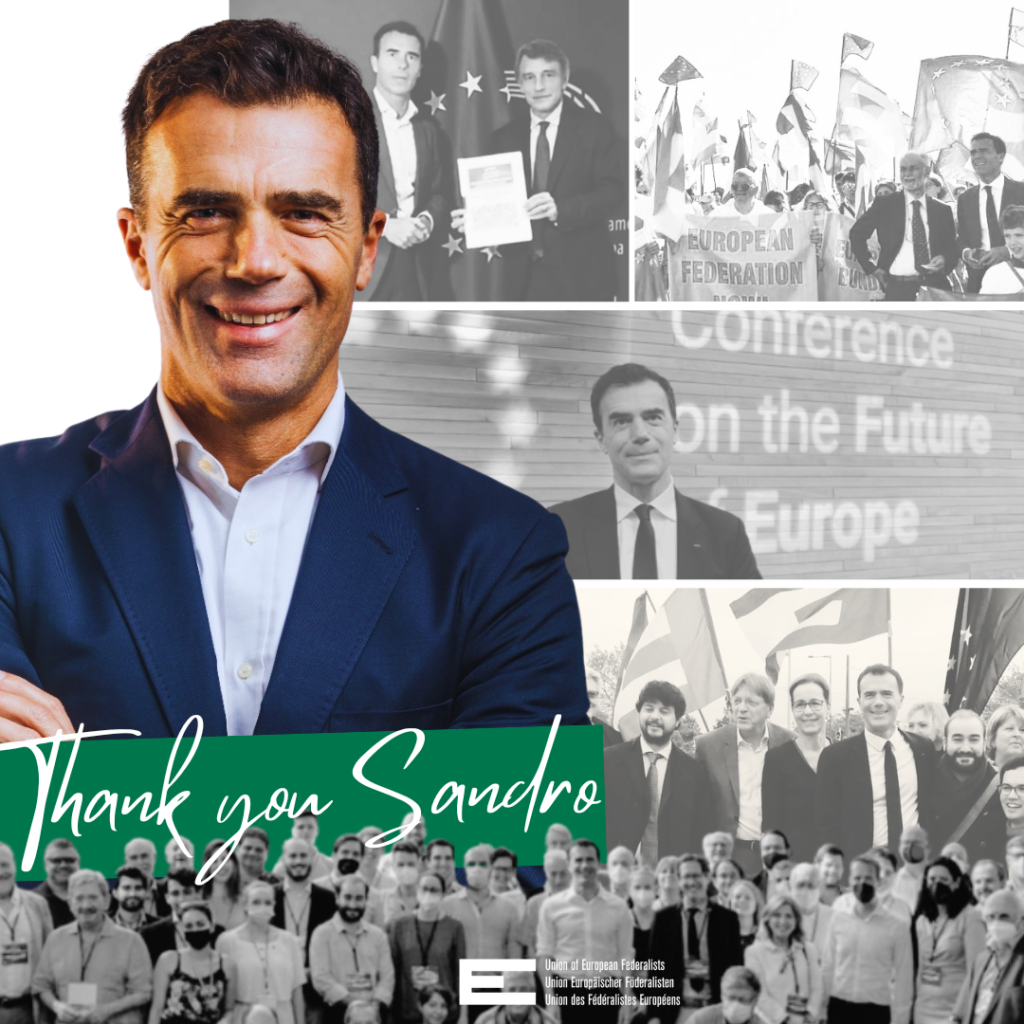
Domènec Ruiz Devesa saluted his predecessor’s achievements: “Sandro Gozi, a true Federalist, did the utmost to improve the UEF and advance its agenda. I know our personal friendship will endure and it is my commitment to continue to cooperate with the European Parliament and the Spinelli Group.”
The UEF remains committed to the advancement of a federal, sovereign and democratic Europe, notably through:
- The negotiations on the reform of the EU electoral law and the composition of the European Parliament after 2024, for which Domènec Ruiz Devesa and Sandro Gozi are reporting on the European Parliament’s behalf,
- The upcoming AFCO report calling for a Convention for the reform of the treaties,
- The preparation for the upcoming European elections.
Background
The Union of European Federalists (UEF) is a pan-European, non-governmental political organisation dedicated to the promotion of European political unity since 1946. We believe that completing European political unity is required to ensure Europe’s economic prosperity and strength. The UEF calls for a European democracy where all citizens can determine the policies of a European government. The UEF promotes a federal, sovereign and democratic Europe.