ACTION COMMITTEE PRESS RELEASE
7 September 2026, Brussels
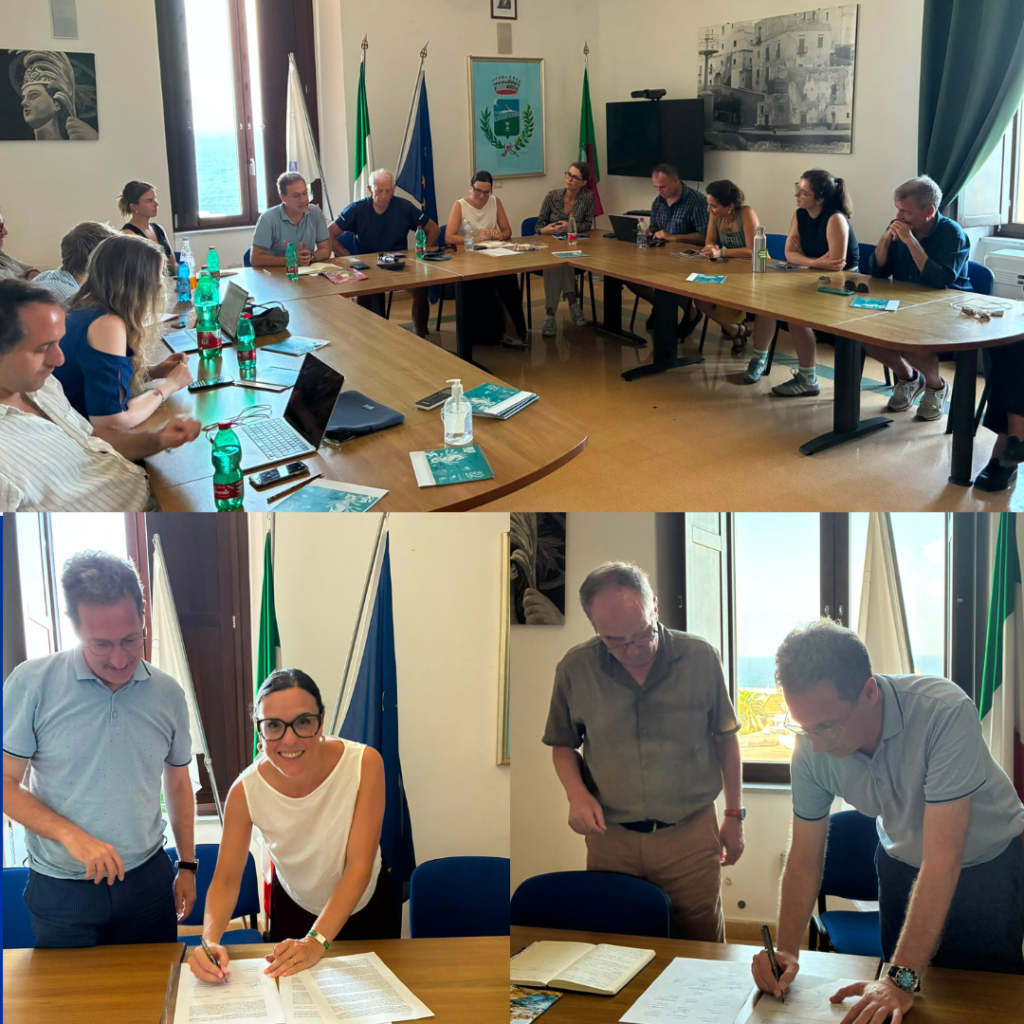
Ventotene is once again at the heart of the debate on Europe’s future. On the Italian island that is a symbol of European federalism, the declaration “It is time to build the United States of Europe” was adopted and signed on 30 August 2026, promoted by the Third Jean Monnet Action Committee for the United States of Europe.
The document draws directly on the legacy of Altiero Spinelli and Jean Monnet and calls on the European Union to take a decisive political and institutional step forward, strengthening shared sovereignty, moving beyond unanimity in strategic areas and developing more effective common foreign, security and defence policies.
Among the signatories is Josep Borrell, former High Representative of the European Union for Foreign Affairs and Security Policy. The initiative has also gathered the support of prominent European political and intellectual figures, including Romano Prodi, former President of the European Commission and former Prime Minister of Italy; Guy Verhofstadt, former Prime Minister of Belgium and President of the European Movement International; Daniel Cohn-Bendit, former Member of the European Parliament and a longstanding voice of European federalism; former Presidents Toomas Hendrik Ilves of Estonia and Rosen Plevneliev of Bulgaria; former European Commissioner Nicolas Schmit; and philosopher Slavoj Žižek.
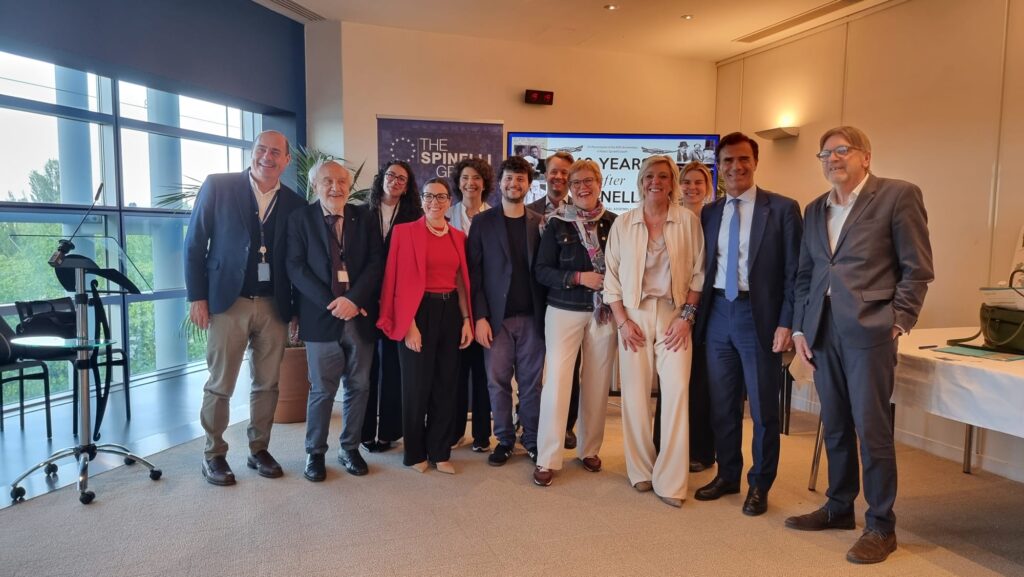
A particularly significant contribution comes from Members of the European Parliament involved in supporting the federalist initiative. They include Raquel García Hermida-van der Walle, Andrea Wechsler, Anna Strolenberg, Benedetta Scuderi, Brando Benifei, Petras Auštrevičius, Sandro Gozi and Daniel Freund, alongside Thijs Reuten, a member of the Spinelli Group who has been actively involved in the relaunch of the Action Committee for the United States of Europe.
Among the signatories Carmine Caputo, Mayor of Ventotene, once again underlining the island’s historic and symbolic role in the process of European integration.
The appeal is based on a clear conviction: faced with today’s geopolitical, economic, technological and security challenges, Europe can no longer simply react to crises. It must develop the political capacity to decide and act together.
From Ventotene, an ambitious vision is therefore being renewed: to transform the current Union into a genuine federal political union, capable of acting autonomously and authoritatively on the international stage.
To foster all these ends the Action Committee will gather in Rome on 19-20 March 2027, on the occasion of the 70th anniversary of the Rome Treaties, and invite all pro-European civil organisations to join the European People's Congress and citizens’ demonstration that it co-organises.
2 September, Ventotene
UEF-SPINELLI GROUP JOINT PRESS RELEASE
The Union of European Federalists (UEF) and the Spinelli Group welcomes the initiative by eleven Member States to stop national vetoes from paralysing the EU's Common Foreign and Security Policy.
Domenec Devesa, President of UEF and MEP Raquel Garcia Hermida van der Walle, Chair of the Spinelli Group declare this initiative confirms what federalists have long argued: unanimity is increasingly incompatible with Europe's capacity to act in a world of geopolitical competition, war and growing insecurity.
Upholding the principles of sincere cooperation and mutual solidarity, relying more on constructive abstention, and fully using passerelle clauses to introduce qualified majority voting should be pursued immediately. Member States should also support the case brought by the Parliament before the Court of Justice for the extension of qualified majority voting in foreign and security policy under Art. 31(2) TEU.
At the same time, these measures can only be a beginning. Recent years have shown the limits of overcoming veto power through Treaty provisions, whose activation itself requires unanimity. The eleven governments' initiative should therefore become the starting point for shaping a vanguard of Member States ready to build a genuinely sovereign and democratic Europe.
UEF and Spinelli Group call on a coalition of the willing – starting with the eleven governments, and with the support of the European Parliament and the Commission – to:
- push for the immediate use of all existing Treaty provisions allowing decisions without unanimity;
- in the meantime, be ready to move forward with the willing, creating a coherent federal vanguard pooling foreign policy, defence, fiscal capacity and other essential instruments of European sovereignty;
- support the Treaty revision procedure long requested by the European Parliament, aiming to abolish national vetoes in foreign policy and other strategic areas such as fiscal policy.
Europe cannot keep advancing at the speed its most reluctant government allows.
The choice is no longer between the current system and improved procedures.
It is between a Union of Nations and a democratic Europe capable of exercising sovereignty on behalf of its own citizens.
PRESS CONTACT
Mathilde Baudouin, Secretary General of the UEF
The US sanctions against ICC President and Senior Lawyer are a frontal attack to international law and must be met resolutely by the international community
EU must activate the blocking statute to prevent any sanctions against ICC.
On August 19, US Secretary of State Marco Rubio announced sanctions against the President of the International Criminal Court (ICC), Tomoko Akane, and the ICC’s senior lawyer, Abdoulaye Seye. The sanctions were imposed on the grounds that they had participated in the ICC’s efforts to prosecute officials whose governments had not consented to the Court’s jurisdiction.
These sanctions are part of a US foreign policy aimed at weakening the multilateral institutions established after World War II. Under US pressure, Chad became the fifth country in recent months to begin a formal withdrawal process from the International Criminal Court, following Venezuela, Burkina Faso, Mali and Niger. These developments are the consequences of a broad campaign against the ICC launched on July 13.
The International Criminal Court was established by the Rome Statute, which has been ratified or acceded to by 125 states worldwide, including all EU Member States, to prosecute the gravest crimes of concern to the international community: genocide, war crimes, crimes against humanity and the crime of aggression.
Significantly, China, Russia, North Korea, Iran, Israel and the US have not ratified the Rome Statute. Their refusal reflects a broader rejection of the principle that they should be subject to the same rules as other states and that their officials and military personnel should be held accountable for any crimes against humanity they may commit.
The Court is currently under attack by the Trump Administration. First, Microsoft was reportedly instructed to withdraw its services, effectively disrupting the Court’s IT infrastructure. Subsequently, judges and prosecutors were cut off from the US financial system, on which banks and financial institutions around the world rely, thus making it impossible for them to use credit cards or access other financial services. Now, the US is imposing sanctions on the Court’s President and senior prosecutor.
Sanctions are typically imposed on individuals accused of committing serious offences. The US is instead using them against those seeking to investigate and prosecute such crimes. The Court has issued arrest warrants for Putin in connection with Russia’s aggression against Ukraine and alleged crimes committed during the war, as well as for Netanyahu in connection with alleged crimes against humanity committed in Gaza, far beyond any proportionate exercise of the right to self-defence. These actions have triggered the United States’ campaign against the ICC, placing Washington, in this respect, alongside states that reject the principle of international accountability.
The Union of European Federalists (UEF) calls on the 125 governments that are parties to the Rome Statute to defend the International Criminal Court against US sanctions.
The UEF welcomes the statement issued by the European External Action Service and the declaration by Kaja Kallas, the EU’s High Representative, in support of the Court.
Furthermore, the UEF calls on the European institutions to activate the EU’s Blocking Statute (Council Regulation (EC) No 2271/96), which prevents European operators from complying with US sanctions that have extraterritorial effects. This statute provides the EU with a legal mechanism to resist the application of foreign laws that conflict with European legal protections. The Blocking Statute was notably used in 2018, when the EU sought to mitigate the effects of US sanctions on Iran following the US withdrawal from the Iran nuclear deal. The ICC President, Judge Tomoko Akane, who is now subject to US sanctions, has stressed that the EU Blocking Statute is one of the Court’s most essential tools for withstanding sanctions and ensuring its continued functioning.
Finally, the UEF calls on the European Parliament to adopt a resolution in support of the ICC and to reaffirm the Court’s essential role in protecting human rights and upholding international justice.
PRESS CONTACT
Davide Negri,Political Communication and Campaign Strategist of the UEF
UEF calls for a European response based on solidarity with Spain following the deadly humanitarian crisis in Ceuta, warns against the instrumentalisation of migration by third countries, and underlines the importance of effectively implementing the EU Pact on Migration and Asylum
The Union of European Federalists (UEF) expresses its profound sorrow over the loss of life in the waters off Ceuta in recent days. According to the latest joint count by the Spanish Guardia Civil and the Moroccan police, at least 84 people have died while attempting to reach European shores, making this already the deadliest episode recorded at this border in more than a decade. Our first thoughts go to the victims, most of them young people carrying little more than the hope of a better life, and to their families.
Between 30 and 31 July, an estimated 50,000 to 60,000 people crossed into the Spanish autonomous city of Ceuta within the space of two days, overwhelming its reception, healthcare and security services far beyond any reasonable capacity for a city of just over 80,000 inhabitants. Most of them have already returned to Morocco.
This is the first major humanitarian emergency at the EU’s external borders since the entry into force of the EU Pact on Migration and Asylum. The EU must therefore respond in a coordinated and effective manner, reaffirming its solidarity with Spain and recalling that EU rules now exist to address orchestrated movements of people by third countries that generate or facilitate irregular migration flows towards EU territory.
Solidarity, not opportunism
UEF regrets statements by some European leaders, including Prime Minister Giorgia Meloni, suggesting the possible suspension of the free movement of persons with Spain in response to this episode.
Such statements misrepresent the legal reality. Ceuta and Melilla have never been part of the Schengen area. Spain secured this specific exception when it acceded to the Schengen Convention in 1991, precisely in order to manage the particular nature of its land border with Morocco.
What happened in Ceuta did not involve the crossing of a Schengen border. Using this episode as a pretext to threaten freedom of movement within Europe undermines European cooperation at the very moment when it is most needed.
As in previous similar crises involving Greece, Poland, Latvia and Lithuania, the EU cannot leave Spain alone to manage the current emergency.
A possible case of instrumentalisation
UEF notes with concern the reported passivity of Moroccan security forces during the initial hours of the crisis, followed by the rapid and effective deployment of riot-control units once Rabat chose to act.
This contrast raises legitimate questions as to whether the episode may constitute an instrumentalisation of migratory flows for the purpose of geopolitical pressure. Such a pattern was already observed in 2021 and is consistent with the framework developed by the European Commission following precedents involving Belarus and Turkey.
We note that there is currently no publicly available evidence linking organised trafficking networks, as alleged by the Spanish government, to the viral spread of the rumour that triggered the crossings, which appears to have spread organically through social media.
This episode could therefore constitute a hybrid threat requiring a coordinated European response — diplomatic, judicial and operational — under the Union’s existing framework on the instrumentalisation of migration.
No pushbacks, under any circumstances
UEF reiterates unequivocally that summary returns — so-called “hot returns” or pushbacks, whether at land borders or at sea — are incompatible with the Charter of Fundamental Rights of the European Union, in particular with the prohibition of collective expulsions and the right to asylum under Article 19.
Every person who reaches European territory or falls under European jurisdiction, regardless of the means by which they arrive, is entitled to an individual assessment and access to the safeguards associated with international protection.
This obligation does not cease to apply because of the method of crossing, the scale of an emergency or the physical infrastructure — including any future maritime barriers — used to control a border.
We call on the Spanish government to ensure that these standards are fully upheld as it manages return procedures in the coming weeks. We also call on the European Commission to closely monitor compliance with the obligations arising from the EU Charter at every stage of those procedures.
Our call to action
The answer cannot be the renationalisation of migration policy or the re-establishment of internal borders. On the contrary, what is needed is a more integrated European Union, beginning with the correct and effective implementation of the EU Pact on Migration and Asylum.
The effective management of migration also requires a genuine European foreign policy and the means necessary for the EU to enforce it. Until we achieve political union, it will remain impossible for a truly common European interest to emerge, and each Member State will continue to pursue its own short-term interests, influenced in part by its domestic electoral cycles.
UEF urges the European Union to:
- Firmly reiterate its policy against any instrumentalisation of migration and hybrid tactic that uses human mobility as a form of leverage, while underlining the legal obligation to save lives and protect victims;
- Activate concrete solidarity mechanisms for Spain, and for Ceuta in particular, including reception support, relocation where appropriate, and financial and operational assistance;
- Open a serious, evidence-based inquiry, in coordination with the Spanish authorities and other international bodies, into the role played by the Moroccan authorities during the initial hours of the crisis;
- Guarantee, without exception, that all return procedures comply with the Charter of Fundamental Rights of the European Union and with EU asylum law.
This tragedy is a European tragedy. It demands a European response grounded in solidarity, the rule of law and the humanity we owe to those who risk everything to reach our shores.
On this July 17, World Day for International Justice, the Union of European Federalists (UEF) reaffirms its support to the International Criminal Court (ICC), a unique jurisdiction in the world, which embodies one of the major achievements of international justice, promoting international law and victim’s redress.
We strongly condemn the Trump Administration's ongoing interference and unjustified sanctions against ICC judges and prosecutors and in particular the recent statement by U.S. Secretary of State Marco Rubio announcing that Washington will work to “systematically disable” and “dismantle the ICC, brick by brick, if necessary.”
In fact, Marco Rubio accused the Court of “waging a war against our country, not with bullets or missiles, but with the force of so-called international law,” and described it as an institution “backed and run by a powerful network of leftist nongovernmental organizations, smug globalists, and hostile Third World governments.” The State Department confirmed the campaign will expand sanctions, visa revocations, and travel bans against ICC judges, prosecutors, and affiliated organizations, while pressing allied governments, including EU Member States, to reject the Court’s jurisdiction or risk losing U.S. security cooperation. This marks a sharp escalation from targeted sanctions to an explicit, government-wide effort to incapacitate the Court altogether.
The Union of European Federalists recalls that the European Union has been among the strongest supporters of the ICC and its mandate. The ICC exemplifies the belief that some crimes (genocide, crimes against humanity, war crimes, the crime of aggression) are so grave that they concern the whole of humanity.
In this context, we view the Trump administration actions as an unacceptable attack on international justice. The extraterritorial enforcement of these measures within the European Union is a clear violation of our legal and political sovereignty. It attempts to compel EU-based entities to participate in a blockade against an international judicial body that the Union itself is bound by treaty to support. The EU Blocking Statute was designed precisely for this scenario in 1996: to protect European operators from the unlawful application of foreign legislation.
The demand to shield the ICC is rooted in the clear, established mandate of the European Parliament. Throughout 2025 and into 2026, the Parliament has exerted intense and sustained pressure with several urgent Parliamentary questions on the European Commission to deploy this legal shield, echoing the demands of Member States like Slovenia, civil society organizations, and the ICC itself. In particular in its Resolution 2025/2528 adopted on 12 March 2025 the European Parliament expressed its “utmost concern about US sanctions against ICC, its prosecutors, judges and staff, which constitute a serious attack on the international justice system” and called upon “the Commission to urgently activate the Blocking Statute and on Member States to urgently increase their diplomatic efforts in order to protect and safeguard the ICC and the indispensable cornerstone of the international justice system”.
However, despite these clear directives, and despite public statements by European Commission President Ursula von der Leyen and European Council President António Costa defending the ICC's independence from Washington's pressures, the executive is actively ignoring the repeated, explicit calls of the European Parliament.
Domènec Ruiz Devesa, president of UEF and MEP 2019-2024 stated that: “The EU should react by protecting ICC, defending international Justice and stopping Donald Trump and his allies' dream of a world governed by impunity and arms”.
The UEF is committed to promote International Justice, fight impunity and protect victims of human rights crimes. We firmly support the mobilization led by Eumans and No Peace Without Justice (NPWJ) and the campaign of the Coalitions for ICC and call for the immediate activation of the EU Blocking Statute to protect the ICC.
READ THE UEF STATEMENT ON THE EU BLOCKING STATUTE AND THE DEFENSE OF THE INTERNATIONAL CRIMINAL COURT
PRESS CONTACT
Mathilde Baudouin, Secretary General of the UEF
Brussels, 13 July 2026
The Union of European Federalists (UEF) welcomes the non-paper presented by the Government of Spain on the creation of a European Sovereign Facility (ESF). This is a bold and pragmatic proposal that can contribute to developing a European safe asset through common debt issuance, while preserving fiscal obligations and avoiding any increase in overall public debt.
The Spanish non-paper proposes a "European Sovereign Facility" through which the European Commission would centralize part of participating countries' annual borrowing—covering around a third of their debt redemptions plus deficit needs—by issuing common EU bonds and passing the money back as loans, all without creating any new debt, since it just reorganizes financing that would exist anyway. Participation would be voluntary and conditional on following EU fiscal rules, and the goal is to build a much bigger, more liquid pool of EU debt (up to roughly €850 billion a year) so it becomes attractive enough to global investors to lower borrowing costs for everyone involved, backed by a double guarantee (the loan itself plus the EU budget) that shields non-participating countries if someone defaults. In the event of a default by a participating country, losses borne by the EU budget will be recovered from EU payments to that member state. Only if these were insufficient would other participating states cover losses, while non-participants would be shielded and would hold a claim on the defaulting member state.
Such an initiative would complement the EU bonds issued by the Commission to finance SURE, Next Generation EU, and the loan to Ukraine.
The proposal is consistent with the resolution adopted by the UEF European Congress in Barcelona in March 2026, which called for a new generation of European joint borrowing, a gradual transition towards a European safe asset, and the possibility for a coalition of willing Member States to move forward when unanimity proves impossible to do it at 27. At a moment when global investors are increasingly seeking alternatives to traditional reserve assets, in particular the US dollar, Europe has a historic opportunity to lower borrowing costs for several Member States, strengthen the international role of the euro by providing a sizable quantity of a Euro-denominated asset, and enhance its economic and geopolitical influence.
Domènec Ruiz Devesa, president of UEF and MEP 2019-2024 stated that: “A genuine window of opportunity exists today for the euro to strengthen its global role. The international monetary system is evolving, but Europe is failing to seize this moment because too many governments remain trapped in short-sighted national calculations. A European safe asset is not merely a financial instrument. It is a strategic tool to strengthen Europe's sovereignty, reinforce the international role of the euro, reduce financial fragmentation and increase the European Union’s capacity to project power and defend its interests globally. In a world of continental powers, monetary sovereignty and geopolitical influence go hand in hand.”
Spain has put forward a serious and innovative proposal that should ideally develop within the EU framework. Other Member States, starting with France and Italy, two of the largest economies of the euro area and among the main beneficiaries of a deeper and more liquid European sovereign debt market, should now join in transforming this initiative into a concrete political project, beyond the financial benefits for individual Member States, that could catalyze in the medium term the creation of an EU permanent borrowing capacity focused on financing clearly defined European public goods (like defense, energy, measures agains climate change) and strategic investments where Europe can deliver more effectively and efficiently than European member states.
Such a permanent borrowing capacity must be necessarily accompanied by European forms of taxation approved by the European Parliament. This could also foster deeper political integration while maintaining fiscal obligations ensuring financial stability in Europe, triggering the necessary steps to further reform the governance and institutions in Europe to make them fit-for-purpose and ensure that funds are spent efficiently/effectively and in total more fiscal space won, in the spirit of the reports of Mario Draghi and Enrico Letta. Such steps would represent a decisive advance towards a stronger Economic, Monetary, and fiscal Union and, ultimately, towards a more sovereign and federal Europe.
For media enquiries, please contact:
- UEF Secretariat, secretariat@federalists.eu
Brussels, 24 June 2026
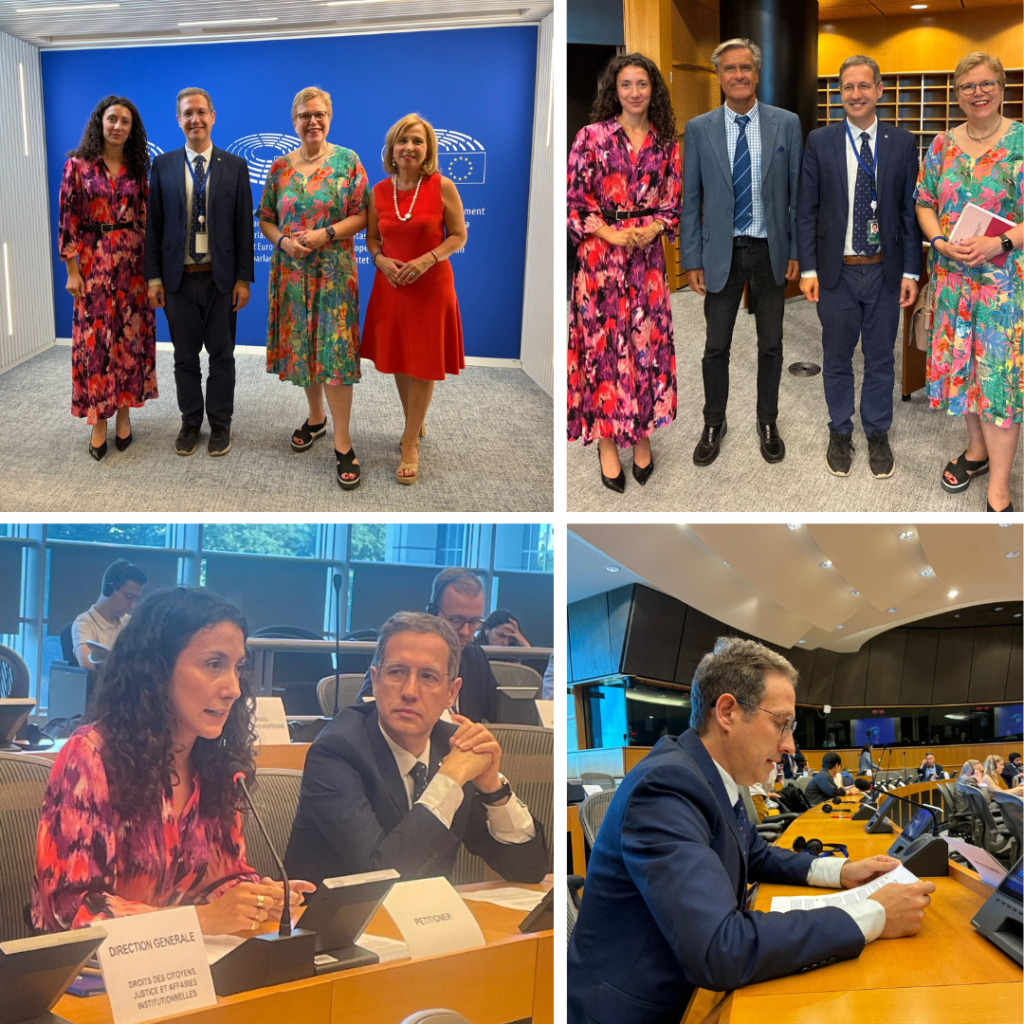
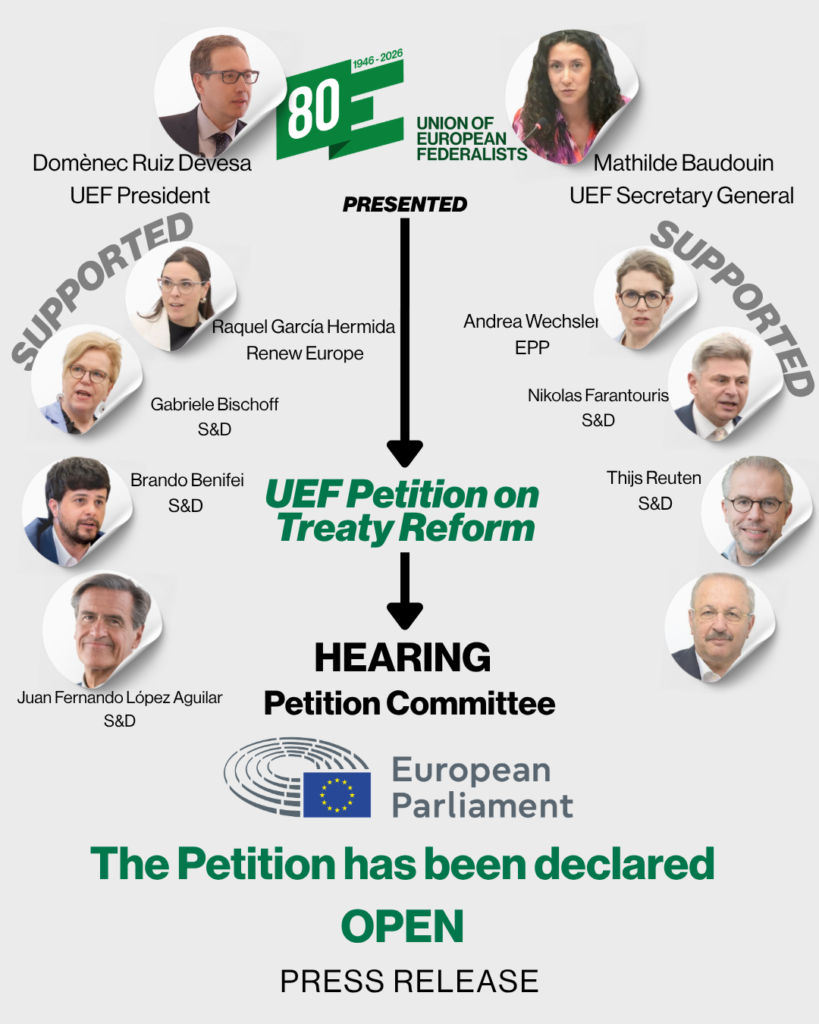
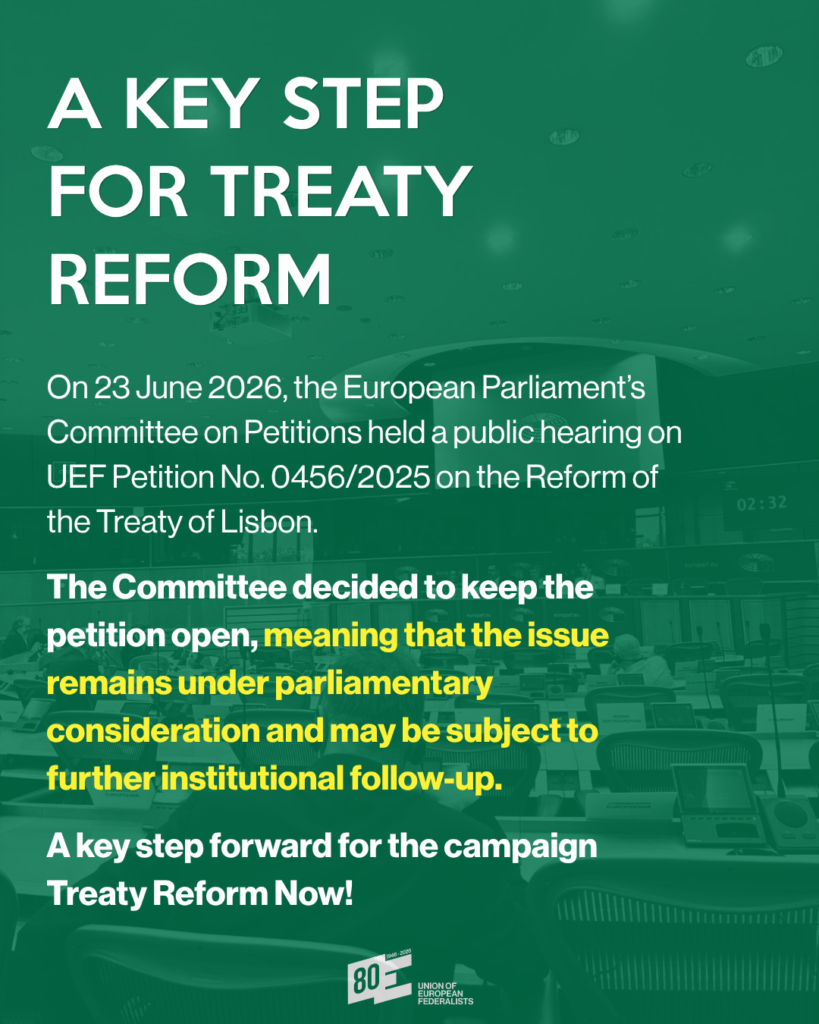
The Union of European Federalists (UEF) welcomes the decision of the European Parliament's Committee on Petitions (PETI) to declare open Petition No. 0456/2025 on the Reform of the Treaty of Lisbon, following a public hearing held yestarday, on 23 June 2026.
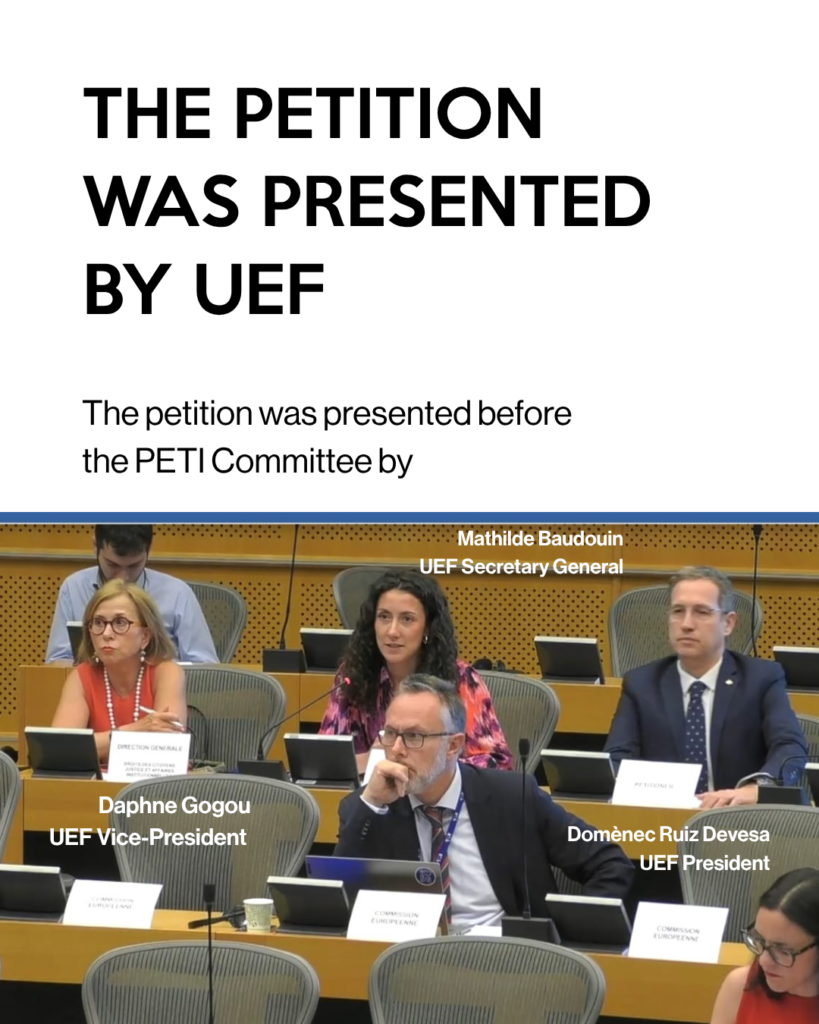
The petition was presented before the Committee by UEF President Domènec Ruiz Devesa and Secretary General Mathilde Baudouin, in the presence of the UEF Vice-President Daphne Gogou. The PETI Committee's decision to keep the petition open represents a significant step forward in the campaign Treaty Reform Now! and reinforces the UEF's call for a federal, democratic and sovereign Europe capable of acting decisively on the global stage.
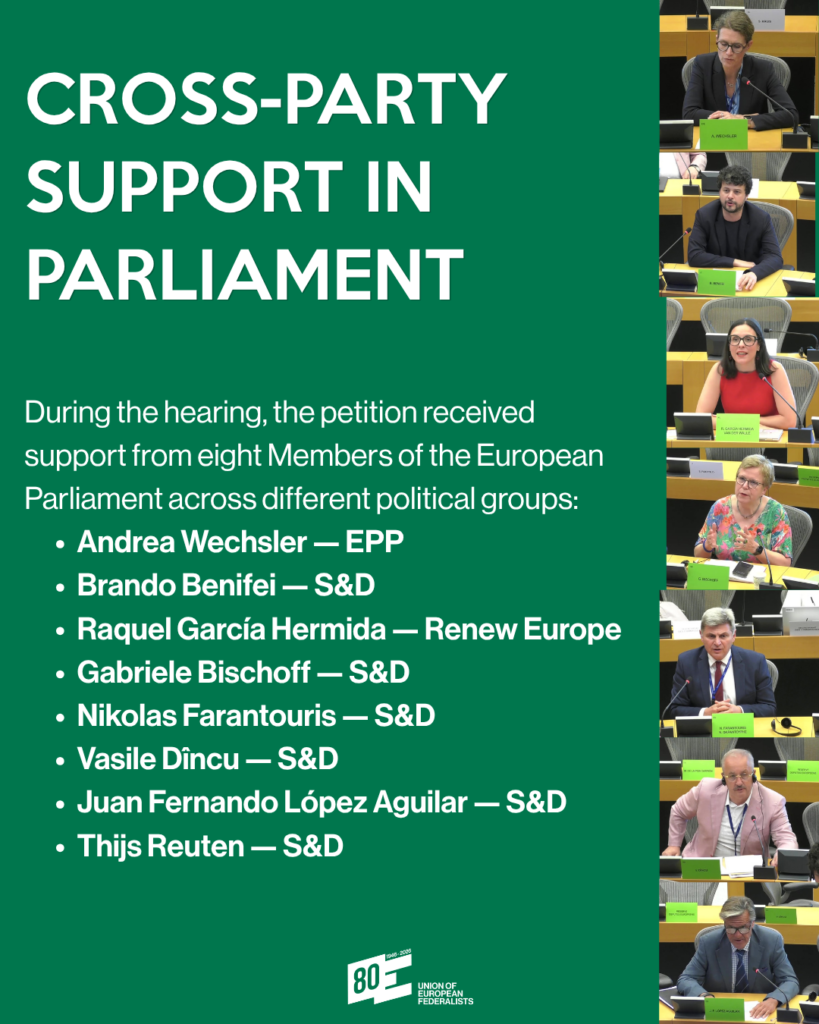
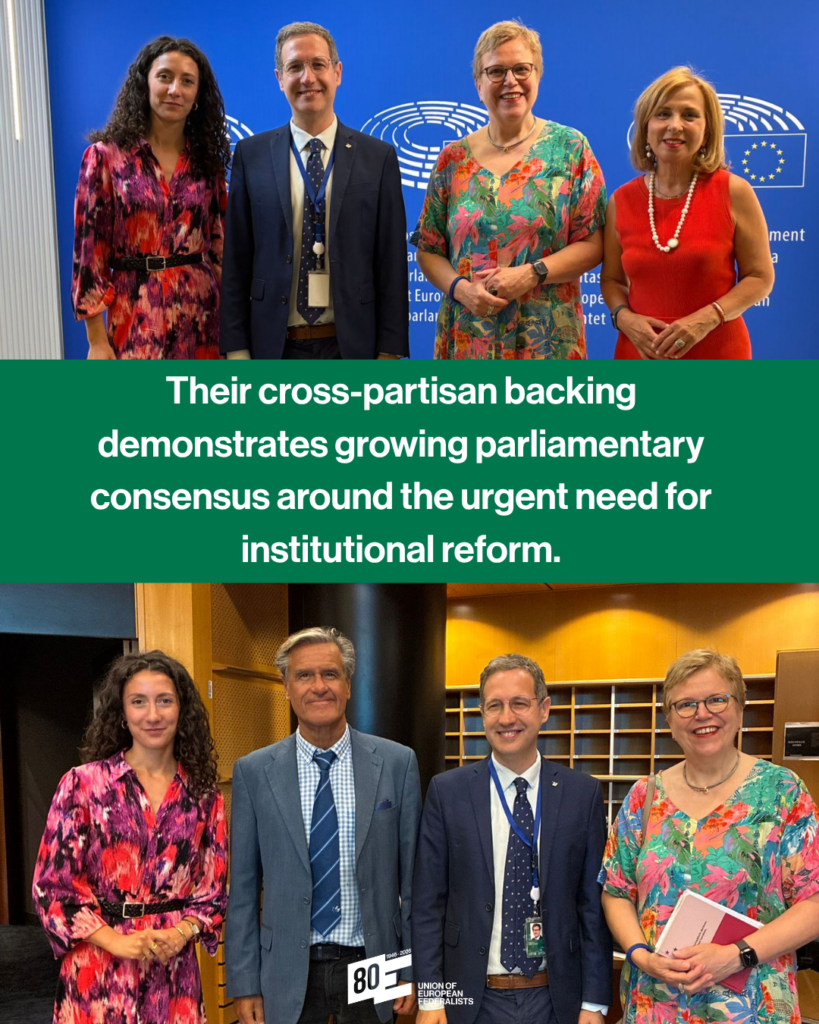
During the hearing, the petition received the explicit support of eight Members of the European Parliament spanning multiple political groups: MEPs Andrea Wechsler (EPP), Brando Benifei (S&D), Raquel García Hermida-Van der Walle (Renew), Gabriele Bischoff (S&D), Nikolas Farantouris (The Left), Vasile Dîncu (S&D), Juan Fernando López Aguilar (S&D), and Thijs Reuten (S&D). Their cross-partisan backing demonstrates growing parliamentary consensus around the urgent need for institutional reform.
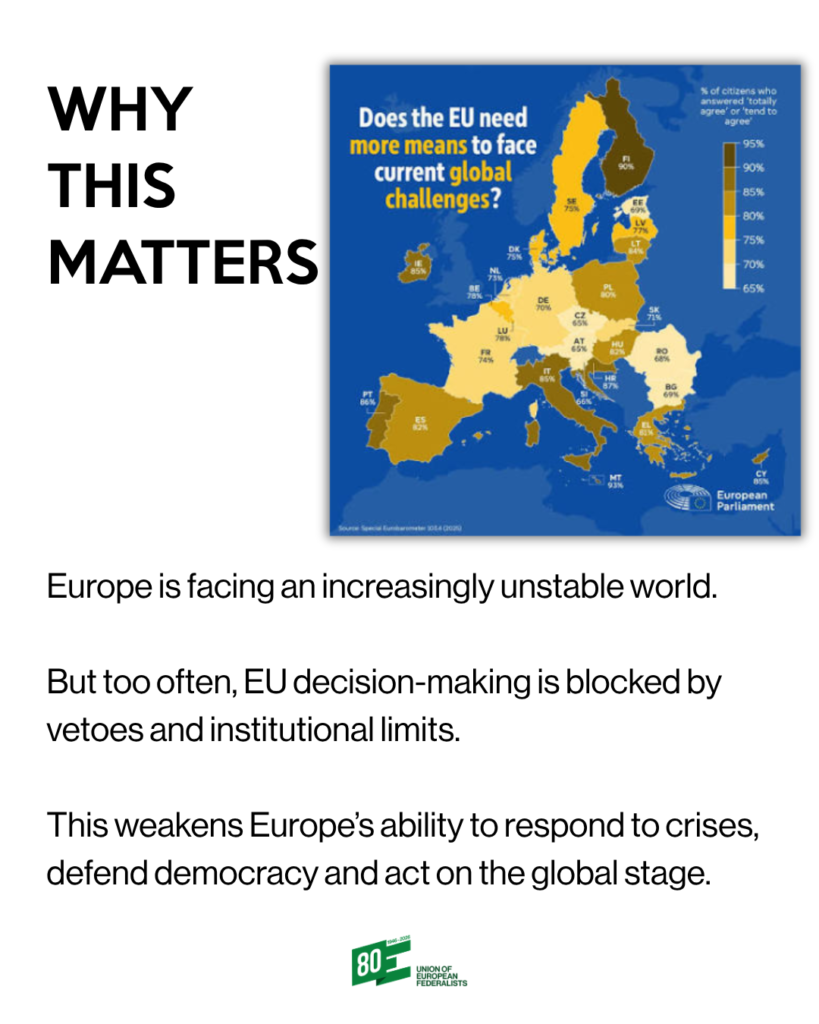
Speaking before the Committee, UEF President Ruiz Devesa stressed the existential urgency of the moment: "The EU faces an increasingly unstable world. The decision-making processes, often conditioned by vetoes, paralyze our ability to respond to crises. This is unacceptable." Secretary General Baudouin underlined the democratic dimension of the petition: "The European Parliament is the only institution directly elected by European citizens, and its proposals must not be ignored."
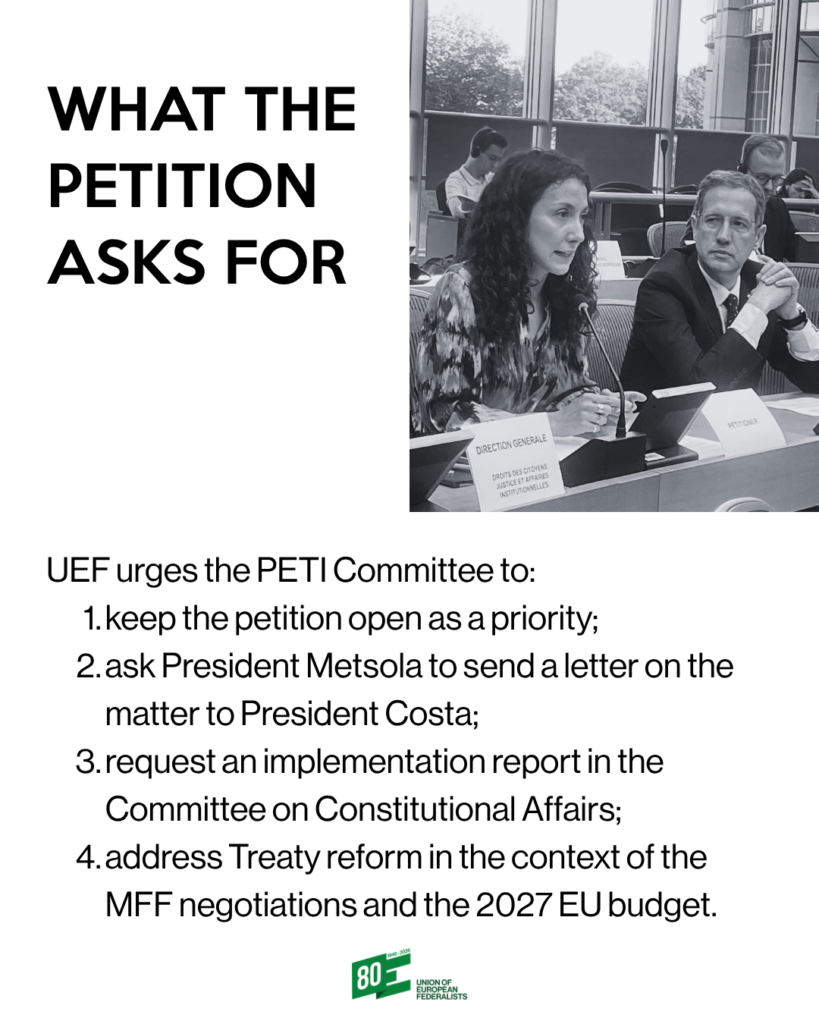
The petition urges the PETI Committee to keep the matter open as a priority, to request an implementation report from the Committee on Constitutional Affairs (AFCO) to track progress on Treaty reform, and to address institutional reform in the context of the MFF negotiations and the 2027 budget, using Parliament's budgetary powers to press the Council into action.
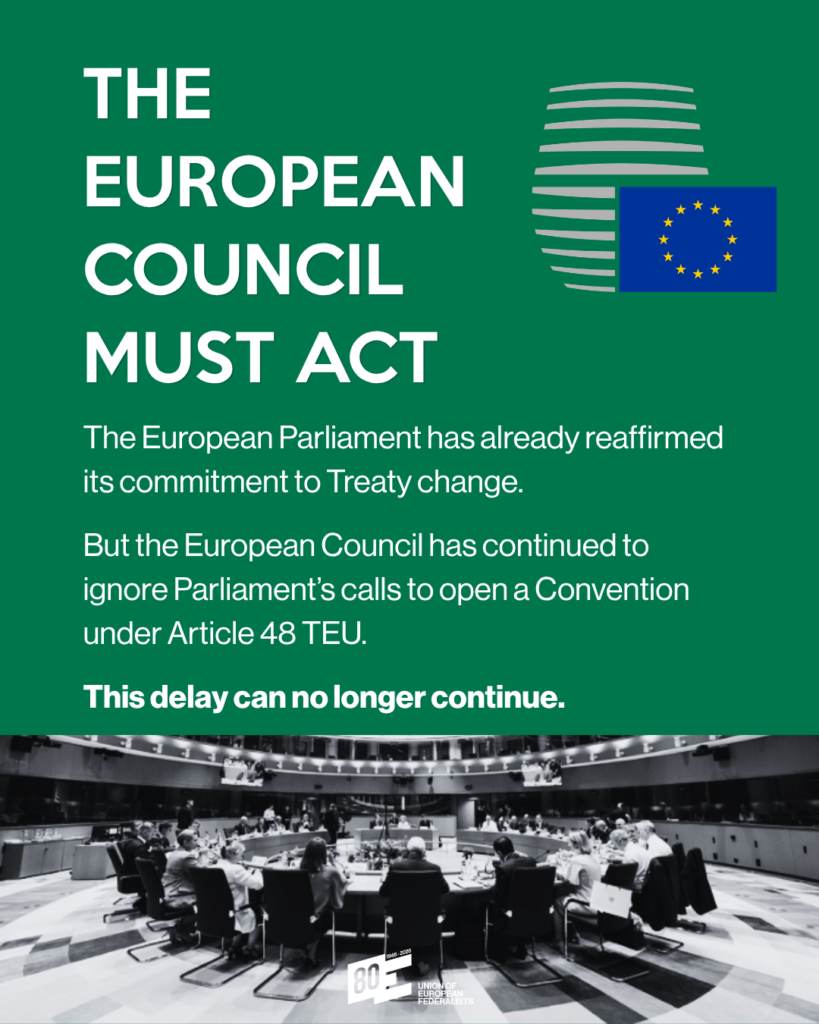
The UEF recalls that the European Parliament has already twice reaffirmed its commitment to Treaty change since the petition was submitted in April 2025 — through resolutions adopted in October and November 2025 — while the European Council has continued to ignore Parliament's calls to open a Convention under Article 48 TEU.
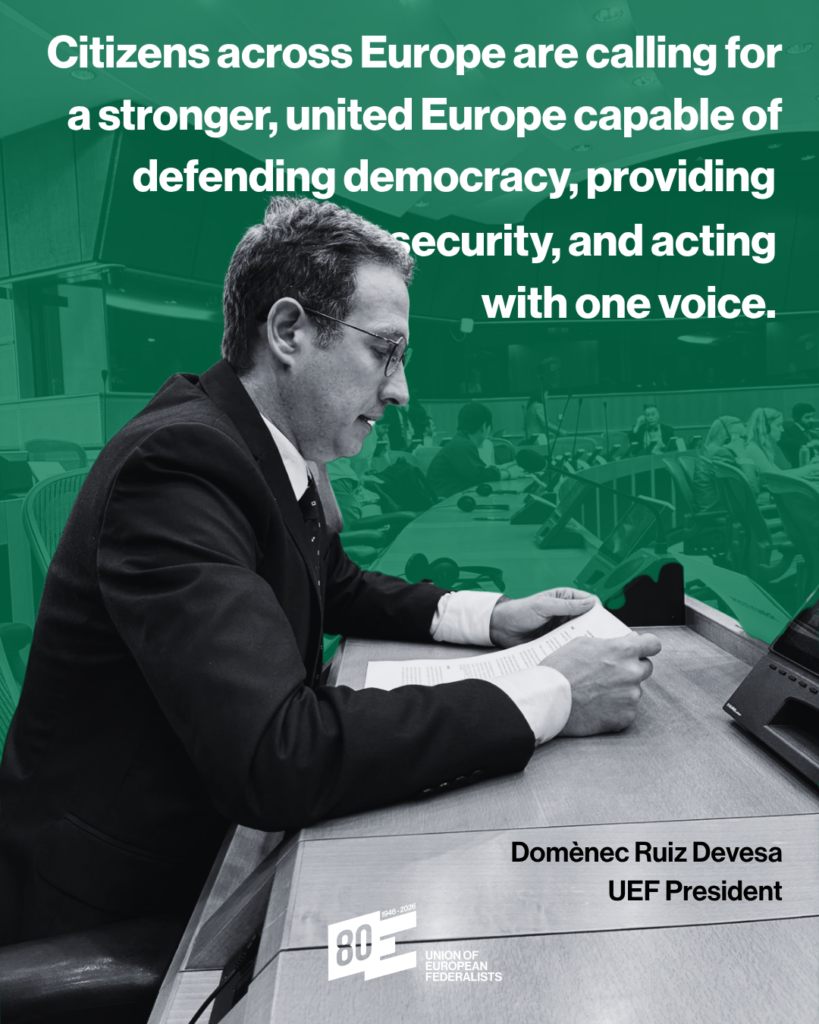
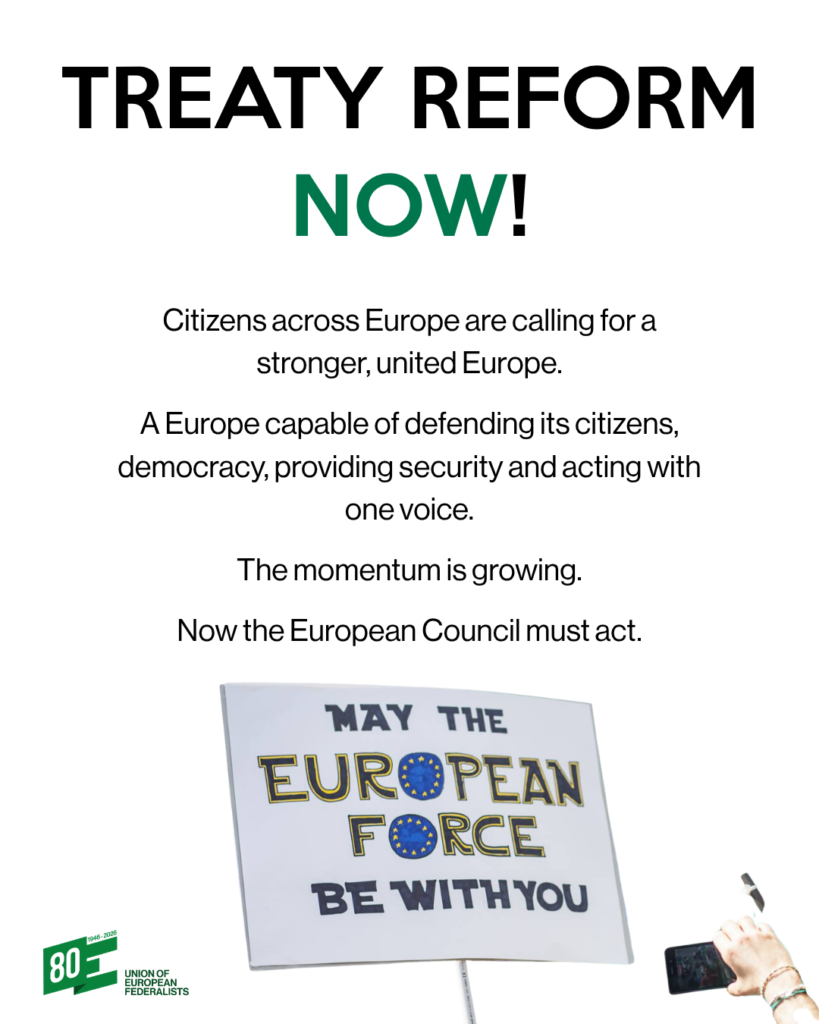
"Citizens across Europe are calling for a stronger, united Europe capable of defending democracy, providing security, and acting with one voice," said Ruiz Devesa. "Today's hearing shows that an increasing number of MEPs are willing to stand with them, and that the European Commission is ready to move forward. The European Council must no longer delay."
PRESS CONTACT
Mathilde Baudouin, Secretary General of the UEF
Please find the attachments below
This Press release has been relaunched
Here the trascript of the Interventions
Domènec Ruiz Devesa "Thank you very much, chair. Also to all the members of the petty committee and uh to the coordinators that alongside with with you the chair have uh supported the hearing on our petition. uh dear Cheronskam and also of course uh many thanks as well to some of the MEPs uh that are present in the room to support us like uh Andrea Vexler, Brando Benif and uh Rael Garcia Reander Val on behalf of our organization I would like um to express our position on this topic.
This petition is a call to action in a moment of existential urgency for the European Union. The EU faces an increasingly unstable world. The invasion of Ukraine by Russia, the conflict in the Middle East, and the emergence of an axis between a democratic and illiberal regimes have exposed the fragility of our union. This underscores the need for a strong stronger and united Europe capable of speaking with one voice. particularly in foreign affairs, security and defense and therefore able to act decisively. The reports by Leta Drago and Drai and Ninisto made it clear. We are currently unable to provide for our own security and to maintain our competitiveness on the glo on the global stage. This failure risk undermining the very achievements that define the European social model. including the rule of law, the rule of law and the safeguarding of fundamental rights.
The root of this problem lies in the eur eur in the current European Union's inability to act uni united particularly regarding the unanimity rule in a number of uh important policy fields as mentioned foreign policy security and defense but not only. The European Parliament adopted a resolution on the 22nd of November of 2023 which was a critical step toward addressing this issue. by proposing amendments to the treaty of Lisbon in accordance to the reform procedure foreseen in the treaty itself article 48. However, more than two and a half years later, the European Council has yet to uh reply to this proposal by the European Parliament, which in our view this constitutes a violation of the reform procedure of article 48, but also a violation of the principle of loyer loyal and sincere cooperation between EU institutions.
Therefore, we uh consider that this is a matter of particular interest to the European Parliament who proposed this reform. It is also a question of course of defense of the prerogatives of the European Parliament. And in the end, I'd like to conclude my part before giving the floor to my colleague, the secretary general of the UEF, Matilda Bod Bada, that it is not acceptable that member states appear to fear more um losing the capacity to block a common decision than the the world of dangers that we live in, including Mr. Putin. Thank you."
Mathilde Baudouin: "The European Parliament is the only institution directly elected by its citizens, the European citizens, and its proposals that are actually in continuity with the demands from the Conference on the Future of Europe must not be ignored. This is not simply a procedural issue. In recent months, citizens have increasingly voiced their support for a stronger united Europe, for even a common European defense, as reflected in all the latest Euro barometer surveys. They have repeatedly called for an end of the veto, demanding a union that can act decisively and democratically. We are facing a crisis of both democracy and accountability. If the EU is to defend democracy globally, it must show the example at home.
Since we submitted our petition in April 2025, the parliament has reaffirmed its commitment to treaty change and called again the European Council to act, namely through two very important moment. First, the resolution adopted on October 22, 2025 on the institutional consequences of EU enlargement negotiations which reiterates the call to open a convention under article 48 of the treaty of the European Union. Second, the resolution adopted on November 25, 2025 on the institutional aspects of the draggy report, which urges the European Council to respond to the Parliament's request and ask both the commission and the European Council to outline precise steps towards reform.
We care deeply about the European project and its citizens, and we know you do as well. Therefore, we respectfully ask this committee to first keep the petition open and ensure it remains a priority. Second, ask the president messah to send a formal letter to the European Council. Third, request an implementation report in the constitutional affairs committee to track progress. And finally, to address this matter in the context of the MFF negotiations and the 2027 budget using the parliament power of the purse to pressure the European Council into action. The EU finally needs to listen to its citizens and to take the bold steps that are needed to secure its future. Thank you."
European Commission representative during the hearing: "All right there chair honorable members um dear Mr. Devesa I can be very short um the or very brief the parliament's resolution from 22nd of November 2023 with proposals for treaty change activated the treaty revision procedure in article 48 of the treaty on European Union on 18th of December 2023 the council sent the parliament's proposals to the European Council and informed the national parliaments in accordance with the procedure laid down in article 48, paragraph 2 of the treaty. In line with the treaty, it's for the European Council to decide on the next steps. The commission stands ready to fully play its institutional role in the procedure as set out in article 48 of the treaty and in particular to give its opinion if and when consulted by the European Council. Many thanks."
MEP Andrea Wechsler (EPP): "Thank you very much chair. I would like to thank the petitioner Mr. Domènec Ruiz Devesa as well as his Secretary General Mathilde Baudouin and the Union of European Federalists for bringing this very important institutional question before our committee. The petition addresses a matter of clear relevance for the European Parliament. The follow-up to Parliament's resolution on the 22nd of November 2023 on the amendment of the treaties and the responsibilities of the Parliament and the European Council under Article 48.
Parliament has exercised its prerogatives. The European Council is therefore expected to examine Parliament's proposal and to engage substantively with a revision process. This is not only a political expectation but also a question of sincere cooperation and respect for the institutional balance of the Union. From the EP side, we share the view that the Council's response has so far not been sufficient. The European Parliament should continue to insist that its proposals are treated seriously and that there is clarity on the way forward. For today, the right signal is clear. We should not close this file. We should keep the petition open, maintain public dialogue with the petitioners and ensure that this issue remains on the agenda in our dialogue with the Council. Thank you."
MEP Raquel García Hermida-Van der Walle (Renew Europe): "Thank you, sir chair, you said it very well. Thanks, thanks a lot. Thank you to the petitioners. It is a great pleasure and an honor to listen to your presentation today and also to see a lot of members of the Spinelli Group. For those of you who might not know us, we are the people fighting for a federal Europe here in the European Parliament. But we're mostly, and that's what brings us to the subject of today, the people fighting for a Europe which is able to defend its sovereignty. It's the people fighting for Europe which is able to defend our people. It is the ones fighting for Europe which really can face the challenges of the 21st century and the geopolitical situation.
So I think this petition is very timely and I think the Commission and of course the member states should reply in a suitable manner, in an adequate manner to the demands of this European Parliament from 2023 to open up the treaties to reform to ensure that our treaties are fit for purpose, that they can take us into the future and they don't stop us from achieving the goals that we are trying to achieve with each other. Um, I think it's extremely important that this petition remains open. I would like to support that call and I would also like to make a call to all colleagues in the European Parliament to ensure that we are able and willing to use the biggest power that we have in this house which is the power of the budget. So again, thank you so much to the petitioners, to the organizers of this action and again, all encouragement to keep it open for the time being. Thank you."
MEP Nikolas Farantouris (S&D) "Thank you very much. I would like to say I support the need to revise the treaties. I would also support the fact that the bodies within the European institutions have to be consistent. What I mean by that is that they themselves should have taken initiatives after the decision from the European Parliament. But unfortunately we've had silence from them. So I would just like to join my voice to those other colleagues who are a more federalist in approach to have a complete completion of the EU. Thank you."
MEP Gabriele Bischoff (S&D): "Thank you very much Mr. President. And I would also like to thank the petitioners for this initiative. And I would like to highlight again that—and I was one of the different rapporteurs of the report on treaty changes—that we based this long work of all pro-European democratic political groups on the work of 800 randomly selected citizens who came up with proposals. So it is very much based, developed from the ground then up to this house and therefore it is very important also indeed to keep this petition open and ongoing.
But I think also we could do a little bit more. So I would like to propose and ask you as chair of this honorable committee to also take up this petition, also to write a letter, for example, to the Council President, and also emphasizing again how important it is for this house, how important it is for the petitioners that we keep this road not only open but that we go down, especially to have a Europe that is capable to act for its citizens. Thank you very much."
Brando Benifei (S&D) "Thank you, chair. First of all, congratulations to Domènec Ruiz Devesa and the Union of European Federalists for their commitment in keeping the debate on the reform of the treaties alive through this petition and all this effort that I think is extremely timely. At the moment of unprecedented geopolitical challenges, Europe will either be federal or it will not be at all. Europeans through this parliament have already spoken following the Conference on the Future of Europe. In 2022 and 2023, we adopted resolutions calling for a convention and for treaty change. Today, those who advocate for European disintegration, certain political parties say that the parliament's position on the treaty reform belong only to a previous and different legislature. I want to clarify this because this is factually wrong. The AFCO report on the institutional aspects of the Draghi report which I followed as rapporteur and which was adopted by large majority of this parliament in November 2025 recognize the simple reality: Europe cannot achieve its objectives on innovation, decarbonization and defense without targeted treaty reform. So in a different legislature again the same political message from this parliament.
So the question now is what follow-up we need to give. So in my view we must continue the effort launched by parliament to open a convention and advance the treaty revision process under Article 48 of the Treaty of the European Union. This means reminding the European Council of its responsibilities under the treaties including through a new plenary resolution calling for meaningful follow-up to Parliament's proposals. Then parliament should be prepared to use its budgetary powers to ensure that its treaty reform initiative is taken seriously and not ignored. We should also bring this debate to national parliaments across the union, encouraging member states to discuss parliament's proposals and place treaty reform back on the agenda of the European Council. Finally, if the deadlock persists, we should not exclude pursuing legal action before the Court of Justice. So let me conclude in the line of what I just said that this petition should remain open until such time as the European Council has substantively addressed the parliament's proposal and announced the procedural path forward to finally deal with these very important issues. Thank you very much."
MEP Juan Fernando López Aguilar: "Well, first of all, I always when it comes to the petitions committee, I always thank the petitioners because they are exerting a fundamental right on their own to begin with. It's a fundamental right enshrined in the charter and in the treaty of functioning of the European Union to begin with. Second, as to the substance, if we follow the Euro barometer parameters, we can only conclude that most of European citizens clearly favor stronger, more united, more capable EU. We honestly of course question about the equipment of our institutions as they are by now in order to deliver their stronger more united more capable European Union. So time again it comes to unanimity in the council paralyzing EU action allowing national vetos to block common solutions weakening the union's credibility outside and within precisely when union unity matters most and that challenge can only grow with enlargement. That's absolutely clear. strengthening a union politically, economically and geopolitically meaning meaning that we need to reinforce the the the EU capacity to deliver in an stable world bringing about our commitment to peace and prosperity. The European Parliament has done it part of the job. We actually we actually set in in motion an initiative to bring about and trigger the process of treaty revision. We did it in the past mandate of the European Parliament 2023 and yet state of engaging with parliament's proposal the council has chosen silence so far European asking stronger Europe and the council in silence treaty reform is not an option it's indispensable so I can only conclude that we need for that reason first to keep this petition alive deserving better attention on its merits, welcoming the opportunity to discuss it today with the European federalists. But having said this, I only stress also the importance of fully involving the constitutional affairs committee, which is the one in charge of treaty revision, ensuring that it is invited to deliver an opinion on the matter. So I support the petition. I welcome the European Federalists to calling for attention on the matter. I remind that we have actually activated a treaty reform on the side of the European Parliament expecting for a response for the council stating that silence should not be an option and I ask for the involvement of the constitutional affairs committee ensuring that is invited to deliver an opinion. Thank you."
The intervention by petitioner Domènec Ruiz Devesa: "Thank you very much uh dear chair. Once again, many thanks to all the MEPs uh that have participated in the petition in the hearing and that have uh provided uh support to keep it open. Um also thanks to as I said before to the coordinators to Sandra Gomez particular that tabled the the petition to the coordinators to the proposal. Maybe just uh very quick uh observations of course also regarding the the last MEP's comments the the the majority of the legislation in the EU is already adopted in the in the procedure by qualified majority voting. So it's not that we have thankfully right to veto on everything already. So we're just proposing to use a democratic procedure in all policies. Uh uh and then maybe one remark also for the the commission um that I slightly disagree when the commission said if and when the European Council ask for the consultation because there is no if in the article 48. So in any case it's when but not if uh and then of course the commission has to provide uh its opinion as it is established in as it is established in article 48. I agree with uh what has been said uh that uh the parliament has several tools to move this file forward including the power of the budget including going to the court of justice uh acting uh with a report from uh the AFCO committee and indeed the this is a very crucial point and with this I end that by definition the petition has to remain open until there is a reply from the European Council. Thank you very much and I also allow it's okay like that."
Promotion on Instagram social media
Brussels, 23 June 2026
European security is under threat, together with the world order, as shown by four years of Russian aggression on Ukraine. However, progress on European defence is very insufficient, both at the industrial and political dimensions, which in fact are closely connected. The collapse of the Franco-German-Spanish Future Combat Air System (FCAS) is a very illustrative case in point of a political gap masked by industrial failure, due to the disagreements between privately owned Dassault and the semi-state-owned Airbus, over control of the programme and workshare, access to sensitive technology, and ownership of the intellectual property developed during the project.
The collapse of FCAS pushed German and Spanish companies to propose a new “Team Gen 6”, outlining plans to pursue a next-generation fighter architecture outside the original SCAF framework. All of this, while the alternative Global Combat Air Program (GCAP) by Italy, UK and Japan is going ahead. We risk having three competing projects, where we need just one.
However, the industrial deadlock between Dassault and Airbus was not merely a commercial dispute over workshare and intellectual property, but the expression of different national political preferences and defence postures: France's doctrine of full military self-sufficiency - encompassing not only independent nuclear deterrence, but also carrier aviation, and sovereign control over its entire defence industrial base - clashed with Germany's different operational requirements and its preference to operate with allied systems. Ultimately, the governments proved either unwilling or unable to impose a compromise on the companies - unwilling, because the positions each company defended largely reflected what their respective governments considered non-negotiable national interests, and unable, because forcing a concession would have meant overriding those very interests.
In other words, this case shows once again, very clearly, that neither industrial companies nor national governments to which they are linked, can lead on military integration. A greater role for the European Commission and the European Defence Agency operating within the framework of a Common European Defence System, and stricter requirements to access EU funding is needed to go towards joint procurement and the reduction of the European weapons system. The fact that the 27 Member states have around 130 types of major land, air and naval weapon systems and the US around 30, is a key reason why we spend 30% of the US with a 10% capacity, thus wasting most of our expenditures ineffectively. The EU should incentivise the merging of these projects to create one European sixth generation fighter jet.
To reach strategic autonomy Member states must accept to go beyond voluntary industrial cooperation toward limited but real centralised procurement authority for major defence systems, alongside clearer allocation of industrial leadership based on capability rather than political return. Successful EU defence procurement is in the end dependent on setting up a European Common Defence. A European multinational force, starting with the Rapid Deployment Capacity, to whom to allocate EU-funded defence equipment is thus a crucial step.
Such an EU supranational authority must define what we need, and thus the technical specificities of the future weapon system, and the open procurement to procedures, instead of national enterprises that reflect private interests or narrow national interests.
While national defence expenditures are increasing, joint procurement is stuck at 20 per cent. However, the new Security Action for Europe (SAFE) threshold for joint procurement is even lower than the European Defence Industry Reinforcement through Common Procurement Act (EDIRPA) ones. If SAFE 150 billion € were used to strengthen EDIRPA, the European Defence Fund and the European Defence Agency to finance joint programs (for example to merge the Anglo-Japanese Global Combat Air Programme and the FCAS), this would allow significant progress. But SAFE only finances national military expenditures, which continue to benefit mainly US enterprises, with US weapons exports to Europe doubling between 2021 and 2024.
An EU defence is essential to gain deterrence capacity and ensure the EU security, spending more efficiently and reducing US dependencies. This requires identifying our capability gaps – an exercise regularly done both within NATO and the EU – developing tools to fill them, starting with the strategic enablers, for which we depend massively on the US. The Joint Undertakings could be a tool for the Commission, Members states and private actors to cooperate in developing European satellite monitoring and communication systems, air defence, troop transport, and cyber-defence capacities.
The EU must rise to the challenge of the reduced US commitment to European security, amplified and accelerated by the current administration, but started much earlier. The NATO New Force Model, approved under Biden Presidency, foresees that in the case of an attack against a European NATO member, NATO should mobilise 300.000 troops in a month, all of them Europeans. Only at later stages US troops could eventually be mobilised. With a possible significant reduction of the US troops in Europe, the need to strengthen EU capacity for territorial defence is evident. Permanent Structured Cooperation on Defence (PESCO) could be used by willing Member states to upgrade the Rapid Deployment Capacity into an EU permanent multinational force – already agreed by the European Council in Helsinki in 1999 but never made fully operational – to communitarise existing bi-lateral and multinational military cooperation among Member states, like the Baltic Naval Squadron, the Franco-German Brigade, the Eurocorps, etc, and to develop a true EU command-and-control system, possibly linked to NATO.
As Mario Draghi said in Aachen “external hardness requires internal depth”. Progress in common defence, a common industrial policy, and investments (which require resources), and federal political union, are closely interlinked. Achieving them requires the political will of at least some Member States to proceed in a unified manner across all these sectors. If steps are not taken along this path soon, citizens’ confidence in Europe’s ability to protect them will further erode, and nationalist forces will gain ground.
Domènec Ruiz Devesa, President of the UEF
Mathilde Baudouin, Secretary General of the UEF
Brussels-Madrid, 29 May 2026
The Union of European Federalists Spain (UEF España), the Union of European Federalists (UEF), and the Spanish Federal Council of the European Movement (CFEME) welcome the approval by the Spanish Congress of Deputies of a Resolution (Proposición No de Ley) calling on the Government of Spain to declare, with irrevocable character, Spain's membership of the European Union, and support for the federal reform of the Treaties.
On 28 May 2026, the Plenary of the Congress of Deputies approved Resolution 162/000767, ext negotiated across parliamentary groups, which instructs the Government of Spain to:
- Reaffirm and advance Spain's commitment to the European project as guarantor of democracy, the rule of law, human rights, security and economic stability;
- Declare with irrevocable character Spain's membership of the European Union;
- Support in the European Council the project for reform of the Treaties to strengthen European sovereignty and independence, endowing the Union with greater capacity to act in foreign policy, security, defence, energy, industry and the ecological, digital and social transitions, while guaranteeing social and territorial cohesion and the principle of subsidiarity;
- Promote the full development of the Treaties and the Charter of Fundamental Rights with regard to regions and peoples of the European Union;
- Work with fellow Member States towards the recognition of Basque, Galician and Catalan as official languages of the European Union.
The resolution was approved with the support of several parliamentary groups and marks the 40th anniversary of Spain's accession to the then European Communities, formalised on 12 June 1985.
A Milestone in Spain's European Vocation
UEF España, UEF and CFEME welcome this resolution as a significant political statement. Spain has consistently been one of the most pro-European societies in the Union, and this declaration consolidates that tradition at the highest level of democratic representation.
The resolution is also notable for its explicit endorsement of the reform of the EU Treaties proposed by the European Parliament in November 2023 — a proposal that has long formed part of the agenda advocated by European federalist organisations. Moving beyond unanimity rules and strengthening the Union's capacity to act in key policy areas is not a federalist aspiration alone: it is, as the resolution rightly states, a functional necessity for a Union that must remain credible and effective in an increasingly complex world.
The Role of Civil Society
Our organisations have long argued, through publications, public debate and engagement with political actors, that Spain's commitment to the European project should be stated clearly and durably — not as a mere political preference but as a foundational orientation of the Spanish state.
We are pleased that these debates have found their way into the legislative process, and we acknowledge with appreciation the initiative of the Socialist Parliamentary Group (GPS) and the other parliamentary groups that supported or contributed to the final text. This is, above all, a success of Spain's democratic institutions and of the broad pro-European consensus that underpins them.
Looking Ahead: From Parliamentary Resolution to Government Declaration
A parliamentary resolution is a powerful political signal. Its full potential, however, will be realised only when the Government of Spain acts upon it. We call on the Government to follow through on the mandate of the Congress by issuing a formal, solemn declaration of Spain's irrevocable commitment to the European Union — a step that, under the principles of international law governing unilateral declarations of States, would carry legal weight beyond the domestic political sphere.
We equally urge the Spanish Government to translate its support for Treaty reform into active, constructive engagement within the European Council, where this proposal has yet to receive the attention it deserves.
Quotes
Enrique Barón Crespo, President of the UEF España: "Forty years after accession, Spain is not merely a member of the European Union — it is one of its most committed builders. This resolution reflects that spirit and sends a clear message: Spain's place is in Europe, and that place is not up for debate."
Domenec Ruiz Devesa, President of the UEF: "We congratulate the Spanish Congress of Deputies for this forward-looking resolution. At a time when the European project needs friends who speak clearly, Spain has done so. We hope other national parliaments will follow this example in supporting the proposal to reform the Treaties"
Francisco Aldecoa , President of the CFEME: "The European Movement has worked for decades to make European integration irreversible not just in law but in the hearts and minds of citizens. This resolution is a step in that direction, and we encourage the Government to give it the fullest possible effect."
About the organisations
- UEF España (Unión de Europeístas y Federalistas de España) is the Spanish section of the Union of European Federalists, advocating for a democratic, federal and united Europe.
- UEF (Union of European Federalists) is a pan-European citizens' organisation with members across all EU Member States, working towards a federal Europe based on the rule of law, democracy and fundamental rights.
- CFEME (Consejo Federal Español del Movimiento Europeo) is the Spanish national council of the European Movement International, the oldest pro-European civil society network in Europe.
For media enquiries, please contact:
- UEF Secretariat, secretariat@federalists.eu
The Dutch Renew and D66 MEP Raquel García Hermida-van der Walle will take over the rotating presidency of the parliamentary intergroup.
Strasbourg, May 21, 2026
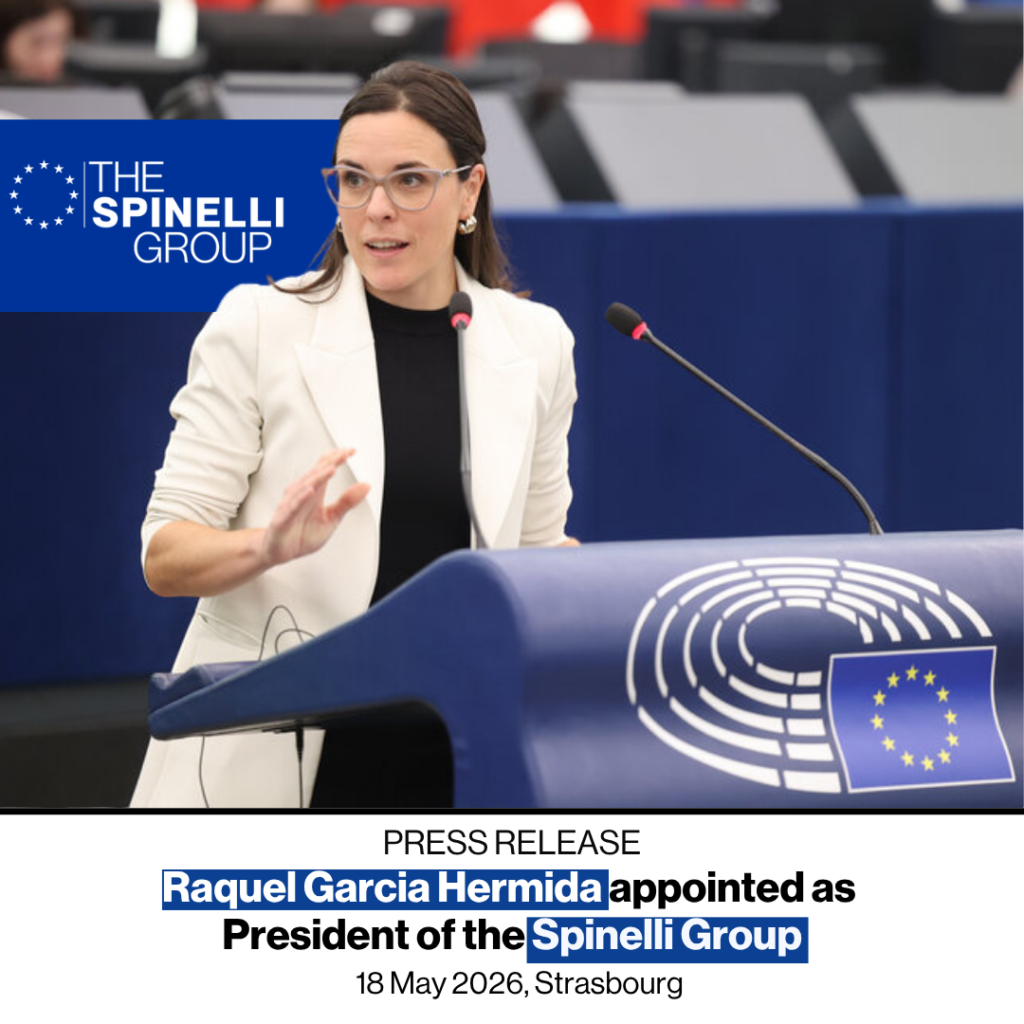
Dutch Renew Europe and D66 MEP Raquel García Hermida-van der Walle will take over the rotating presidency of the parliamentary intergroup. She was elected by acclamation on Monday 18th May by the Spinelli Group Board in Strasbourg.
The appointment was announced during the Public General Assembly “40 Years After Spinelli”, held at the European Parliament to honour the legacy of Altiero Spinelli and his vision for a federal Europe promoted by the UEF and European Movement France.
As Raquel García Hermida-van der Walle succeeds Gabriele Bischoff, S&D and SPD MEP and First Vice-President of Europa-Union Deutschland, in the rotating presidency of the Spinelli Group, the Union of European Federalists (UEF) expresses its full support for her leadership and its continued commitment to working closely with the Group in advancing the federalist cause.
The Spinelli Group and the Union of European Federalists warmly thank Gabriele Bischoff for her dedicated chairwomanship since July 2025 and her commitment to strengthening the federalist movement within the European Parliament.
“Serving as Chair of the Spinelli Group has been a profound honour. At a time when Europe faces existential geopolitical, democratic and social challenges, our responsibility has been to defend and strengthen the European project with courage and ambition.
As the first woman ever to chair the Spinelli Group, I am particularly proud to have contributed to broadening and strengthening our federalist coalition across political families and national borders. Europe’s future will only be secured through unity, democracy and a stronger capacity to act together.
The European moment is now. Europeans expect us to move beyond fragmentation and vetoes, and to build a Union capable of protecting its citizens, defending its values and shaping its own destiny.” Gabriele Bischoff said.
During Bischoff’s presidency, and in addition to regular Board meetings, the Spinelli Group organised several politically significant events dedicated to the future of European integration and institutional reforms.
These included:
- The high-level conference “For a Stronger, More Democratic and Inclusive European Union – Towards a European Federation” in November 2025 in the Hellenic Parliament in Athens, which brought together policymakers and civil society representatives to discuss democratic reform and the future architecture of the European Union.
- The initiative “Bring a European Federalist” reception at the European Parliament in Strasbourg, aimed at fostering dialogue between Members of the European Parliament and inviting them to join the Spinelli Group.
- The round table held during the UEF European Congress in Barcelona, entitled “Is Draghi’s Pragmatic Federalism enough to face current challenges?”
- The event in May 2026 in the European Parliament in Strasbourg celebrating 40 years after Altiero Spinelli’s passing.Under Bischoff’s leadership, the Spinelli Group also adopted and promoted an updated political manifesto, “The European Moment is Now”, calling, in a concrete and pragmatic proposal, for a more sovereign, democratic and federal European Union capable of acting decisively in an increasingly unstable global environment.
The new President, Raquel García Hermida declared after her appointment: “Forty years ago, Spain joined the European Union. Today, as a Spaniard who became a Dutch citizen and now serves as a Dutch Member of the European Parliament, I see my own story as part of the European story itself.
The European Union gave me the freedom to live, work, and participate politically across borders. That is the European dream: a Europe where everyone can benefit from freedom, opportunity, and shared citizenship.
But our freedoms, prosperity, and security cannot be taken for granted. I deeply believe that only a stronger and more federal Europe can protect future generations and preserve the values that define us.
We do not need the American dream. We have our own European dream. And in that dream is the future of civilization as we know it.”
The federalist movement is deeply grateful to have such dedicated individuals supporting its cause.
Thank you very much Gabriele, Good work Raquel!