

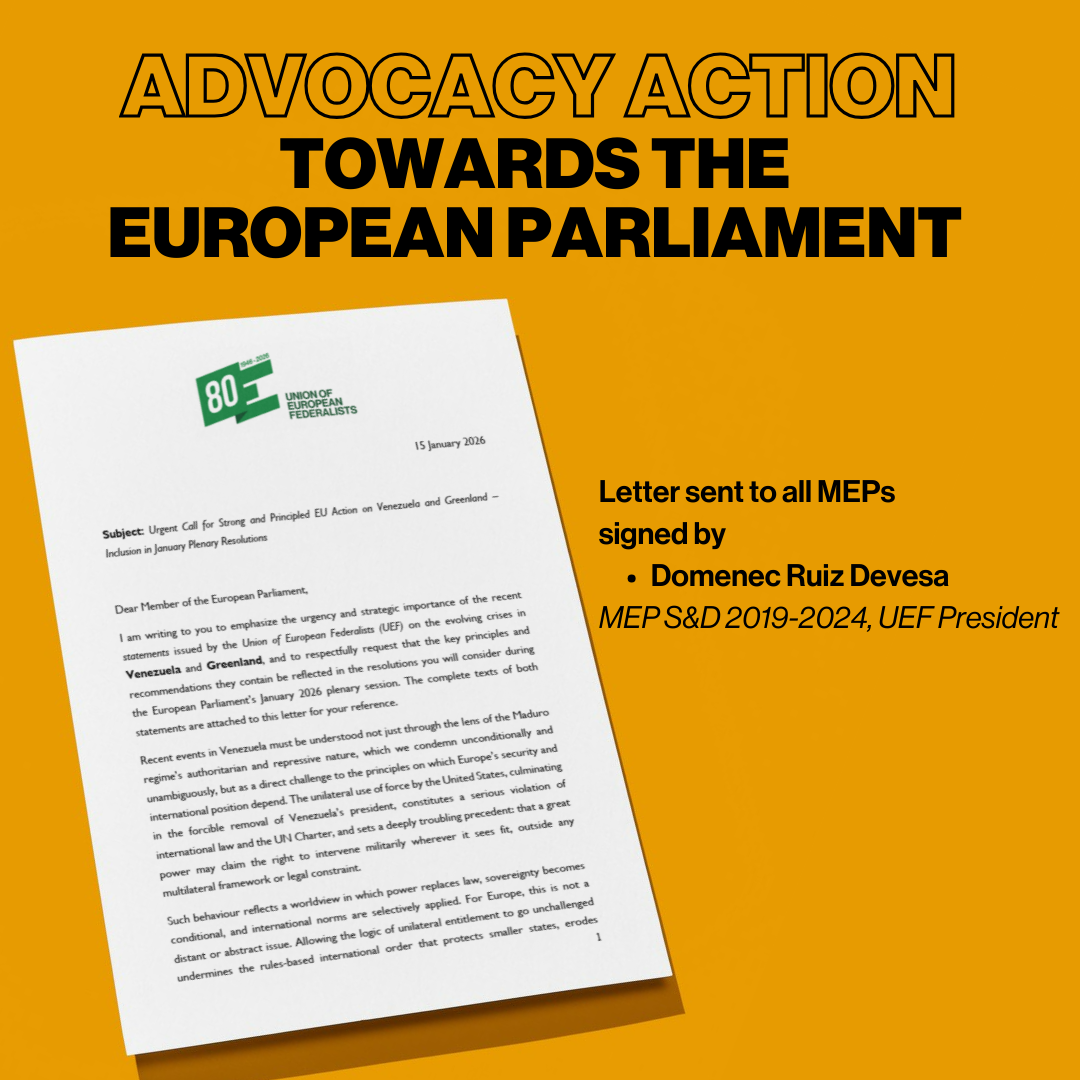
Letter to the MEPs | Urgent Call for Strong and Principled EU Action on Venezuela and Greenland
Brussels, 15 January 2026
Dear Member of the European Parliament,
I am writing to you to emphasize the urgency and strategic importance of the recent statements issued by the Union of European Federalists (UEF) on the evolving crises in Venezuela and Greenland, and to respectfully request that the key principles and recommendations they contain be reflected in the resolutions you will consider during the European Parliament’s January 2026 plenary session. The complete texts of both statements are attached to this letter for your reference.
Recent events in Venezuela must be understood not just through the lens of the Maduro regime’s authoritarian and repressive nature, which we condemn unconditionally and unambiguously, but as a direct challenge to the principles on which Europe’s security and international position depend. The unilateral use of force by the United States, culminating in the forcible removal of Venezuela’s president, constitutes a serious violation of international law and the UN Charter, and sets a deeply troubling precedent: that a great power may claim the right to intervene militarily wherever it sees fit, outside any multilateral framework or legal constraint.
Such behaviour reflects a worldview in which power replaces law, sovereignty becomes conditional, and international norms are selectively applied. For Europe, this is not a distant or abstract issue. Allowing the logic of unilateral entitlement to go unchallenged undermines the rules-based international order that protects smaller states, erodes Europe’s own strategic autonomy, and weakens the credibility of the Union as a defender of multilateralism, sovereignty and international law. Europe’s hesitant and fragmented response risks reinforcing the perception that it is willing to tolerate breaches of fundamental principles when committed by powerful nations — a stance that ultimately diminishes both its security and its moral authority in the Global South.
This same logic of power politics and strategic entitlement is now manifest in relation to Greenland, an integral part of the Kingdom of Denmark and home to European citizens. Statements and actions that question Greenland’s sovereignty or treat it as a negotiable strategic asset represent a direct challenge to European territorial integrity and security. Strategic ambiguity in the face of such pressures does not preserve stability; it weakens deterrence and invites further coercion. For the European Union, Greenland is a test of political maturity and credibility: either Europe demonstrates that it is capable of defending its territory and citizens, or it accepts a gradual erosion of its sovereignty at the margins.
Against this background, I respectfully call on the European Parliament to demonstrate clarity, firmness and leadership in its January resolutions, instead of fear and delusion. In particular, the Parliament should reject any attempt to normalise a world in which President Trump — or any external leader — behaves as an unchecked “emperor of the West”, free to override international law and the sovereignty of states. It should also openly challenge the current strategy of appeasement displayed by the Council and the Commission, which risks emboldening further violations of international norms and the vassalisation of Europe.
Instead, the European Parliament should affirm that threats to Greenland engage Europe’s collective responsibility and require concrete action, including support for a credible European military presence or mission, at Denmark’s request, as a deterrent and a signal of resolve. More broadly, the Parliament should use this moment to call for the activation of the Union’s existing treaty provisions on defence and political integration, advancing decisively toward a genuine European Defence Union and a federal political union capable of acting autonomously when Europe’s security, values and sovereignty are at stake.
The credibility of the European Union as a global actor depends not on declarations alone, but on its willingness to uphold the principles it proclaims, regardless of who violates them, and to stand firm. Incorporating the substance of the attached UEF statements into the January plenary resolutions would send a clear message that Europe is prepared to defend the rules-based international order — and itself.
Yours sincerely,
Domènec Ruiz Devesa
Former Member of the European Parliament S&D
President of the Union of European Federalists